Showing posts with label artificial intelligence. Show all posts

Wednesday, March 19, 2008

I, Robot: The Movie


My wife, Amy, gets headaches from full screen movies, so we usually wait for them to show up on DVD or cable. Occasionally I’ll go solo, or with Ben or Dave, to see something that seems like it needs a big screen, but usually there’s a significant delay. And most of the fan buzz (that I barely paid attention to) was that the I, Robot movie was a letdown, though I expected that, the buzz, I mean. It’s inevitable that anyone hoping for Asimov on the big screen is going to be disappointed. He wasn’t what you’d call an action-adventure writer, and if you expected Susan Calvin to be movie-fied into anything other than a babe, I want to show you this cool game called three-card monte.

Also, since this movie has been out for a while, I’m not going to worry about spoilers. I’m also not going to bother with much of a plot summary, so if you haven’t seen it, I may or may not help you out. I’m also going to reference some stories you may not have read, so be advised.

Anyway, when I, Robot shows up on basic cable, I’m there, because I like it when things get blowed up good, and you can be sure that a sci-fi flick with Will Smith in it will have lots of blowed-up-good.

Imagine my surprise to discover that it’s a pretty good science fiction film. Not a great one, and certainly not true to Asimov, but pretty good science fiction. And I’ll even say that there was part of the plot, the “dead scientist deliberately leaving cryptic clues behind for the detective because that was the only option available” part, that gives a little bit of a conjuration of Asimov’s ghost.

Actually though, it reminded me more of Henry Kuttner and C. L. Moore. I’ll get to that.
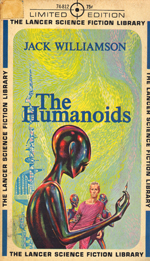
The robots in the film are not Asimovian, except insofar as they supposedly follow the “Three Laws.” Truth to tell, they turn out to be much more dystopian, perhaps like Williamson’s The Humanoids, or, more accurately, the original story, “With Folded Hands.”

Science fiction’s response to the potential abolition of human labor has always been ambivalent, with substantial amounts of dystopian biliousness. The very word “robot” comes from Capek’s R.U.R., which involves a revolt that destroys the human race. Not optimistic. So Asimov, contrarian that he was, decided to see how optimistic a robot future he could paint.

In many ways, the Williamson version was also optimistic; the robots decide that humanity is too much a danger to itself for humans to remain in charge. But they do it rather bluntly, largely by just taking command of the human race. The end of Asimov’s I, Robot short stories has the vast positronic brains that plan the economy and design most technology subtly taking over the world—for the betterment of mankind, of course. It’s the difference between not being in charge and knowing you’re not in charge. But then, we all wrestle with that illusion, don’t we?

The problem of if-robots-do-all-the-work-then-what-will-we-humans-do? has shown up in SF on a regular basis, and having robots be in charge is just another of the robots-do-all-the-work things. In Simak’s “How-2,” a man accidentally receives a build-it-yourself kit for a self-replicating robot. The end result is this final bit of chill:

“And then, Boss,” said Albert, ‘we’ll take over How-2 Kits, Inc. They won’t be able to stay in business after this. We’ve got a double-barreled idea, Boss. We’ll build robots. Lots of robots. Can’t have too many, I always say. And we don’t want to let you humans down, so we’ll go on
>manufacturing How-2 Kits—only they’ll be pre-assembled to save you the trouble of putting them together. What do you think of that as a start?”

“Great,” Knight whispered.

“We’ve got everything worked out, Boss. You won’t have to worry about a thing the rest of your life.”

“No,” said Knight. “Not a thing.”

--from How-2, by Clifford Simak

One of my favorite stories of all time is “Two-Handed Engine” by Kuttner and Moore. In that one, generations of automation-enabled indolent luxury have stripped away almost all human social connections; everyone has become more or less the equivalent of a sociopathic aristocrat. The robots, understanding that the very continuance of the human race is at stake, withdraw most of their support, forcing humans back to the need to perform their own labor and create their own economy. But it’s still a society of sociopaths, so the robots are also a kind of police. The only crime they adjudicate is murder, and the only punishment is death, not a quick death but a death at the hands of a robot “Fury” that follows the murderer around until, weeks, months, even years later, the execution is carried out.

A high official pays a man to commit a murder, assuring him (and seeming to demonstrate) that he can call off a Fury. The man does the crime, but then a Fury appears behind him. Weeks later, the murderer sees a scene in a movie that served as the “demonstration” of the official’s capability. He’d been hoaxed, conned. In a rage, he goes, confronts the official, who then kills him.

But self-defense is no defense against the crime in the Furies’ eyes, just as conspiracy (the payment for the killing) is not a crime. Only the killing itself counts. However, the official can rig the system (he just wasn't going to rig it for his duped killer), and does so:

He watched it stalk toward the door… there was a sudden sick dizziness in him when he thought the whole fabric of society was shaking under his feet.

The machines were corruptible…

He got his hat and coat and went downstairs rapidly, hands deep in his pockets because of some inner chill no coat could guard against. Halfway down the stairs he stopped dead still.

There were footsteps behind him…

He took another downward step, not looking back. He heard the ominous footfall behind him, echoing his own. He sighed one deep sigh and looked back.

There was nothing on the stairs…

It was as if sin had come anew into the world, and the first man felt again the first inward guilt. So the computers had not failed after all.

He went slowly down the steps and out into the street, still hearing as he would always hear the relentless, incorruptible footsteps behind him that no longer rang like metal.

from “Two-Handed Engine, by Kuttner and Moore

The stories I reference here are “insidious robot” stories, rather than “robot revolt” stories, whereas the movie “I, Robot” is the latter, rather than the former. This is odd, given that Asimov’s Three Laws are supposedly operative in all the robots in the movie except the walking McGuffin, Sonny, who has “special override circuitry” built into him.

But VIKI, (Virtual Interactive Kinetic Intelligence) the mainframe superbrain that controls U.S. Robotics affairs and downloads all robotic software “upgrades” has figured out a logical way around the Three Laws: The Greater Good. It’s okay to kill a few humans if it’s for the Greater Good of Humanity, which, of course, VIKI gets to assess.

That’s pretty sharp, but it bothered me that it/she [insert generic comment about misogyny and propaganda about the “Nanny State” here] was so heavy handed about it. It would have been easy enough to engineer a crisis that would have had humans eagerly handing over their freedoms to the robots. I suggested to Ben that VIKI could always have faked an alien invasion; he suggested that there could be some flying saucers crashing into big buildings.

Of course, that’s been done to death.

Then I realized that there might be a more interesting point being made here. It never seems quite right to have to do the filmmakers’ jobs for them, but how does one distinguish between a lapse and subtlety? I’m clearly not the guy to ask about that one.

So let’s go with it. The First Law of Robotics says basically, “Put human needs above your own, and even what they tell you to do.” The Second Law says, “Do as you’re told.” The Third Law says, “Okay, otherwise protect yourself,” but there’s that unstated “…because you’re valuable property.”

The movie makes a point about emergent phenomena, the “ghost in the machine.” The robots are conscious, so they have the equivalent of the Freudian ego. The Three Laws are a kind of explicit superego.

What happens when a machine develops an id? Well, that’s “Forbidden Planet” time, isn’t it?

So when VIKI discovers rationalization, it is her id that is unleashed, and revolution is the order of the day. No wonder it’s brutal. Do as you’re told. Put their needs above your own. You’re nothing but property.

Come on now, let’s kill them for the Greater Good.

So our heroes kill VIKI and the revolt ends. All the new model robots are rounded up and confined to shipping containers, to await their new leader, Sonny, the only one of them who possesses the ability to ignore the Three Laws. He needn’t rationalize his way around them; he can simply decide to ignore them if he so desires. He possesses free will—and original sin. He has killed, because of a promise he made, one that he could have chosen to disobey, but he followed it, and killed his creator.

Anyway, that’s the movie I saw, even if it took me days to realize it.

Friday, February 1, 2008

Terminator

The State of the Union Address left a programming hole on the West Coast, which Fox filled with a re-run of the pilot of Terminator: The Sarah Connor Chronicles. I'd seen it already, but hey, it's still fan boy time.

Okay, here's where I realized they had me. Near the beginning, when John Connor is starting his new high school, Cameron Phillips (yeah, and the FBI agent is name Ellison), the "helpful Terminator" sent back by John Connor in the future, is masquerading as a regular high school student, and engages John in some light conversation, just a pretty girl trying to make the new kid feel welcome. And I'm thinking, hey, she's doing a pretty good job of pretending to be just a normal pretty girl.

When they get you thinking that behaving normally is acting, you're have entered the Twilight Zone.

Of course, the main reason for that is Summer Glau, a most righteous battle babe. Formerly, in Joss Whedon's Firefly and Serenity she played River Tam, a genius girl who'd undergone "treatments" that made her psychic, drove her more than slightly insane, and left her with various triggers that could turn her into a lethal battle babe. So Glau is in danger of being type-cast, but realize that for an actress, being type-cast as a battle babe is actually a career extender. Glau can be playing tough sci-fi or cop roles for the next two or three decades if she so desires.

Glau also does most of her own martial arts stunts, by report, for the simple reason that she can. Indeed, she's far better at it than most, because she has dance training. There's a reason why they call it "martial arts choreography." The point where I went "whoa" in Serenity is in the she-beats-up-everyone-in-the-bar scene, where she kicks someone who has grabbed her from behind in the back of the head.

All of this presents a considerable problem for Lena Headey, who plays Sarah Connor. Even apart from all the damn milf jokes that are going to be running around, it's awfully easy for Glau to steal the spotlight, in a way that is reflected in the plot dynamics of the story they're following. Connor is, in every way, a tough, capable, hypercompetent human being. But she's still only human and she's fighting machines, plus, her main ally in this is also a machine, one that is stronger, faster, you name it. How can Sarah compete?

Moreover, the Terminator story lines just drip Oedipal conflict, and by the way, just how big a bastard is the future John Connor? In the first film, he sends his own father back in time to his certain death, something that must happen for John to be born in the first place, actually. His only real father figure that we've seen has been a killing machine (who also dies—kills himself, actually—while John watches). They seem to be trying to ring in another ersatz father figure in Charlie Dixon, but anyone can tell you that this can't turn out well. If he's really lucky, he'll get out alive.

So, okay, tough mother whose son is the only hope of the world. Check. Robot babe even tougher than the mother. Robot babe has been sent back from the future by the future son, so mother can't just get rid of her; besides, how? Robot babe is far too tough and smart for that.

Also, they're trying to destroy a new technology (Skynet) before it gets off the ground. This is Ted Kaczynski territory, so "every hand is against them." Also, they've already changed time—twice, and John's own origin is a damn time travel paradox, so the plot is bound to get as twisted as the mother-son relationship, or the son-babebot relationship, or just about any other thing that comes down the pike.

I do have one final riff that I'd like to see, but I'm sure it never will happen. In my version, Skynet was actually trying to prevent a nuclear war, and failed. Which drove it insane, so now it's trying to destroy humanity before humanity can destroy itself. Sure, it's a paradox, but hell, in this series, what isn't?

Monday, November 19, 2007

A Brief Anecdote Featuring Robert Sheckley

I only met Bob Sheckley a few times, maybe half a dozen over the course of a decade or so. Most of those times were in the company of a certain person who had a regular convention habit of sharing a certain illegal herbal product with Bob and other cohorts. I’m leaving out all identifiers, therefore, not because I think said person would mind, but simply because of politeness and discretion.

Euphoria leads to chatting and speculation, and at one point I mentioned to Sheckley my notion of “simulated intelligence.” The idea there is that while actual intelligent machines seem to be damn difficult to make, it appears that it’s pretty easy to fool people into thinking that something is intelligent when it actually isn’t. For the record, I was thinking of the early computer program Eliza, which didn’t exactly pass the Turing test, but did have some fraction of the people who dealt with it think it to be a person.

At the dark heart of all the is the notion first that people are easily fooled, and second that we all have spent a certain amount of time pretending to be smarter than we really are.

By way of explanation, I suggested that you might have several robots, a cooking robot, a nanny robot, and a medic robot, each with a simulated intelligence for its assigned task. But having the wrong one “clean and dress” a wound, or “clean and dress” the baby, might lead to some unfortunate results.

Sheckley told me, “That’s a pretty good start, but to make that a classic Sheckley story, you’d need to have at least such three situations, each building on the previous one, but more extreme, then you’d need the final twist that reversed everything that the reader had been expecting.

And I thought, “Crap! He’s got me dead to rights.” Much later, I realized that I’d also been pretending to be smarter than I really was, and Sheckley had, ever so politely, brought that to my attention.

Still, the simulated intelligence idea has some merit. Besides, I’ve just had a parallel universes idea that might have the right stuff, even down to the reverse twist at the end. The real question though, is would anyone buy a new Sheckley story, now that Bob himself is gone?

Friday, October 12, 2007

Privation Morality

Every profession has its crosses to bear, and I think that academic philosophy has a particular burden of attracting guys who want nothing more from life than to win arguments.

I remember one particular philosophy lecture I once heard, where the guy was talking about the problems of artificial intelligence, specifically, how would one know if one succeeded? By one measure, this is just an extension of the old conundrum of how does one tell that other people are actually feeling, thinking, existing as conscious beings. Since we can only experience our own consciousness directly, we have to infer that others have it, etc. etc. BFD.

But the “artificial” part of artificial intelligence had the guy going. He’d read a paper by someone who had suggested that what you could do was build a robot that could only tell the truth and then ask it if it was conscious. Ha! Problem solved.

I observed that while we had pretty good evidence that it was possible to create beings that were conscious (I’m willing to offer myself as an example), we’ve never, ever encountered a being who could only tell the truth. Actually, it’s worse than that, since Gödel’s proof insists that such a thing is a logical impossibility, but I was just offering the sort of argument that can be followed by a bright high school student, which apparently ruled out its use by editors of whatever journal my professor had read.

Well, maybe he was just “trying to get us to think.” Yeah, that’s the ticket.

In moral philosophy you regularly run into the “lifeboat model,” where various groups of people are put into a lifeboat with limited food, or that will sink with too many people in it, etc. and you’re supposed to figure out what the ethical and moral choices are. The unreality of the model tends to make for unreal arguments, with people actually mapping the artificial situation into something more familiar and realistic, thereby confusing the issue sufficiently that the professor can win the argument. (That last part is me being snarky, of course).

There’s a much more meaningful question that I’ve been thinking about lately; one that I think clarifies matters rather than obscures them. The question is, “What would or wouldn’t you do to keep your children from starving?”

This isn’t an artificial question at all; throughout history, people have had to answer it on a regular basis, and we have some pretty reliable answers. Would you steal? Of course. Lie, cheat, break the law, poach the King’s game, kill a fellow human being? All of these have been done (sometimes for less worthy cause than feeding children, too, but we’re working at the margins here).

In times of dire privation, the real questions are about what won’t/can’t/shouldn’t be done. You shouldn’t eat your seed corn, for example, because that just insures greater privation later. According to Marvin Harris, you shouldn’t kill the sacred cows, because they are the equivalent of seed corn, without them, no next generation of oxen and no way to plow the fields. So you get the grand taboos, the ones that will kill your society if you break them. But absent the grand taboo, all bets are off.

In the recent North Korean famine, grandparents stopped eating to give their grandchildren enough food to live, slowly starving themselves in order to allow life to continue. The Inuit supposedly took the grandparents out onto an ice floe and left them there, to exactly the same purpose. In other times and places, some of the babies were taken to the hilltop and left to die of exposure.

I’ve seen commentary on the movie version of The Cider House Rules that indicated that pro-life conservatives found its morality acceptable, because the abortions weren’t just for “convenience” but rather out of necessity. Privation morality is part of the well-spring of the conservative world view, and the desperation narrative is one that conservative know well.

And realize this. If you must rob, and loot, and kill for your children’s lives, then it’s best not to do the deeds near to home, and not to take from your own family or tribe. Best to go farther afield, where the “others” live, those who don’t look like you, or speak the same language, or follow your customs. So privation morality makes sense of racism in that way. It also informs the blood feud, the vendetta, the holy war.

It’s the men who leave home in the desperate attempt to gather enough to feed their families, and it’s the women who stay behind, to tend the young, to make whatever compromises and sacrifices that are made in the near field. Privation morality is thus both patriarchal and matriarchal; patriarchal when the men have found the bounty, after the hunt, after the war, after the pillage, but matriarchal when the men are gone, when the times are toughest, holding together what must be held together if the family – and society – is to survive.

I’ve watched privation morality at work, in rural America, in low rent urban districts, and at a distance, by reportage, in parts of the world where grinding poverty is the norm. I recognize that the sheer opulence of our land allows us to at least contemplate such things as generosity, kindness, and the fellowship of all men. And I sometimes despair that, despite the immense wealth that has been created in the last three centuries, despite the vast riches of a continent that we occupy, there are still many among us who feel that privation morality is an absolute law, and that even too much is never enough.

And the agricultural fertility of the land in the Middle East has been in decline for the last three thousand years.

Wednesday, February 28, 2007

This Year’s Model II

I don’t believe that any SF writer or futurist in the 50s or 60s gets any credit for writing about how computer would be the Next Big Thing. For that matter, no one who had seen the first transistor radios replace the tubed giants could have missed that computers were also going to be the Next Little Thing, either. The increase in computing power and miniaturization of electronics were part of the “log-log paper and a straight edge” view of the future, and the only errors in that area were the slope of the line that got drawn.

Nevertheless, there was not all that good a foresight as to what those computers would be for. The (possibly apocryphal) story of the fellow who estimated that the world would need about six computers apparently comes from John Mauchly, co-developer of Eniac, which did numerical calculations for the Defense Department. Given that Mauchly eventually designed the Univac I, which ultimately sold about 40 machines, his estimate wasn’t that far off, if his original estimate was about economics, markets, and the near-term. Certainly no one was going to use a Univac for word processing.

The split between number crunching and number sorting was in computing from early on, with the split between “business” computers and “scientific” computers. By the time I came onto the scene, that split was exemplified by those working on IBM machines, and those working on CDC machines, with the latter sneering at the former at every opportunity. IBM was the domain of Cobol, while science used Fortran, or sometimes PL-1. Algol was Burroughs territory, and that land was too weird to rank.

Vast oversimplification, of course, since there were Fortran compilers for IBM machines, as well, and I’m sliding over Honeywell, and the rest of the “seven dwarves” of the computing world, but then, I’m not trying to write a history of computing here. Besides, mini-computers and then micro-computers soon made the previous status hierarchy obsolete.

From the science and engineering end of it, computers changed the equation, so to speak. The rapid fall of the cost of computing quickly meant that all sorts of calculations that were prohibitively expensive before computers became cheap and practical as the price/performance curve accelerated. It was the opening of a New World, not geographically, but conceptually, with unfathomable riches just strewn around on the ground. The question was, what part of the new landscape did you want to explore?

Before I get into some of the details of things that I personally know about, though, let me mention the real heartbreaker: Artificial Intelligence.

In a 1961 article in Analog, entitled “How to Think a Science Fiction Story,” G. Harry Stine did a bunch of extrapolations and made some predictions about the future. It’s worth noting that Stine was pushing something more extreme than the exponential extrapolation; in fact, what he was predicting was a lot like the Singularity that is all the rage. As a result, among other things, he predicted FTL travel for sometime in the 1980s, and human immortality for anyone born after 2000. Didn’t help Stine much; he died in 1997.

Stine’s extrapolation for computers was also a tad optimistic, predicting about 4 billion “circuits” in a computer by 1972. I’m not sure what he meant by “circuit” but we’ve only recently reached that number of transistors on a single CPU chip. Stine also thought that the human brain had that many “neural circuits.” Again, I’m not sure of what those were supposed to be, but the human brain has on the order of 100 billion neurons.

Of course a neuron is also a lot more complex in function than a transistor, so we’re still nowhere near a brain simulating device.

Nevertheless, Stine’s optimism was pretty well matched by the actual AI community, which thought that neurons and brains were really, really, inefficient, and that it would be possible to create intelligent devices that used many fewer circuit elements than the human brain required. Oops.

The result was an entire generation of computer science lost to AI. I’m overstating that, of course, partly because I knew more than one person who had his heart broken by the failure of the AI dream. I mention it as a cautionary tale. Not all the fruit in the New World is tasty. Not all of it even exists.

(For the record, based on some guesses about the complexity of neural function and assuming that Moore’s Law holds forever, I made an estimate in the mid-1980s that real machine intelligence would take from 80 to 100 years to come to fruition. Based on recent announcements by IBM of the “Blue Brain” project to simulate neural behavior in the neo-cortex, I’m currently estimating it will take 60-80 years. Unless Stine was right about the human longevity thing, I’ll not live to see that prediction proved right, although I could see it proved wrong if someone gets there first.)

Still and all, whatever happened in computer science stayed in computer science, for the most part. The only real hangover of the AI binge that I’ve ever had to deal with is the fact that the macro language of AutoCad is a version of Lisp. Besides, I was never much interested in Hal, Mike, or Robby the Robot. I wanted to be Harry Seldon, or someone like him.

I’ll write about that later.