In Between Planets by Heinlein, the intelligent dragons who lived on Venus used a “voder” to speak. “Voder” was clearly a contraction of “vocoder,” which itself is a contraction of “voice encoder-decoder.” In The Moon is a Harsh Mistress, Mike, the intelligent computer, used a vocoder.
The vocoder was a real device and a pretty cool gizmo. It took a sound sample and fed it through a series of notch filters, very narrow bandwidth filters, and measured the amplitude of each narrow frequency, making it essentially a device for producing a power spectrum. That’s the encoding part. The decoder essentially reversed the process. If you put enough bands into it, you can get more-or-less recognizable speech out of the decoder, at a small fraction of the bandwidth of full speech.
The trick is that you are tossing out phase information, the connection between each sound frequency, so you never get the sound of real speech out of a vocoder, no matter how many frequencies you segment the sound into. What you get is one of those “robot voices” that you’ve heard in movies and TV since the 50s. You can also twiddle with the playback by changing the nature of the original frequency set, or even imposing a voice envelope onto other sounds. That’s how Disney and Bell Labs TV specials got all those “talking instruments” ‘way back when. I’m not sure about Gerald McBoing-Boing
The unnaturalness of the vocoder output sent sound researchers back to an older vision: vocal tract modeling. I’m told that before the phonograph, there was a lot of interest in “talking machines,” literally, machines that talked like people do, by expelling air through a vocal tract. Vocal tract modeling attempted to do the same thing, only digitally, and it met with about the same success: not much. It sounded okay if restricted to some very amenable phrases (“We were away a year ago”), but more frequently, it was just unintelligible.
Eventually, cheaper hardware, especially memory, came to the rescue. Current speech generators simply look up words in a dictionary, and spit out the correct phonemes, linked together with some special rules. They can sound fairly realistic, provided your idea of realistic speaks with a Swedish accent. Stephen Hawking uses one of these types of speech synthesizers, by the sounds of it, but he has it set to sound more like the old vocoder style of robotic intonation, perhaps to emphasize that it is a robotic voice he’s using, or maybe because Hawking is a bit of a card.
Showing posts with label engineering. Show all posts
Showing posts with label engineering. Show all posts
Wednesday, May 28, 2008

Monday, April 7, 2008
Log-log Paper and a Straight Edge
 The TV show Numb3rs started off magnificently, but has been predictably deteriorating. A cop show based on mathematics is a clever idea, and they managed to wring more story ideas out of it than I would have expected, but that’s been accomplished primarily by continually reducing the math content and increasing the amounts of character interplay, police procedural story lines, plus massive firepower.
They also “fine tuned” the ensemble, primarily by getting rid of Sabrina Lloyd’s character, Terry Lake, (photo at left)after Season One. Lloyd is fondly remembered by those of us who were hooked on Sports Night. Her character in Numb3rs was supposed to be a fairly cold and calculating “profiler,” which Lloyd did well, but cold women on TV don’t often go over, and I suspect that Terry Lake got written out of the show for that reason (the “official” explanation seems to be that it was Lloyd’s decision to leave the show, but I’m not buying it).

The replacement profiler on Numb3rs is Megan Reeves, played by Diane Farr (at right), and the first thing they did with her was to show her math illiteracy. She refers to something as “growing exponentially” and Charlie immediately smiles condescendingly and explains what “exponentially” really means: a rate of change that is proportional to size. So the math whiz puts down another dumb blonde. I know, I know, the show is actually better and more subtle than that, but I still have the suspicion that the exchange was supposed to make the new character less threatening, hence more appealing.
Exponential growth, or its twin, exponential decay is common as dirt, or at least the bacteria in dirt, which get to follow exponential growth curves pretty regularly. The typical “S” curve, in fact, is two exponential curves laid onto each other. The first one occurs when some growth phenomenon begins without significant limitation, like the first doublings of yeast in the brew vat. There are so few yeast cells relative to the nutrient that the growth at first doesn’t alter any of the factors that might affect the growth rate.
After time, of course, the yeast begins to run out of nutrients, or begins to be poisoned by their own waste products. At that point you switch to a case where the growth manages to get some fractional distance toward the inevitable limit with each cycle. As the old Firesign Theater bit goes, Antelope Freeway, one mile, Antelope Freeway, one half mile, Antelope Freeway, one quarter mile, Antelope Freeway, one-eighth mile, Antelope Freeway, one sixteenth mile… Xeno’s Paradox as logarithmic decay, in other words, “logarithmic” and “exponential” being two words for the same thing, a constant term added or subtracted to the logarithm of the quantity in question.
At Nasfic in Seattle a few years ago, I was on a panel with an energy consultant who had a good story to tell about the folly of assuming that exponential growth goes on forever. The title of this piece is a quote from that consultant: “…people who believe that you can predict the future with some log-log paper and a straight edge.” This, of course, identified him as an old foggy who remembers when log-log paper was used for that purpose. Now its all spreadsheets and curve fitting, but the principle remains.
My co-panelist told the story of a power company in the Pacific Northwest that did their predictions of electric power demand in the early 1970s and decided on that basis that they should build a nuclear plant. The Pacific Northwest has a lot of hydropower resources, but there came a time when all the easy dams had been built, so they decided that nuclear was the way to go. But nuclear power is pretty capital intensive; it costs a lot of money to build a nuclear plant, though not so much to keep one running. The PN power agency had a regulatory structure that allowed them to pass capital costs through to their customers, so that’s what they did. This raised their rates sufficiently that it effectively suppressed demand growth such that the anticipated growth in demand never occurred and the nuclear plant was an instant white elephant. They’d effectively saturated the market for low cost power and when it got more expensive, well, bye bye exponential growth. It didn’t do much good for the customers and stockholders, either, I’ll bet.
Before I’d ever heard of Moore’s Law, I read a book by Philip Sporn, who noted that electric power generation in the U.S. had doubled every decade in the 20th Century. That was in the early 1970s, just before the doubling stopped.
A goodly amount of both science fiction and futurism is basically just extrapolating growth curves indefinitely, but the really interesting stories are the ones where the exponential growth stops, the whys and wherefores. It takes more insight to do that, of course; it’s a lot easier to just use the log-log paper and the straight edge.
Friday, March 28, 2008
Hot as the Sun
A few weeks ago, digging around in a storage box that had mysteriously surfaced, I found one of my old notebooks, and when I say old, I mean old, dating back to high school. Amid the random detritus, (and no, I'm not going to get very specific; the lad that was I deserves some privacy of his flailings) there appears a sketch of a parabolic trough, with a heat absorbing pipe at the focus, and little explanatory notes about "salt water" in the pipe, etc.
At the time, I was interested in desalinization, thus the salt water part. I don't know if I swiped the parabolic trough idea from somewhere, or if I came up with it on my own. If it was the latter, I'll note that it's both a fairly obvious idea, but also pretty clever for a teenager.
Photovoltaic cells and panels get the really sexy press, and I'm cool with that, because direct light-to-electricity is very sexy. We're getting very close to the point where photovoltaics are competitive with other methods of electric power generation, and I've already mentioned that covering a hybrid automobile with them could reduce average fuel consumption by as much as 25%. The "pluggable hybrid" is clearly the technological path of least resistance, albeit one that has a lot of political resistance because of its very virtues. I'm not sure how U.S. automakers became captive to the oil industry, but the evidence for it is pretty stark.
Still, photovoltaics are not yet competitive with oil/gas/coal generated electricity. Wind power essentially is competitive, but there is the old tradeoff between capital costs and operating costs (including fuel costs, which are basically zero for wind and solar). More on that in a bit.
It so happens, however, that the use of mirror-concentrated solar energy to generate electricity from standard steam-type turbines is competitive with fossil fuel generated power. Moreover, this isn't some back-of-the-envelope or even "demonstration plant" calculation. This is based on solar thermal electricity (STE) plants that have been generating power for decades. There is a 354-MW Solar Energy Generating Station (SEGS) in California’s Mojave Desert, which is still the world’s largest solar power plant, and it's been around for over 20 years. It uses parabolic troughs that focus heat onto tubes containing synthetic oil, which is then used to superheat steam for turbines.
The Nevada Solar One plant, for example, went on-line in June, 2007 near Boulder City, Nevada, covering a 350-acre site with 760 parabolic concentrators. Solar One is a 64-W plant, built and owned by Solargenix Energy, a subsidiary of Spain’s Acciona Group, will sell electricity to Nevada Power Company and Sierra Pacific Power Company under a 20-year power purchase agreement. It has enough thermal storage power such that it's expected to be able to meet 98% of it's baseload requirements, meaning that it will use gas turbines for backup for only about 2% of its power generating needs. The SEGS plant needs backup power for as much as 25% of its operation.
Notice the origin of the Solar One plant, however: Spain. Spain is currently the World Leader in STE, despite being at the same latitude as New England. But Europe has made high level policy commitments to renewable power generation, while the U.S. has made high level policy commitments to using military power to "secure" oil resources, and denying that atmospheric CO2 buildup has climate change implications.
Hi Ho.
Another method of STE collection is the "solar tower" design, which puts a bunch of mirrors that focus the light onto a tower containing a molten salt. The large thermal inertia of such a system also allows near continuous power generation.
Nationally, the best places for "harvesting" solar thermal power (and solar power generally) are in the Southwestern states, California, Nevada, New Mexico, and Texas. California would be doing a better job of it were it not for the fact that the California State budget requires a 2/3 supermajority to pass each year, and so is perennially hostage to the California Republican Party, as deranged a crew as I have ever encountered. The CRP is basically for tax cuts and prisons, as nearly as I can tell. I'd quit the Party if I thought it would do any good, but all I'd get for my trouble would be that I wouldn't get their campaign literature any more, and really, someone needs to keep track of these folks.
Anyway, to return to the meat of the matter, the pure economic case for STE, as well as wind power, photovoltaics, and even nuclear power, is complicated by two factors. One is that "deregulation" of the power industry over the past several decades has put its organization and management into such turmoil that no one in authority is willing to take any chances on things like trying new power plant designs and such. All the risk-taking is centered on finance, trading, and how much those at the top can slip into their own pockets without being sent to jail.
The second complication is that the price of fuel over the past several decades has fluctuated wildly, as has the cost of investment capital. All of the renewables (plus nuclear) substitute high initial capital expenditures for lower operating costs, low to zero fuel costs. On the other hand, fossil fuels (and nuclear power) have fairly high "externalities," which is econospeak for "getting someone else to pay part of the price." In the case of fossil fuels, the externalities are such things as local pollution, global climate change, and foreign wars.
In the grand scheme of things, "capital investment" can be used to build things that actually create more goods and services, or it can be used to build things that siphon money from one set of pockets to another. A road, or example, provides a service, while a toll booth on the road pulls money from the pockets of motorists. My own dark suspicion about the current state of the U.S. economy is that it is concentrating on building toll booths rather than new roads.
Spending money on such things as STE power plants could reduce U.S. dependence on foreign energy sources, reduce the environmental damage of mining to land and water (at some cost to desert ecosystems, I'll stipulate that). It could, in short, create useful capital rather than mere "transfer payment" capital.
Which, again, may be one of the reasons why some people are against such things.
At the time, I was interested in desalinization, thus the salt water part. I don't know if I swiped the parabolic trough idea from somewhere, or if I came up with it on my own. If it was the latter, I'll note that it's both a fairly obvious idea, but also pretty clever for a teenager.
Photovoltaic cells and panels get the really sexy press, and I'm cool with that, because direct light-to-electricity is very sexy. We're getting very close to the point where photovoltaics are competitive with other methods of electric power generation, and I've already mentioned that covering a hybrid automobile with them could reduce average fuel consumption by as much as 25%. The "pluggable hybrid" is clearly the technological path of least resistance, albeit one that has a lot of political resistance because of its very virtues. I'm not sure how U.S. automakers became captive to the oil industry, but the evidence for it is pretty stark.
Still, photovoltaics are not yet competitive with oil/gas/coal generated electricity. Wind power essentially is competitive, but there is the old tradeoff between capital costs and operating costs (including fuel costs, which are basically zero for wind and solar). More on that in a bit.
It so happens, however, that the use of mirror-concentrated solar energy to generate electricity from standard steam-type turbines is competitive with fossil fuel generated power. Moreover, this isn't some back-of-the-envelope or even "demonstration plant" calculation. This is based on solar thermal electricity (STE) plants that have been generating power for decades. There is a 354-MW Solar Energy Generating Station (SEGS) in California’s Mojave Desert, which is still the world’s largest solar power plant, and it's been around for over 20 years. It uses parabolic troughs that focus heat onto tubes containing synthetic oil, which is then used to superheat steam for turbines.

The Nevada Solar One plant, for example, went on-line in June, 2007 near Boulder City, Nevada, covering a 350-acre site with 760 parabolic concentrators. Solar One is a 64-W plant, built and owned by Solargenix Energy, a subsidiary of Spain’s Acciona Group, will sell electricity to Nevada Power Company and Sierra Pacific Power Company under a 20-year power purchase agreement. It has enough thermal storage power such that it's expected to be able to meet 98% of it's baseload requirements, meaning that it will use gas turbines for backup for only about 2% of its power generating needs. The SEGS plant needs backup power for as much as 25% of its operation.
Notice the origin of the Solar One plant, however: Spain. Spain is currently the World Leader in STE, despite being at the same latitude as New England. But Europe has made high level policy commitments to renewable power generation, while the U.S. has made high level policy commitments to using military power to "secure" oil resources, and denying that atmospheric CO2 buildup has climate change implications.
Hi Ho.

Another method of STE collection is the "solar tower" design, which puts a bunch of mirrors that focus the light onto a tower containing a molten salt. The large thermal inertia of such a system also allows near continuous power generation.
Nationally, the best places for "harvesting" solar thermal power (and solar power generally) are in the Southwestern states, California, Nevada, New Mexico, and Texas. California would be doing a better job of it were it not for the fact that the California State budget requires a 2/3 supermajority to pass each year, and so is perennially hostage to the California Republican Party, as deranged a crew as I have ever encountered. The CRP is basically for tax cuts and prisons, as nearly as I can tell. I'd quit the Party if I thought it would do any good, but all I'd get for my trouble would be that I wouldn't get their campaign literature any more, and really, someone needs to keep track of these folks.
Anyway, to return to the meat of the matter, the pure economic case for STE, as well as wind power, photovoltaics, and even nuclear power, is complicated by two factors. One is that "deregulation" of the power industry over the past several decades has put its organization and management into such turmoil that no one in authority is willing to take any chances on things like trying new power plant designs and such. All the risk-taking is centered on finance, trading, and how much those at the top can slip into their own pockets without being sent to jail.
The second complication is that the price of fuel over the past several decades has fluctuated wildly, as has the cost of investment capital. All of the renewables (plus nuclear) substitute high initial capital expenditures for lower operating costs, low to zero fuel costs. On the other hand, fossil fuels (and nuclear power) have fairly high "externalities," which is econospeak for "getting someone else to pay part of the price." In the case of fossil fuels, the externalities are such things as local pollution, global climate change, and foreign wars.
In the grand scheme of things, "capital investment" can be used to build things that actually create more goods and services, or it can be used to build things that siphon money from one set of pockets to another. A road, or example, provides a service, while a toll booth on the road pulls money from the pockets of motorists. My own dark suspicion about the current state of the U.S. economy is that it is concentrating on building toll booths rather than new roads.
Spending money on such things as STE power plants could reduce U.S. dependence on foreign energy sources, reduce the environmental damage of mining to land and water (at some cost to desert ecosystems, I'll stipulate that). It could, in short, create useful capital rather than mere "transfer payment" capital.
Which, again, may be one of the reasons why some people are against such things.
Thursday, February 28, 2008
The Philosopher's Stone
My favorite lab course at RPI was Radiochemistry, which was the second part of a two semester sequence. The first course was on the theoretical underpinnings of nuclear and radiochemistry. I didn't take it, but talked my way into the second course after an interview with the two lead professors that convinced them that I knew the material well enough. The two were Overman and Clark, who had written our textbook, called simply Radiochemistry, and a little googling tells me that, yes, it was a widely used text.
My favorite lab work in the course was neutron activation analysis, which is very, very cool. After exposure to neutrons, many elements become radioactive, having at least one isotope that does so after neutron absorption. This is especially true of the heavier elements, which tend to have a lot of isotopes and a lot of energy shells in their nuclei. Most of the artificially created radioisotopes have a gamma spectrum associated with them, so if you measure their decay using a multichannel gamma spectrometer, you get a "fingerprint" of that isotope. Repeated measurements also give you decay rate information, and, putting all that together, you can usually get a pretty good quantitative trace element analysis of the original sample. Also, because only a few atoms absorb neutrons, and the product isotopes are usually fairly short lived, it's a non-destructive technique that can be repeated many times using the same sample.
The neutron source we used was called a "bomb" as I recall, not because it could explode, but because it was big and heavy and looked like laboratory "bombs" that contained compressed gas. What our N source contained was, if memory serves, beryllium and cobalt-60, the latter explaining the heaviness of the device. It was very thickly shielded.
Under high energy radiation, beryllium becomes a neutron source. Our source exploited the gamma-neutron reaction, which splits off a neutron from Be-9; the resulting Be-8 is unstable, and goes to two alpha particles. There is also an alpha-neutron reaction that gives a neutron and carbon-12. The early "initiators" on nuclear bombs used this reaction, with polonium as the alpha source, because it doesn't emit any gamma radiation, so it only worked after the Po and Be were brought close together, reducing the likelihood of pre-detonation.
Both boron-11 and deuterium also undergo the gamma-neutron reaction, though not as efficiently as beryllium. Californium-252 is also sometimes used these days as a neutron source, as it undergoes a fairly rapid rate of spontaneous fission.
There are commercial neutron sources that use nuclear fusion as the neutron source. Many of these are basically small particle accelerators that aim a beam of deuterons at a target that has tritium adsorbed onto it. A sufficient number of fusion events occur to make this a viable source of high energy neutrons for industrial applications. The D/T reaction has a characteristic energy (around 14 MEV), which is useful for deep imaging applications. Some of these type of neutron sources are quite small.
Larger installations often use full bore particle accelerators to create fusion, and sometimes the deuterium-deuterium reaction is used. This gives a lower energy to the resulting neutron, but deuterium is much cheaper and easier to work with than tritium, tritium being both radioactive and a proliferation hazard.
Another interesting neutron source is the Farnsworth Fusor, or rather, its descendants. These are "inertial electrostatic confinement" fusion generators, and examples of them have even shown up in high school science fairs. Usually, the rate of fusion is quite low; I've seen numbers for quasi-amateur builds that produce maybe a million fusion events per second. The radiation hazard from attendant X-rays is greater than the neutron hazard. However, I've also seen some advanced laboratory results suggesting output as high as 10^14 events per second which is respectable and dangerous. Once you get to this level of output, radiation damage to the electrical components becomes important, an indication of just how difficult the fusion problem is, since you're still orders of magnitude from practical power production.
If you want a really high neutron flux, the usual method of production is a nuclear reactor. Reactor-based high energy neutrons are usually obtained in a reactor with a fast core but a moderated outer shell that achieves criticality, thereby sidestepping the safety issues that come into play with fast reactors. However, there are "pulsed" reactors that rely on changes in neutron cross section with temperature to create "inherently safe" designs. One such design was described by Freeman Dyson in his book Disturbing the Universe.
Reactors only produce "fission spectrum" neutrons, of course, although for fast reactors the spectrum is shifted toward higher energies. If you really want a big flux of high energy neutrons, failing some major breakthrough in fusion technology, you want a "spallation source."
Spallation is based on the fact that, if you hit a heavy nucleus with a very high energy proton, you get a neutron "splash" effect (this would be the "liquid drop" model of the nucleus, we're using here). The Spallation Neutron Source in Oak Ridge, Tennessee runs a high power (over a megawatt) proton beam at about 1 Gev (1000 Mev) and gets about 30 neutrons per proton in the beam. The neutron spectrum of the output peaks at around 10 Mev, but some of the neutrons have much higher energies.
The Oak Ridge facility uses mercury as the spallation target, with the indication that liquid targets are more robust to the sort of shocks that a pulsed accelerator beam produces. There were some designs from an old USSR program that used a eutectic mix of lead and bismuth for a similar purpose, heated to liquefy the metal.
Remember that I noted above that reactors are sometimes used as neutron sources. One reactor design is to use a "subcritical" fast reactor and drive it to power production via a spallation beam. If, for example, the criticality of the reactor is 0.95, meaning that it is only 95% of the way to self-sustaining, then any neutron introduced into the reactor core will induce a reacton chain of about 20 more neutrons. Thus, a spallation source plus a sub-critical fast reactor can be a copious source of fast neutrons. Moreover, it's overall power balance will be positive; it will generate considerably more power than it consumes.
I've noted before that fast neutrons are a modern equivalent of the "Philosopher's Stone," able to transmute elements, and able to convey, well, not eternal life, but eternal death to those exposed. It's the transmutation aspects that have caught some interest. Fast neutrons will fission all transuranic elements, so, properly run, there is no plutonium et al. remaining after an accelerator driven reactor fuel cycle has run its course. In fact, an accelerator-driven reactor system can be designed to run on nuclear waste remaining from other reactors. It's also been suggested that other long-lived waste products, like technetium-99 and iodine-129 be transmuted to shorter-lived isotopes, taking the nuclear waste disposal problem from a time scale of millennia to a matter of years, or perhaps centuries if you don't want to transmute the cesium and strontium waste isotopes.
It sounds great, doesn't it? Nuclear energy without the waste disposal problem? So what's the catch?
Well, there are a couple of technical catches, such as the fact that even the Oak Ridge facility doesn't have the power to drive a full closed-cycle system. But that's a technical matter, and I have no doubt it's solvable. There's also the fact that such a system requires on-site fuel reprocessing, to extract the transuranics and other long-lived isotopes from the waste stream. That's a chemical engineering problem, and we don't have much experience with designing chemical processes that are totally closed cycle. More accurately, trying to do so has always resulted in some leakage, plus the occasional outright accident.
Still, it might be possible to get the thing to work well enough, technically speaking.
But there's a deeper problem, and that has to do with social and economic systems and ideology. As I've said before, nuclear energy is inherently "socialistic" in the sense that it requires government level planning and operation at every step of the way. Yes, an accelerator-driven nuclear power system would produce a substantial power surplus—at enormous initial capital cost. A government can pick up that tab and take that kind of risk; corporations could raise the money (the estimated price tag for a ADS is on the order of $20 billion, but would probably be notably higher, given NIMBY concerns, etc.) but are simply not trustworthy when it comes to high public risk endeavors. Corporations take risks to enhance profits. It is up to government to regulate corporations' risk taking, but the ascendance of Conservative Movement ideology in this country has degraded the regulatory process to such an extent that one simply can't trust the regulatory function of government. The NIMBY folks are not being mere obstructionists. They are being realistic.
It's said that there was a time, in the early days of explosives manufacturing in Europe, when the owners of an explosives company were required to live on site. Ask yourself how many corporate executives would situate themselves and their families next door to any nuclear reactor site.
ADS systems are well-suited for thorium fuel cycle nuclear power, and India has a lot of thorium, but not much uranium. And if China ever decides to curb its greenhouse gas emissions, ADS systems would look very attractive. Naturally socialistic, remember? Very much in the Chinese tradition. The two countries look like natural competitors in this particular game.
The U.S. does not. The oil and gas men are still in charge, willing to expend trillions for neo-colonial wars and the perpetuation of various sorts of privilege. The idea of spending government money on the creation of actual industrial capital is ultimately foreign to them. So here, as in so many other endeavors, the U.S. will not be on the cutting edge of technology. It is no longer up to the job.
Sunday, February 10, 2008
Faster
I vaguely remember reading an anecdote once where Edison gave a newspaper reporter a list of things that every scientist should know. I don't remember the whole list, but one of them was the speed of sound in air. Another reporter showed the list to Einstein, who confessed to having no idea how fast sound propagated through air.
Edison, being partly deaf, was somewhat more interested in sound than Einstein, who was more of a light man, as it were. Still the speed of sound, as a principle, is mighty important; it just varies with a lot of things that were, to be fair, of interest to Einstein as well.
Sound propagates when atoms bump into each other, so it's important how fast the atoms can go, and the nature of the bumping. In solids and liquids, where molecules are sitting right next to each other, as it were, the forces between them, the elastic modulus is the critical factor, as is the nature of the wave that is being transmitted. Molecular movement in solids is also quantized, with the pseudo-particle being the phonon, which represents the quantum levels of forces transmitted from one molecule to another.
The speed of sound (SOS) in gases depends on how fast the individual molecules of the gas are moving, since any individual particle must actually traverse the distance between it and the next particle for momentum to be transferred. So there we get into all sorts of cool things like ideal gas laws, heat capacities, and statistical mechanics, some of which Einstein did have in his thoughts.
In the simplest approximations, the speed of sound for a gas is determined by two factors, the molecular weight of the gas and its temperature. The speed of sound is always limited by the RMS (root mean squared) molecular speed; the two are related via a fairly simple relationship:
RMS/SOS = Sqrt(3/BM)
where BM is the bulk modulus of the gas, it's resistance to pressure. For a diatomic gas, the bulk modulus is 1.4, so the ratio of RMS to SOS is about 3/2.
In rockets, the oomph that any given propellant will give is limited by the velocity of the exhaust gases. So basically you want your exhaust to be very hot, with the lightest molecular weight you can manage. In Rocket Ship Galileo, Heinlein had his protagonists use zinc as the propellant (heated via nuclear reactor), and has one of them muse that he'd have preferred to use mercury. This is, of course, almost exactly backwards, and Heinlein did a better job later, in, for example, Space Cadet, where "monoatomic hydrogen" is supposedly used.
Monoatomic hydrogen would indeed be a good rocket propellant, pretty much the best possible, if you could use it. However, the temperature at which diatomic hydrogen (which is to say, hydrogen gas) dissociates into atomic hydrogen is mighty high, in the thousands of Kelvin, and would probably destroy any rocket nozzle that could ever be built. As I recall, Heinlein had tanks of monoatomic hydrogen on his ships, no doubt made out of unobtainium metal, with a bolonium catalyst to keep the hydrogen atoms from recombining.
Rockets are, as I've said before, a horribly inefficient method of travel, since conservation of momentum means that you're hurling huge masses of material out the back end, and it�s taking most of your energy supply with it. In fact, the more "efficient" your rocket in terms of payload to fuel ratio, the higher the percentage of your energy supply is going into your exhaust stream.
Also, with chemical reactions as your energy source, you can't really use hydrogen as your exhaust gas, because it isn�t the product gas of the energetic reactions you'd like to use, always assuming that you don't actually have tanks of monoatomic hydrogen lying around. MH would produce some pretty hot molecular hydrogen when it recombined, so that would work. Too bad about the world wide unobtainium shortage.
All the speed of sound issues apply to explosively driven projectiles, aka "guns," as well, though such projectiles are much more efficient than rockets, energetically speaking. Mass drivers of all sorts have the advantage of using the Earth as a big momentum sink, and when you use something that large to absorb the recoil, it doesn't get much of the energy in the bargain.
You can't generally use hydrogen and liquid oxygen in a bullet (though there are some cannon designs that do), so typical muzzle velocities are limited by the average mass of the molecules in gases like nitrogen and carbon dioxide. Those have greater masses and hence lower particle velocities than does water vapor, to say nothing of hydrogen.
But then we come to gas guns, where the projectile is driven by compressed gas. Sure, you usually can't get the pressures in a compressed gas cylinder as high as you get from an explosive, but you can then use hydrogen, or helium as the gas. Helium, being honestly monoatomic, has only twice the mass of a hydrogen molecule, so its RMS and speed of sound is still pretty fast, which is why you get a high pitched voice if you inhale helium.
If you use a compressed gas cylinder, you have what is called a "single stage gas gun," which rather demands an answer to what a "two stage gas gun" is, right? Ah, there it gets interesting. In a two stage gas gun, you use an explosively driven piston to ram the gas into the compression chamber. Then, when it reaches a nice, high pressure (and remember, it's also been heated via compression), it ruptures a perforated valve and slams into the projectile, which is then propelled out of the barrel of the gun. Some designs preheat the original gas as well; you can exceed the melt temperatures for parts of the device for brief periods of time, and gun shots are nothing if not brief.

Lawrence Livermore Laboratory has a nice two stage gas gun that can propel a projectile weighing 5 kilograms to 3 kilometers per second. There were plans in the early 1990s, to upgrade the thing and to use lower weight projectiles, which would reach 8 kilometers per second, and LLL wanted to try putting things into orbit with it. Instead, absent the $1 billion upgrade, they had to content themselves with firing the thing into a liquid hydrogen target, experimentally demonstrating the existence of the previously only theoretical metallic phase of hydrogen. And even without quite so lavish funding, they do seem to have managed to get up to the 8 km/sec range, albeit with pretty light projectiles.
Theory doesn�t quite run out of oomph at 8 km/sec, however. As you go to higher and higher temperatures in hydrogen, you begin to get molecular dissociation. Heat your original gas hot enough, and compress it enough, and you can get a gas containing significant amounts of--wait for it--monoatomic hydrogen. I've seen a design document from The Rand Corporation on how to build one of those, and its theoretical top projectile velocity exceeds 10 km/sec. That's flirting with escape velocity and it's well over orbital velocity. It may also be getting close to the velocity necessary to compress inertial fusion materials to the point where a tritium-deuterium burn can occur, but that's a different essay, for another time.
Thursday, January 17, 2008
Pyramid Scheme

Zinc sulfide forms the basis of many scintillation detectors, dating from practically the beginning of the science of radioactivity. The old radium dial clocks mixed radium with the zinc sulfide, to provide that "glow in the dark" wonderfulness. Few modern scintillation detectors use zinc sulfide, however, because other crystalline compounds such as NaI are better suited to electronic detection.
When doped with various elements, the color emitted by zinc sulfide scintillation varies, with silver (blue emission), manganese (reddish orange), and copper (green) being most common.
Suppose you were to mix a zinc sulfide powder, properly doped, with nuclear waste material. It would, of course, glow in the dark. Actually, it would glow all the time, but it would be most noticeable in the dark.
One way to do this would be to do the mixing at an intermediate step in a process of nuclear waste vitrification. One typical way of doing this is to convert the liquid waste into a silica gel, which is then and dried, followed by heating to melt the gel into a glassy substance. If zinc sulfide were added to the mix at the dry gel stage, the resultant glassy substance should scintillate with the radiation of the waste.
Now let's imagine surrounding the glassy material with fused quartz, a clear, hard substance. I'm figuring on getting a block that's maybe two meters on a side, which would weight around 24 tons, but one could easily create larger or smaller blocks if there were practical reasons to do so.
It's said that nuclear waste needs to be stored for hundreds of thousands of years, but that's waiting for the long-lived actinides to decay. Without the actinides, several centuries would do. Either way, stone pyramids in the middle of a desert have been shown to last for thousands of years to date, which is a good start. And it's always a good idea to keep things where you can keep track of them.
Imagine glowing pyramids in the middle of the Nevada desert. Any breach in containment would be easy to detect; the radiation has its own glowing tracer that would follow it. The radiation penetration through the blocks could be engineered to be minimal; if the quartz isn't enough, put a few layers of leaded glass around the center. God knows, we have plenty of leaded glass around from old CRT screens.
I figure it would be a tourist attraction. Properly managed, you might be able to build a casino or two nearby, where the gamblers could sit at night and watch our nuclear legacy glower in the dark. Just a little reminder of some of the other ways there are to gamble.
Wednesday, December 12, 2007
Murphy Keeps Company
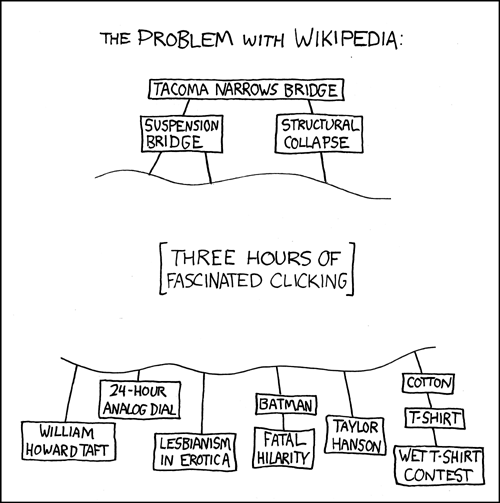
I went to the Wikipedia and looked up Murphy's Law, thereby running across all the similar such laws, Sod’s, Finagle’s, and all the variations of stating them:
- Whatever can go wrong, will go wrong.
- Anything that can go wrong, will.
- Whatever can go wrong will go wrong, and at the worst possible time
- If there's more than one way to do a job, and one of those ways will result in disaster, then somebody will do it that way.
- The perversity of the Universe tends towards a maximum.
- Bad fortune will be tailored to the individual.
- Good fortune will occur in spite of the individual’s actions.
The first list is generally considered to be Murphy’s Law variants, while the second list (Sod’s and Finagle’s Laws) has more to do with the human perception of fate, irony, and the injustice of the universe. The last statement is exemplified by the idea that it won’t rain if you take your umbrella. In our household, we call this “using unsympathetic magic.”
There are two ways of looking at Murphy’s Law, and one of them is the “perverse universe” or “jelly side down” viewpoint. That’s actually the more popular version, because people like to complain. There’s a physics version, for example, that says simply, “Mother Nature is a Bitch.”
Here, though, it’s worth quoting the Wikipedia entry:
In any case, the phrase first received public attention during a press conference in which Stapp was asked how it was that nobody had been severely injured during the rocket sled tests. Stapp replied that it was because they always took Murphy's Law under consideration; he then summarized the law and said that in general, it meant that it was important to consider all the possibilities (possible things that could go wrong) before doing a test and act to counteract them. Thus Stapp's usage and Murphy's alleged usage are very different in outlook and attitude. One is sour, the other an affirmation of the predictable being able to be surmounted, usually by sufficient planning and redundancy.
So, properly understood, Murphy’s Law is an engineering design principle, whose highest expression is in the idea of Fail Safe, a design whose failure modes are all innocuous, rather than a design with failure modes that, however rare, can have disastrous consequences. (The book and movie versions of Fail Safe, of course, used the phrase ironically).
One of the most famous (and flagrant) violations of Murphy’s Law as a design principle is to be found in nuclear reactor design in the 50s, 60s, and 70s, where safety was, for the most part, actively maintained, so a failure of safety mechanisms could lead to disaster. The notorious Rasmussen report (Rasmussen N. (editor) (1975) Reactor Safety Study WASH-1400, USNRC) calculated the likelihood of catastrophic accident as very unlikely, but the calculations involved an assumption of statistical independence of adverse events, i.e. that one bad thing happening didn’t have an effect on other bad things happening.
In the case of the Three Mile Island disaster, however, multiple bad things did happen, all more or less at once, at least partly because human error tends to come in clusters, like on the midnight shift, when people are not tippy top. What saved TMI from being a full bore catastrophe was the final, passive safety system: the containment structure. It’s worth noting that had Chernobyl had a similar containment structure, the graphite fire would have rapidly consumed all the available oxygen and ceased. The Chernobyl radioisotopes would probably have remained within containment. It’s also worth noting that there were many in the U.S. nuclear industry in the 1970s who argued that containment structures were a needless expense because reactors were so safe.
Another problem with the assumption of statistical independence of adverse events is the “bathtub curve,” the statistical distribution of failure of devices. Simply put, things tend to break most often when they are either new (due to manufacturing flaws), or when they are near the end of their designed life. In other words, new things have a greater likelihood of multiple component failure, as do devices near the end of their own design life. This is because designers try not to put very long-lived components with those of much shorter lives, sturdier components being more expensive. Thus, multiple component failure is much more likely near the end of device design limits, aka “The Wonderful One Hoss Shay” effect.
Evolution does this with people, too, and it’s not just aging that produces a “design envelope.” I wrote a paper, never published (though it made the rounds within the air geek community such that I’ve seen some signs that some of my colleagues got the point) entitled , "Does PM Mortality Follow a Bathtub Curve?" which suggests that there is both a high exposure and low exposure elevated human health reaction to particulate matter in the atmosphere. That, of course, is another, albeit related, topic.
Saturday, December 1, 2007
Three Jokes
#1
Rene Descartes went out for a walk on a fine Parisian spring day. The air was sweet and warm, perfumed with flowering plants and the smells of baking along the boulevards. His stroll went on for some time, and he realized that he was beginning to feel the first pangs of hunger.
But Paris in spring is bountiful, and Descartes stopped into a sidewalk café. Again, the perfection of the day asserted itself. The bread was fresh and tasty, the wine was full-bodied without impertinence, and the pate seemed to melt into his hunger with barely any need for the rigors of digestion.
His appetite nearly sated, Descartes watched the crowd passing on the boulevard, his thoughts turning to philosophy and the graphical mathematics. So lost in thought was he that he almost did not notice the waiter’s return, and he had to ask the man to repeat the question. The waiter again asked if he wished to have dessert, there was a custard of which the chef was particularly proud.
“Yes, yes,” said Descartes. “That sounds excellent.”
“And will monsieur be having coffee with that?” inquired the waiter.
“I think not,” said Rene Descartes, who then disappeared.
__________________________
This is a fairly mild example of an elitist joke, an in-joke that can be told to strangers. If you don’t know that Rene Descartes famously wrote “Cogito Ergo Sum,” “I think, therefore I am,” the joke goes right over your head.
I once told this joke at a gathering of nurses at my in-laws' house; about a third of them laughed, and when I realized the exclusionary nature of the joke, I figured that I’d been ever-so-slightly rude. But I did notice that the laughter tended to be in two parts, the first part when the person laughed, and the second part being when they realized that not everyone had laughed, and what that meant.
___________________________
#2
An airplane leaving from Poland wound up in a storm over the North Atlantic. Everyone was terrified, as the plane was pitching and yawing, and the crew feared that it would break up at any moment. But one young student stood up and called to the passengers, on the right aisle to move across the aisle. The passengers were dubious but the student insisted. “Hurry,” he said. “Our lives depend upon it.”
The passengers complied and the shaking stopped. The plane righted itself, and made its way safely to its destination. Why do you think the student’s plan worked?
Because you need all the Poles on the left side of the plane for stability.
__________________________
That’s an engineering joke. If you’ve never worked with Laplace Transforms, it is almost completely unintelligible. If you’ve sweated through control theory, it can be hilarious. Really.
I was once at a small gathering of fans at the house of a well-known fanzine Editor, and he told that joke. There were no other engineers there, and he didn’t know I was an engineer until I stepped on the punch line. I more or less blurted it out; I hadn’t meant to ruin the joke, and, for that matter I didn’t, not exactly. Because no one else laughed, and no one else was going to laugh, no matter how well the joke was told, because no one else had the background, just me and him. He’d told the joke with every expectation that it would meet with blank stares.
He and I never got along. I have no idea if that incident had anything to do with it.
_________________________
Paul Zuber was a professor of urban studies at RPI, and a little googling finds that he now has an RPI scholarship named after him (he died in 1986). I had a course from him; I think it was Urban Engineering.
One class he reminisced a little about what it was like in the early days of desegregation at the college level and he told a story about it that wasn’t a joke, because he stepped on the punch line.
___________________________
#3
Two of the first southern collegiate athletics departments that were desegregated had a long standing football rivalry. One of them had a single black running back, while the other had two defensive tackles. During the big, annual matchup game, one play had the running back going straight down the middle, where he was cut down by the two tackles.
A loud voice went up from the stands, yelling…
______________________________
Paul then threw the joke away, saying that the voice yelled something to the effect of “get your blacks off of our black.”
I muttered, not quite under my breath, “That isn’t the way I heard it.”
The actual punch line is “Get those n-----s off our colored boy!”
Paul glanced over at me with a little smile and winked.
This joke isn’t a racist joke, of course; it’s a joke about racists. Wanda Sykes has a routine where she notes that the more championships Tiger Woods wins, the less black he is. My father-in-law tells a similar joke about a black college football star, who wins so much that by the end of the season it’s “Go, Dutch, go!”
One of the things I got to think about during my Urban Engineering course was the ways in which jokes can be a means of hidden communication, and how place of origin and shared witness can sometimes trump race in making, as opposed to breaking, connections.
Friday, November 30, 2007
Detcord
So I just got back from Loscon, and boy, are my arms tired. Seriously, we drove, and that always tires my arms.
One of the things about gatherings of all sorts, of course, is that you meet interesting people with interesting stories. One of the folks I shared a panel with (Future Horror, I think it was) is a special effects pyrotechnician. That's part of the deal with Loscon, the connection to the movie biz, especially the technonerdy parts, which I find fascinating because, well, because.
After the panel, he told me a story about going through airport security. The name of this company was on his briefcase, bags, etc., and it included the word "pyrotechnics" and possibly, "explosives." Never mind. He was "randomly selected" for a bag check, and the guy swabbed his briefcase, then fed it into the sniffer. He scratched his head, then took another swab sample and fed it in again. Then he looked at the guy and asked, "What's PETN?"
That would be pentaerythritol tetranitrate, official IUPAC name: 1,3-Dinitrato-2,2-bis (nitratomethyl) propane. It's the principle ingredient in detcord, detonating cord that's used as a superfast fuse for triggering simultaneous explosions.
Okay, so the name "Department of Homeland Security" gives me the Orwellian creeps to start with. I noticed several weeks ago that on the TV show Smallville, they concocted a fictional name for the same organization and called it the "Department of Domestic Security." Smallville is based on Superman, a comic book character. What does it say when a comic book story has a less hokey name than the real thing?
Many people have noted the ongoing dynamic of "terrorism," where real or imagined threats are taken as license not to make policy changes that might actually address security, but rather as excuses to erode legal rights, expand police authority, and generally harass segments of the populace. Part of the wink, wink, nudge, nudge is that the Authoritarian Right assumes that these powers will never be used on them, but rather on other ethnic groups and the Right's political—and social—enemies. They are wrong, of course, but they never figure that part out. There are Russians who still yearn for the good old days of Stalin. For that matter, some still yearn for the Czar.
A recent trilogy of episodes on South Park had the nice conceit of terrorists invading "Imaginationland," literally attacking, not reality, but our imaginations. Last June, after Amy had her toothpaste confiscated by airline security, I realized that the policy of confiscating gels and liquids was to protect us from the terrorists in "Die Hard with a Vengence," i.e., from a type of explosive that does not actually exist, but has appeared in a movie.
Then there is the phenomenon of various pundits just salivating at the prospect of another 9/11 type event, often fantasizing it taking out some "left wing type" who have transgressed, who "don't love America," at least certainly not enough to fantasize about having famous landmarks blown up because they didn't like some election result.
Okay, so none of this is new, and, frankly, there are plenty of people who have been commenting on the politics of it for longer and at greater length than I have, and many of them are better at it. So why am I adding my oar to the water? Because of the other little thing that slips by in this story.
The airport security guard who asks "What is PETN?" is not to blame in this story. He's underpaid and undertrained and he knows full well that his job is basically harassing people, not actually improving their security. Besides, the sheer boredom of swabbing people's shoes and briefcases day after day would turn almost anyone's brain to mush.
But this stuff is supposed to be important, right? Shouldn't they at least try for the appearance of competence? Well, that would violate Conservative Movement Ideology, wouldn't it? I mean, government is supposed to be incompetent.
But wait. These are not government employees. They are employees of companies that have been contracted to provide these services. These companies are supposed to be "more efficient" than government.
Ah, but more efficient at what? Well, the purpose of it all has come to be "provide shareholder value," which is to say, "to make money." And there is some efficiency there, after all. But paying your workers well, training them, well, that just gets in the way of efficiency.
I once saw a documentary on John L. Lewis, who ran the United Mineworkers of America for 40 years. It was mostly coal mining, and coal mining is dirty, dangerous, and brutal. Lewis pushed not only for more money, but also higher safety standards. And he made what amounted to a long term bargain with the coal industry: they would not oppose mechanization if the miners got their fair share of the wealth that derived from enhanced productivity. It made sense; mechanized jobs required higher skills, more experience, and were safer. But there would be fewer of them. So Lewis got more money for fewer workers, undercutting his own political power for the good of those that remained.
The same thing happened with longshoremen when containerization came in. Nowadays, "stevedore" is essentially an archaicism; the men in the longshoremens union run those giant cranes and are paid very well. Ben tells me that Eric Hoffer wrote about the phenomenon in one of his books.
That was the deal as everyone understood it after WWII: rising productivity meant better pay in fewer jobs, but the economy as a whole would create jobs, especially "knowledge based" jobs that required college degrees, etc., so overall wages would increase and productivity would rise. They hadn't coined the phrase "win/win" yet, but there it was.
Somewhere along the line, that pact was broken. Somewhere between 1950 and now, the new business model became that of a South American banana republic: beat down the wages for the masses of workers so that those at the top could skim more cream. This is sometimes called the "Walmart model."
It pains me to think that both the engineering profession and science fiction were enablers to breaking the pact, but there that is as well. Engineers have always been their own worst enemies, partly because we love the work so much, and partly because so many engineers wind up in management. But I do not get the part about slowly undercutting the value of expertise and training. It took me forever to realize that new technologies were being accepted or rejected on the basis of whether or not they allowed the substitution of unskilled labor for skilled labor. And once that process begins, you get more and more highly capable people shoved into lower and lower scale jobs. I've lost count of the number of people I know who have to "dumb down" their resumes to find employment. Then, because the workforce is, in fact, overqualified, really, really, stupid managerial decisions sometimes can be made to work—simply because of the sheer competence of the labor force.
As for science fiction, Analog magazine has been the SF equivalent of Fox News for at least a couple of decades now. When was the last time you read an SF story that portrayed a union or government bureaucrat in a favorable light?
At the top, of course, the push for this new business model is the same as it always was: more booty for those who divvy up the spoils. There has been a huge effort to rationalize the vast sums paid to these folks as "the superstar effect," as if a CEO who gets a $50 million pay packet when his company has lost $2 billion in the quarter is somehow comparable to Barry Bonds. Or some hold that "people skills" have become the most important thing in the economy. Which is true, provided "people skills" is shorthand for "kiss up, kick down," treachery, mendacity, and the ability to pass off criminal behavior as standard business practice.
Monday, October 1, 2007
Electric Cars
I haven’t seen “Who Killed the Electric Car?” a documentary directed by Chris Paine about the EV1, a General Motors electric automobile that was withdrawn from (limited) production in the late 1990s, after a California Air Resources Board rule mandating some “zero emission vehicles” was rescinded. That doesn't mean I don't have opinions about the matter, of course.
There’s been a fair amount written about the entire affair, and I’ll only add the point that I suspect that one major factor was never addressed by the filmmakers or anyone else. In every large organization, the major decisions at the top have more to do with personal infighting amongst the managers than anything external. There were people pushing the project, for a variety of reasons, including some who wanted it sabotaged from the beginning, and they got their way. To whatever extent it was a con job designed to demonstrate that there was no market for electric vehicles only underscores the point. The GM divisions that were making big bucks selling gas guzzlers were never going to let an alternative vision get a fair hearing; the eventual fate of the Saturn is a good demonstration of the phenomenon.
Nevertheless, we do have some electric cars on the road now, though they are called “hybrids” and they burn gasoline in a motor to generate electricity that then runs electric motors to power the drive train. Some versions of the hybrid have the gasoline engine connected directly to the drive train and use the electric motors to add power when needed, and to recharge the batteries when the drive demands are less than the gasoline engine output.
A major part of the deal with hybrids is to greatly narrow the operating conditions of the gasoline engine. Under constant, optimized load conditions, you can finely tune the engine performance to maximize fuel economy and minimize emissions of pollutants. The other secret of any electric engine is that it can use “regenerative braking,” i.e., when the car slows (or if you’re going downhill), the electric motors become electric generators and you can recapture and store a substantial amount of the vehicle’s kinetic energy back into the batteries.
Having the internal combustion (IC) motor available finesses the major drawback of electric vehicles, limited range. Typically, EVs only manage less than 100 miles on a full charge, and take substantial time to recharge (1-15 hrs). Hybrids have the full range of gasoline powered vehicles.
The next obvious step in the development pathway is the “pluggable” hybrid, which allows the vehicle to be brought up to full charge from an external electrical source (and there would be a larger battery pack, bringing the thing closer to the true electric vehicle in electric storage). For a substantial number of commuters, the IC engine would seldom need to be engaged; one fellow who has “hacked” his Japanese hybrid claims that his overall fuel efficiency is over 100 MPG, though that doesn’t take into account the fuel burned to produce the pluggable power. (Actually, I seem to recall that he has home solar power panels, so he’s just the greenest of the green, isn’t he?).
Some environmentalists (and some fake environmentalists who carry water for the energy industry status quo), argue that electric vehicles merely shift the power generation (and pollution) elsewhere. That ignores the fact that IC engines operate at a pretty low thermodynamic fuel efficiency (the efficiency of converting the heat of combustion of the fuel to motive force, ignoring losses in the drive train), generally around 25%, though highly optimized, high compression engines can exceed 30%. By contrast, ordinary steam turbines generally start at 40% efficiency, and combined cycle and other tricks make more modern large stationary plants as much as 55% efficient.
It’s also considerably easier to manage pollution control from a single, large point source (whether the regulatory process manages to accomplish this is another story), and there is some hope that such things as geological sequestration of combustion CO2 might reduce the greenhouse gas emission from such facilities as well. Such tricks are pretty well out of the question for mobile vehicles.
Then there is the matter of the impending changeover from fossil fuel driven electric power generation to renewable sources. Wind power is already economically competitive to fossil fuels in many circumstances, and will become more so as the greenhouse gas "externalities” (economist-speak for “beggar thy neighbor”), are rationalized. As a scientist and engineer, I’m also a fan of nuclear power; I just don’t trust our current industrial oligarchy to do it in anything like a safe and sane manner.
There is also the photovoltaic option. The overall field and the statistics behind it are pretty slippery, but it looks like the cost per peak watt for photovoltaics have been halving at something like 5-10 year intervals, while the install capacity has been going up more dramatically, as each price reduction opens up a larger market. Also, in contrast to the U.S., Europe and Japan have been using regulatory action, subsidies, and guaranteed market tactics to encourage alternative energy, rather than discourage them. (In the U.S., a giant game of “crack the whip” has some governmental entities attempting to encourage alternate energy sources, while other entities penalize them, which is a good way to generate paralysis and wasted development efforts).
If you put photovoltaic cells on an automobile, you don’t get a “solar car” in the sense of being able to run on sunlight alone, but (the last time I did the calcs anyway), you do get the equivalent of about 10-20 miles per day of solar driving in the sunbelt areas of the country. That’s not trivial in terms of oil consumption; on average, it could reduce the fuel consumption of a hybrid by around 15-25%. If you’re already driving to work on the charge you got the night before, you’re down to needing maybe a half-gallon of gasoline per day on your daily commute.
That looks like the natural channel for the technology to follow, but there are plenty of things that can screw up a lovely vision of the future, including those who just plain want to keep everything “under control.”
Thursday, September 27, 2007
Rocket Boys Meet the Radioactive Boy Scout
[Crossposted from WAAGNFP]
Until I began to build and launch rockets, I didn't know that my hometown was at war with itself over its children, and that my parents were locked in a kind of bloodless combat over how my brother and I would live our lives. I didn't know that if a girl broke your heart, another girl, virtuous at least in spirit, cold mend it on the same night. And I didn't know that the enthalpy decrease in a converging passage could be transformed into jet kinetic energy if a divergent passage was added. The other boys discovered their own truths when we built our rockets, but those were mine.-- Rocket Boys by Homer Hickam
Rocket Boys was made into a movie, “October Sky,” the title being an anagram of Rocket Boys, and I’m still charmed by it. I’ve found that the film is much beloved in some quarters, but I found it to be a disappointment, as so many such films are, because the book had the texture of truth, while the film had the texture of Hollywood. Relationships were generified, characters were stereotyped, you know the drill.
There have been a number of historical paths whereby the bright kid gets out and up in the world. Rocket Boys is a description of a new path: Rocket Scientist, exemplified by Hickam himself, but also, to my reading, the more important character, Quentin, the hard scrabble kid who uses his brain and big words to protect himself from his circumstances, and who decides that Hickam, the son of the mine superintendent, has access to the resources they would need to start a rocketry club.
In 1957, the town of Coalwood, in West Virginia, is cut off from the world in ways that are simply unfathomable today. For example, a major point in the book is when their science teacher, through considerable effort, manages to procure for them a book on rocketry. One. Single. Book. Is it possible to picture such a time today, when Amazon.com and Abebooks.com are universally available? I’ve lived in towns nearly as removed as Coalwood, but I have to work very hard at imagining (or remembering) what it was like. It’s simply another world.
One running joke through Rocket Boys are the crazy ideas that Quentin gets, like when he and the rest of the club are talking about making out with girls, considering the wonders of the female undergarment, and Quentin begins to speculate that it might be an efficient thing to combine stockings with panties into a single garment. Or when he’s considering orange juice and instant coffee and wondering if it would be possible to produce some product like instant orange juice.
In the epilog that follows where the rocketry club boys wound up, a goodly number of them became engineers. One can only speculate how many of them became science fiction fans.
The dark side of the teenage geek can be seen in the story of the Radioactive Boy Scout, the story of David Hahn, who, as a teenager in suburban Detroit, managed to accumulate a large collection of radioactive materials, plus build a homemade neutron source that he used to irradiate thorium and uranium, in hopes of building a breeder reactor. What he got was a decontamination team from the NRC, who hauled away the shed in which he’d kept his material and a tour in the Navy, where he wasn’t allowed to work near nuclear reactors, because he’d already substantially surpassed the allowed lifetime exposure to radiation.
The book is based on an article from Harper’s magazine.
I’ll note this warning about the book, which often speaks of how “advanced” was David’s knowledge of radiation chemistry. In reality, Hahn’s knowledge was pretty spotty, which is what you’d expect from an autodidact. At one point he’s shown to be baffled as to why he doesn’t get a Geiger counter reading from polonium (it’s a pure alpha emitter and alpha radiation cannot penetrate the counting tube). He seems to have only the vaguest understanding about neutron moderation and implications on fissile fuel breeding, and, needless to say, the concept of radiation health safety is pretty much beyond him.
To be fair, I don’t know how much of this ignorance is Hahn’s and how much of it is the author’s, or, more specifically, how much of the author’s obvious ignorance is also the case for Hahn.
I’m given to muse a bit on both the upside and the downside of the geek effect. Is the difference in outcome between Rocket Boys, and The Radioactive Boy Scout merely one of luck? After all, the rockets were far from safe, and did nearly cause damage a time or two (though it must be observed that the fatalities in Coalwood were invariably from the coal mine, not the rockets). More importantly, I think, comes the observation that, if you’re going to go off into the wild blue yonder, figuratively or literally, it helps to have some friends in it with you, just to keep you grounded.
Tuesday, August 28, 2007
What is the Frequency, Kenneth?
There are mathematical proofs, there are empirical tests, and there are good narratives. When push comes to shove, the good story gets more believers.
Last year, at an SF convention, I attended a panel titled, The “Future in Oil,” which was about oil painting, and had three artists on it. One of them wound up talking about the difference between CDs and vinyl records (because a subject like oil painting tends to get a lot of artistic musing). The cherished narrative is that vinyl is better than digital. I did try to set the record straight, but there were true believers in the audience, as well as one tech guy who thought he knew what it was all about (he did not). I don’t try to win unwinnable arguments very often these days, though I do kvetch about it afterwards, hence this essay.
In my own personal history, one of the most fascinating courses I ever took was a graduate level thing “Voice and Image Processing.” It’s been interesting watching the technology of voice, sound, and video over the past thirty years catch up to the things we learned in that course. Add to that the fact that I’ve also had a number of friends and acquaintances who were sound and music nuts, and I will claim some expertise on the subject. Whatever else may be said, I am not uninformed, nor am I lacking for opinions.
So why do so many people think that vinyl LPs are better than CD? We’ll leave aside whatever buried agendas are being worked out (rebellion against the digital age, simple nostalgia, etc.). In fact, I’ll stipulate that many people have had experiences that are consistent with the hypothesis that vinyl is better than digital. Why?
I know of three answers to that question, one kinda obvious and unsurprising, one that gets seriously arcane, and one that’s just counter-intuitive.
Let’s first take the one that’s unsurprising. In the production process for making an LP or CD, there is a thing called the “Master” tape, which is mixed, balanced, and frequency adjusted for the medium. Not surprisingly, CDs and LPs have different frequency responses. In fact, the old LPs had a lot of special things done to the frequency response to compensate the need to put all the sound in those little, inherently noisy, grooves. Then, on playback the “phono” jack on the pre-amplifier had a frequency response curve built into it to undo all those special tweaks. The net result was an RIAA standard “compensation curve” built into the master, to achieve closer to a flat frequency response for the final product.
When CDs first came out, and the record companies realized that they could make tons of money selling baby boomers their favorite music yet again (first on LP, then cassette, then CDs, and some poor guys had the Beatles on 8-track, too). In a few cases, they didn’t bother re-mastering the tapes, and the things sounded just horrible, especially in the high frequencies, which were artificially “bright.” In other cases, they did “digitally re-master” the tapes, but the guys who did it weren’t as good as the guys who had originally done it. So CDs got a reputation as being “harsh.”
Then there was the fact that early CD players weren’t up to properly implement the theory of sound sampling.
To understand what went wrong there, let’s start with the Nyquist Sampling Theorem. Short version: you can perfectly reconstruct any wave form like a sound signal, provided you sample it at a rate that is at least twice the frequency of the highest frequency in the signal. In the above noted course, we actually went through the proof of the NST, and while I can no more reproduce it than you can reproduce an aria by sampling it at ten samples per second, I did once know it well enough to have the sort of belief in it that qualifies as “faith” for my kind.
So CDs use a standard that samples at 44,000 samples per second, which, theoretically can perfectly reproduce sound up to 22 kHz, but actually is set up to go to 20 kHz, because you need to put in a high frequency cut-off.
See, if you try to reproduce sound at something less than the Nyquist rate, you get a phenomenon known as “aliasing,” where the lower frequencies also have an “alias” signal that is frequency shifted up to higher frequencies. This isn’t the same as a harmonic, because the frequency shift is related to the sampling rate, not to the original signal. I’ve heard aliased sound, and it’s one of the most unpleasant things I’ve ever heard, but I can’t think of any analogies for it. It just sounds alien and wrong.
So above 22 kHz in the analog signal that is reconstructed from a CD, you get this horrible noise. You can try to filter it out of the analog signal, but filters are imperfect, so some faint residual alias remains. Worse, real circuits have some slight non-linear responses, non-linear in the mathematical sense, not in the sense of a “linear frequency response.” What a mathematically non-linear effect can do it to take a high frequency signal and leak some of it to a lower frequency. Thus, the aliased signal above 22 kHz could result in some faint distortion down where even hearing-damaged Boomers could hear it.
Again, more for the CD reputation of “harshness.”
The aliasing problem was eventually solved by digital filtering. What later generation CD players do is to use “oversampling.” Basically, the original 44,000 samples per second is converted through interpolation to many more samples (12X oversampling is common). Then, use a digital filter to make damn sure that there aren’t any aliased frequencies in the thing, so when you finally do the digital-to-analog conversion, you only need a pretty good high-frequency cutoff filter. This winds up being both effective and cheap. Win/win.
Finally we come to the strange one. I think I saw it in Science a couple of years ago. I’m not even sure if it spoke to the issue with CDs vs LPs, but the implications were obvious, even if the result was counter-intuitive. Simply put, our perception of sound is such that we hear things more clearly if there is a little bit of low level noise in the mix. I think the speculation was that the noise allows us to “calibrate” our perceptions on the fly. Whatever the reason, it flies in the face of everything in sound reproduction in the past century. Noise is supposed to be your enemy, not your friend.
But the implication is that the slight surface noise that you get on even the best turntable with an LP actually assists your sound perception. Go figure.
In any case, I’ve made CDs of vinyl LPs; not all LPs have been re-issued, and besides, I don’t like buying the same thing twice. I’ve listened to the resultant CDs, and I don’t believe that anyone can tell the difference between the CD and the source LP. Furthermore, there have been many, many, controlled A/B tests of whether or not anyone can tell the difference, and it’s a simple fact that whatever differences there may be, they are imperceptible to human beings.
And if that’s not enough, Frank Zappa looked into the matter and he agreed; CDs can perfectly reproduce vinyl, if you want them to.
None of this will convince anyone who is sure that LPs, vinyl, and analog are better than CDs and bitstreams. Vinyl is “organic” (which is perfectly true in the chemical sense), while CDs and digital are harsh and artificial. And that’s a simple narrative, as opposed to what I’ve just described, which is convoluted (little math joke there) and knurdish.
I’m fine with that; I’d rather be right than win an argument.
Subscribe to:
Posts (Atom)

