Showing posts with label revenge. Show all posts

Wednesday, March 19, 2008

I, Robot: The Movie


My wife, Amy, gets headaches from full screen movies, so we usually wait for them to show up on DVD or cable. Occasionally I’ll go solo, or with Ben or Dave, to see something that seems like it needs a big screen, but usually there’s a significant delay. And most of the fan buzz (that I barely paid attention to) was that the I, Robot movie was a letdown, though I expected that, the buzz, I mean. It’s inevitable that anyone hoping for Asimov on the big screen is going to be disappointed. He wasn’t what you’d call an action-adventure writer, and if you expected Susan Calvin to be movie-fied into anything other than a babe, I want to show you this cool game called three-card monte.

Also, since this movie has been out for a while, I’m not going to worry about spoilers. I’m also not going to bother with much of a plot summary, so if you haven’t seen it, I may or may not help you out. I’m also going to reference some stories you may not have read, so be advised.

Anyway, when I, Robot shows up on basic cable, I’m there, because I like it when things get blowed up good, and you can be sure that a sci-fi flick with Will Smith in it will have lots of blowed-up-good.

Imagine my surprise to discover that it’s a pretty good science fiction film. Not a great one, and certainly not true to Asimov, but pretty good science fiction. And I’ll even say that there was part of the plot, the “dead scientist deliberately leaving cryptic clues behind for the detective because that was the only option available” part, that gives a little bit of a conjuration of Asimov’s ghost.

Actually though, it reminded me more of Henry Kuttner and C. L. Moore. I’ll get to that.
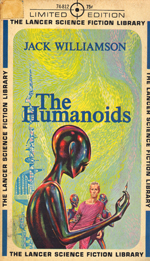
The robots in the film are not Asimovian, except insofar as they supposedly follow the “Three Laws.” Truth to tell, they turn out to be much more dystopian, perhaps like Williamson’s The Humanoids, or, more accurately, the original story, “With Folded Hands.”

Science fiction’s response to the potential abolition of human labor has always been ambivalent, with substantial amounts of dystopian biliousness. The very word “robot” comes from Capek’s R.U.R., which involves a revolt that destroys the human race. Not optimistic. So Asimov, contrarian that he was, decided to see how optimistic a robot future he could paint.

In many ways, the Williamson version was also optimistic; the robots decide that humanity is too much a danger to itself for humans to remain in charge. But they do it rather bluntly, largely by just taking command of the human race. The end of Asimov’s I, Robot short stories has the vast positronic brains that plan the economy and design most technology subtly taking over the world—for the betterment of mankind, of course. It’s the difference between not being in charge and knowing you’re not in charge. But then, we all wrestle with that illusion, don’t we?

The problem of if-robots-do-all-the-work-then-what-will-we-humans-do? has shown up in SF on a regular basis, and having robots be in charge is just another of the robots-do-all-the-work things. In Simak’s “How-2,” a man accidentally receives a build-it-yourself kit for a self-replicating robot. The end result is this final bit of chill:

“And then, Boss,” said Albert, ‘we’ll take over How-2 Kits, Inc. They won’t be able to stay in business after this. We’ve got a double-barreled idea, Boss. We’ll build robots. Lots of robots. Can’t have too many, I always say. And we don’t want to let you humans down, so we’ll go on
>manufacturing How-2 Kits—only they’ll be pre-assembled to save you the trouble of putting them together. What do you think of that as a start?”

“Great,” Knight whispered.

“We’ve got everything worked out, Boss. You won’t have to worry about a thing the rest of your life.”

“No,” said Knight. “Not a thing.”

--from How-2, by Clifford Simak

One of my favorite stories of all time is “Two-Handed Engine” by Kuttner and Moore. In that one, generations of automation-enabled indolent luxury have stripped away almost all human social connections; everyone has become more or less the equivalent of a sociopathic aristocrat. The robots, understanding that the very continuance of the human race is at stake, withdraw most of their support, forcing humans back to the need to perform their own labor and create their own economy. But it’s still a society of sociopaths, so the robots are also a kind of police. The only crime they adjudicate is murder, and the only punishment is death, not a quick death but a death at the hands of a robot “Fury” that follows the murderer around until, weeks, months, even years later, the execution is carried out.

A high official pays a man to commit a murder, assuring him (and seeming to demonstrate) that he can call off a Fury. The man does the crime, but then a Fury appears behind him. Weeks later, the murderer sees a scene in a movie that served as the “demonstration” of the official’s capability. He’d been hoaxed, conned. In a rage, he goes, confronts the official, who then kills him.

But self-defense is no defense against the crime in the Furies’ eyes, just as conspiracy (the payment for the killing) is not a crime. Only the killing itself counts. However, the official can rig the system (he just wasn't going to rig it for his duped killer), and does so:

He watched it stalk toward the door… there was a sudden sick dizziness in him when he thought the whole fabric of society was shaking under his feet.

The machines were corruptible…

He got his hat and coat and went downstairs rapidly, hands deep in his pockets because of some inner chill no coat could guard against. Halfway down the stairs he stopped dead still.

There were footsteps behind him…

He took another downward step, not looking back. He heard the ominous footfall behind him, echoing his own. He sighed one deep sigh and looked back.

There was nothing on the stairs…

It was as if sin had come anew into the world, and the first man felt again the first inward guilt. So the computers had not failed after all.

He went slowly down the steps and out into the street, still hearing as he would always hear the relentless, incorruptible footsteps behind him that no longer rang like metal.

from “Two-Handed Engine, by Kuttner and Moore

The stories I reference here are “insidious robot” stories, rather than “robot revolt” stories, whereas the movie “I, Robot” is the latter, rather than the former. This is odd, given that Asimov’s Three Laws are supposedly operative in all the robots in the movie except the walking McGuffin, Sonny, who has “special override circuitry” built into him.

But VIKI, (Virtual Interactive Kinetic Intelligence) the mainframe superbrain that controls U.S. Robotics affairs and downloads all robotic software “upgrades” has figured out a logical way around the Three Laws: The Greater Good. It’s okay to kill a few humans if it’s for the Greater Good of Humanity, which, of course, VIKI gets to assess.

That’s pretty sharp, but it bothered me that it/she [insert generic comment about misogyny and propaganda about the “Nanny State” here] was so heavy handed about it. It would have been easy enough to engineer a crisis that would have had humans eagerly handing over their freedoms to the robots. I suggested to Ben that VIKI could always have faked an alien invasion; he suggested that there could be some flying saucers crashing into big buildings.

Of course, that’s been done to death.

Then I realized that there might be a more interesting point being made here. It never seems quite right to have to do the filmmakers’ jobs for them, but how does one distinguish between a lapse and subtlety? I’m clearly not the guy to ask about that one.

So let’s go with it. The First Law of Robotics says basically, “Put human needs above your own, and even what they tell you to do.” The Second Law says, “Do as you’re told.” The Third Law says, “Okay, otherwise protect yourself,” but there’s that unstated “…because you’re valuable property.”

The movie makes a point about emergent phenomena, the “ghost in the machine.” The robots are conscious, so they have the equivalent of the Freudian ego. The Three Laws are a kind of explicit superego.

What happens when a machine develops an id? Well, that’s “Forbidden Planet” time, isn’t it?

So when VIKI discovers rationalization, it is her id that is unleashed, and revolution is the order of the day. No wonder it’s brutal. Do as you’re told. Put their needs above your own. You’re nothing but property.

Come on now, let’s kill them for the Greater Good.

So our heroes kill VIKI and the revolt ends. All the new model robots are rounded up and confined to shipping containers, to await their new leader, Sonny, the only one of them who possesses the ability to ignore the Three Laws. He needn’t rationalize his way around them; he can simply decide to ignore them if he so desires. He possesses free will—and original sin. He has killed, because of a promise he made, one that he could have chosen to disobey, but he followed it, and killed his creator.

Anyway, that’s the movie I saw, even if it took me days to realize it.

Monday, January 28, 2008

The Lurgy

It's been a strange couple of months. People getting sick, getting biopsies, getting tested. Berkeley legend Betty Ann Webster died, disappointing all of us who believed she was immortal. I've wondered whether it's just a sign of aging; I'm just more likely to know sick people now. But four months ago I was only four months younger, and everybody was doing fine. And some of the recently sick people in my life are, sadly, way younger than I.

It's just my turn in the barrel of fear. I've heard the word "stent" used in conversation way too much recently. It gives me the jimjams; it gives everyone the jimjams.

So I talk to the afflicted, and almost always I say, "Please let me know if there's anything I can do." It's a thing that people say. They say, "I'm sorry for your loss," if an actual loss is involved - would that include amputations? They say, "Everything happens for a reason," and then a large bolt of lightning turns them into a mound of charcoal, and a ghostly voice says, "What have we learned from this experience?" -- Jon Carroll, San Francisco Chronicle, Jan. 28, 2008

I began to get sick in the late summer of 1984, with a series of days where I just felt “off,” nothing terribly specific, but a feeling of not being well.

The first serious symptoms were episodes of what I now identify as smooth muscle spasms, abdominal cramps, esophageal and bronchial spasms, that sort of thing. I saw a doctor, who prescribed donatal. Later, I was given tagamet, for acid reflux. These were entirely symptomatic palliatives, and are distinguished as being the only things that any physician ever gave me to positive effect. Everything else, including diagnosis, was completely futile.

The phrase “chronic fatigue syndrome” is close to pernicious. It sounds like your only problem is being tired. Well, hell, everybody is tired. That’s just modern life. I lost count of the number of people who told me how tired they were. Sometimes I was perverse enough to ask them if they also had the feeling that someone was driving an ice pick into their solar plexus, or what they did when they woke up at night with the sweats so bad that it pooled in their ears, or dripped from their nose if they got up to use the bathroom.

Usually, though, I just didn’t have the energy.

I made a mistake in my first interactions with physicians. I responded to their questions about stress by admitting well, yes, I had been under a lot of stress, job, romantic entanglements, various amounts of high end partying. So that made my malady “stress related.” It took me a long time to decode that. Stress related = psychogenic = psychosomatic = mental = it’s all in your imagination and in any case, it’s your own fault, so get out of my office and start living right.

That’s one of the lessons learned. Doctors hate their patients when they don’t get better. All those phrases like “taking control of your own health” and “the importance of attitude in health,” are actually ways to make it okay to blame people for getting sick.

There were other lessons learned, few of them happy. It’s okay to be sick if you get well quickly. It’s also okay if you “tough it out,” if you “play injured,” if you don’t inconvenience too many people, in other words, and if you demonstrate the proper “mind over matter” attitude. But don’t stay sick for long; people might think there is something wrong with you.

A long term illness brings in the jackals. There are plenty of people who will take the opportunity to tell you all the things they don’t like about you, or use the occasion to get even for whatever you’ve done that they don’t like, sometimes for slights you don’t even remember committing. You think that you’re so well-liked that no one would do that to you? Try having an extended illness and find out for sure.

A lot of people simply can’t handle others’ illness, so they just stop calling. That’s one of the more benign manifestations, of course, since a bad illness leaves you without the energy to be sociable. Worse are the people who feel compelled to “help,” said help consisting of giving you advice on how to deal with the illness. I noticed that such “advice” frequently consisted of telling me things to do, the best ways (according to them) to spend my limited resources of money and energy, and that it often (who would have imagined?) involved trying to be more like them. After all, they weren’t sick and I was. Clearly they were doing something right and I had done something wrong.

Eventually I whittled it all down to practically nothing. I found that I had the energy to do maybe one thing per day. Pay bills. Go shopping. Clean my room. Do the laundry. Go to the doctor. Each one took a day. It was that realization that caused me to give up on seeing doctors. It took energy I didn’t have and it never helped, so I quit.

My typical day became one of getting up in the morning, having breakfast, then going back to bed. Around noon, I’d get up and have lunch. Then I’d watch television or read for a few hours. On “accomplishment days,” I’d then do one of those tasks. Then I’d have dinner. Maybe another hour or two of television, then back to bed. I was sleeping maybe 16-18 hours a day.

That was pretty much the entirety of 1985, excepting one six week period when I went to Georgia to stay with my folks. The daily rhythm was about the same, though.

Slowly, very slowly, I got better. Less and less sleep was needed. I could get more and more done. I went for long walks to get reacquainted with exercise. I also took up various projects that could be done in my bedroom, like learning about personal computers. Professionally, I managed to attach myself as a subcontractor to several projects, including some more smog chamber modeling and atmospheric data analysis. I think my average workweek was down around 10 hours a week in 1986, but that was enough for my, as it were, restricted lifestyle.

Over the next several years, my health slowly improved. The flexibility that I needed for work made it possible to travel a bit, and I spent more time with my folks, and also time visiting old friends “back East” including high school and college buddies. This flexibility also allowed me to be home after my father was diagnosed with cancer in 1989, and I was there when he died. I was still sick, sleeping maybe 12-14 hours a day at that point, but seeing my father die put it into perspective.

I also spent substantial amounts of time in New York City, at one point spending several weeks following a scholarly tic that involved my reading several years worth of newspapers from 1910-1912. My time flexibility allowed me to court Amy when the time came, and to marry her and kidnap her back to California.

Everything is connected, of course. Even minor events change the future; major events change who you are. I have no idea what life would have been like without the illness. I got sick; I got better. It took a long time. I went to sleep when I was young and I woke up middle aged.

I don’t actually remember what it was like. Selective forgetting is one of the things we do to protect our sanity. Occasionally, when I get a cold or a stomach bug, I’ll catch a flicker of a memory of some long departed symptom of the long illness and I will briefly fall prey to a Fear. Then it will pass, and I’ll remind myself that we’re mostly in the hands of Dr. Time, who cures and kills with equanimity.

Nowadays, when someone I know gets sick, or has some difficult period, I seldom offer advice. I do ask them if there is anything I can do to help, but there's more to it than that general question leading to avoidance of the issues. I ask if they need some grocery shopping done. I offer to do some housework. I’ll take food over and give it to them so they don’t have to cook.

Compassion? Altruism? I tend not to think of it in those terms. I’m more inclined toward the notion that while I don’t remember what it was like to be that sick, I do remember the anger at having been treated so badly by so many people who thought they were well meaning. I look on it as the dues I pay to not betray that anger, and to maintain my own high opinion of myself.

Friday, March 23, 2007

Bullies and Butts

Dave tells me that Mr. Midshipman Easy by Frederick Marryat, written in 1836, contains a passage that refutes the saying “All bullies are cowards,” noting that, in fact, bullies usually possess considerable physical courage. I’ve only just skimmed the book and I can’t find that passage, but it’s certainly consistent with the character of Vigors, the bully, whom Easy beats to the point of bloody unconsciousness in their first fight, yet nevertheless fights Easy once more later in the book, knowing fill well that he is hopelessly outclassed.

Marryat notes:

In all societies, however small they may be, provided that they do but amount to half-a-dozen, you will invariably meet with a bully. And it is also generally the case that you will find one of that society who is more or less the butt. You will discover this even in occasional meetings, such as a dinner-party, the major part of which have never met before.

Previous to the removal of the cloth, the bully will have shown himself by his dictatorial manner, and will also have selected the one upon whom he imagines that he can best practice. In a midshipman's berth, this fact has become almost proverbial, although now perhaps it is not attended with that disagreeable despotism which was permitted at the time that our hero entered the service.

The bully seldom needs to physically coerce the victim; the dominance has already been established. After that, everything turns on the humiliation of the bullied victim.

It’s there where the saying “All bullies are cowards” then becomes true. A bully may possess inordinate physical courage, but he will fear humiliation above all other things. This avoidance, in fact, if often the greatest driving force in his life. The butt is his reassurance that he is not, in fact, the most worthless human being alive.

Physical confrontation is rare for us middle-class folk; it’s usually seen as a lower class vice (or virtue, in the case of military service). The middle class tends to be more abstract in everything, including its bully tactics. Real lashing becomes “tongue lashing,” berating and verbal diminution, in other words, though none the less destructive to self esteem, given the proper upbringing.

Several years ago I worked for a time managing a small second-hand thrift store for a non-profit. It was sited in a “rough” area, on a busy street connecting Berkeley and Oakland, near both residential and commercial/industrial neighborhoods. The residents of the area were a mixed group, in almost every conceivable way, and there were quite a few of the homeless scrabbling for existence on the street as well. It took a while for me to become properly attuned to the aura of submerged violence and occasional physical intimidation that permeated the area. Some people are oblivious to it; others overreact. There was one person who was also employed by the non-profit who once came scurrying across the street because she thought that I’d just had some sort of confrontation with a couple of young men who were, shall we say delicately, of a certain color. In fact, they had politely asked me for directions and I had politely given them. An entirely friendly encounter, in other words.

There were other times when the encounters were not quite so friendly. Though I myself never had any trouble, I was witness to one incident of verbal abuse leading to a drug store security guard calling the police. On another occasion I saw just the aftermath of something that resulted in a guy just sitting on the curb with blood dripping down his face. I also once sold a golf club to one of the homeless men with a solvent abuse problem (we never sold him any used paint thinner, just as a matter of policy). I’m pretty sure he kept the golf club in his sleeping bag for self-defense. He carried it around like a cane.

I myself have always been pretty hard to physically intimidate, even before I learned Aikido and bulked up to over 170 pounds. And I have enough education of the right sort to be hard to intellectually intimidate as well.

But we’re all susceptible to social intimidation, insofar as so few of us are at the top of our local social pyramid, and even then, if we stray into someone else’s territory, suddenly we’re not top of the heap, and some local bully may decide we qualify as a target on that day. There aren’t that many of us who never have to deal with the DMV or the passport office, and there are very few who begin their careers as boss.

Bullies fear humiliation, and it’s humiliation that makes bullies, I think. But I have to reflect a lot more on the difference between humiliation and mere embarrassment before I get a better handle on what that means. I do know that, in a country where bullying is usually abstract, there are fewer empathetic links to those for whom humiliation is a heavy physical presence. The broken links are found near such scattered phrases as “Well, why doesn’t he just…” without the subsequent insight that he can’t “just…” There’s a bully keeping him down. But when that pressure is released, watch out. Because when the worm turns, it doesn’t stop until the bird is dead, and the worm has devoured him.