If I were a high school history teacher, I’d assign my students the project of selecting one year from before they were born and to find a library with newspapers from that year, then to read the entire year of at least one of the newspapers. Two or three would be better, of course. They wouldn’t have to read each one all the way through, of course, but they would have to select at least one or two news articles from each paper to read in its entirety.
I once did pretty much exactly this for two New York newspapers for 1911, Hearst’s New York American and The Morning Telegraph (not a Hearst paper), because Damon Runyon wrote for the former and Bat Masterson wrote for the latter. I had a story in mind, and I managed 20,000 words of it, though I’d need to get back to the source material to do any more of it. It took a particular mindset, and that mindset came only with full immersion.
That’s more or less my first point here, that history looks a lot different when it’s happening, and primary sources are essential. Otherwise, you’re just taking sides in what amounts to literary criticism, comparing the narratives assembled by different historians, each with their own notions of what parts are important. That’s true with the newspaper accounts also, of course, but the narrative tissue is often easier to unwrap when it’s been hastily conjured in an ephemeral publication.
My experience also left me with a certain unease about historical fiction generally, including alternate history. Part of that comes from a realization that I had that it’s impossible to do historical figures justice in a modern narrative. Their actions made sense to them, embedded as they were in their own times, but modern audiences will not abide a true re-creation of those times (how many previous years’ bestsellers are even in print nowadays?), and translation to modern sensibilities smothers the real individuals.
I don’t have that sort of problem with out-and-out historical fantasies; it’s understood (at least by me) that the Edison or Coleridge that you encounter in a Tim Powers novel isn’t meant to be the real guy, and anyone who confuses them has trouble telling fact from fiction in the first place.
The problem is hardly limited to history, is it? Amy sometimes does transcription work, and seems to have found a small niche amongst a certain sort of documentary filmmaker. As a result, we have videotapes of various people talking about Sam Wagstaff, who was Robert Maplethorpe’s lover, patron, and promoter, and who was, as much as anyone, responsible for the shift in the consideration of photography as fine art. One of the interviews is with Patti Smith, who lived with Maplethorpe for a time in the 1970s, and whose presence, judging by the video, is absolutely riveting. That may be just the fan in me talking, since I consider Patti Smith as one of the artists in the 20th Century who kept the word “poet” from becoming something risible. But however you figure it, I’ll bet that the eventual documentary doesn’t feel the same as the original source material, because there will be someone else’s notion of the narrative in between.
Another one of the transcription projects concerned the movement to ban military recruitment from high schools and colleges. There we got to see an interview with Cindy Sheehan, talking about her son Casey. This was several months before Sheehan became famous, and the raw emotion and the severity of the injury to her soul was just nakedly displayed. This is one of those cases where the competing pro and anti-war narratives have done a substantial job of smothering the original truth of the matter. But the original source material destroys all subsequent storylines, starkly projecting the central image of a woman shattered at the loss of her child.
Real history doesn't play into narrative that well. It often misses the good tricks. I had certain reasons for reading newspapers from 1911, reasons that didn't include the occurance of the Triangle Shirtwaist Factory fire. A novelist would have had some foreshadowing, but with newspapers, you just turn the crank on the microfilm reader and suddenly you are staring at one of the most famous tragedies of the early 20th Century. No good storyteller would just hit you in the face like that, but history is a story made up after the fact, while original events are facts on the wing.
Showing posts with label writers. Show all posts
Showing posts with label writers. Show all posts
Thursday, June 12, 2008

Tuesday, May 20, 2008
Maybe It's That Simple
I'm having more of a slog through the latest issue of Helix than usual, partly because of a recurrent back spasm that renders me intermittently immobile, but also because I usually start with the John Barnes column, The Well-Bitten Hand, and there's a lot to gnaw on this time. To begin with, Barnes is telling us what being a semiotician means to him, and since he gets paid to be one, it's a good thing to pay attention to what he says, money being what it is and all.
Also, in the first part of his essay, he's dealing with some of the issues that are often trotted out when people discuss science fiction, and, more specifically, why some people don't like science fiction, and perhaps why some people have trouble reading science fiction. This is often summed up in the phrase, "The door dilated," which is supposed to signal the savvy SF reader that we're not in Kansas anymore, but which troubles the regular reader, because, perhaps, we're not in Kansas anymore.
I'm actually giving away a bit of my own argument here with that last sentence, because the sort of literary analysis that Barnes is critiquing calls these things "reading protocols," and suggests that non-sf readers either do not possess the protocols that make sf readable, or they do not enjoy using those protocols.
My own suggestion, which Barnes does not really mention (though I'm sure he's considered it), is that some people just don't like science fiction. It's not as if this is a feature of the landscape that is confined to literature; there are plenty of sf movies, tv shows, comics, etc., and there are many, many people who simply don't care for them. The same is true of various sorts of fantasy. A friend of mine had a long-running (and joking) argument with his wife and daughter about Buffy, the Vampire Slayer. They loved it; he refused to even watch it. He preferred The Sopranos, which is a different kind of wish fulfillment fantasy, but a fantasy nonetheless. He even agreed with this when I pointed it out. However, he still preferred The Sopranos.
Similarly, there are currently entire genres that are, by classical standards, science fiction, but which regular science fiction readers disdain because they don't speak to whatever said sf readers really want. I'm thinking here of the cross-genre romances, the paranormal romances, the time-travel romances, and so forth, which spoil all the good sf action with that "chick lit" stuff.
In any case, I'm pretty sure that Barnes skips over this part of the argument because he wants to get on about reading protocols generally, and what he calls "dip and flip," as a result of a series of observations he's made of people reading in public places:
Also, in the first part of his essay, he's dealing with some of the issues that are often trotted out when people discuss science fiction, and, more specifically, why some people don't like science fiction, and perhaps why some people have trouble reading science fiction. This is often summed up in the phrase, "The door dilated," which is supposed to signal the savvy SF reader that we're not in Kansas anymore, but which troubles the regular reader, because, perhaps, we're not in Kansas anymore.
I'm actually giving away a bit of my own argument here with that last sentence, because the sort of literary analysis that Barnes is critiquing calls these things "reading protocols," and suggests that non-sf readers either do not possess the protocols that make sf readable, or they do not enjoy using those protocols.
My own suggestion, which Barnes does not really mention (though I'm sure he's considered it), is that some people just don't like science fiction. It's not as if this is a feature of the landscape that is confined to literature; there are plenty of sf movies, tv shows, comics, etc., and there are many, many people who simply don't care for them. The same is true of various sorts of fantasy. A friend of mine had a long-running (and joking) argument with his wife and daughter about Buffy, the Vampire Slayer. They loved it; he refused to even watch it. He preferred The Sopranos, which is a different kind of wish fulfillment fantasy, but a fantasy nonetheless. He even agreed with this when I pointed it out. However, he still preferred The Sopranos.
Similarly, there are currently entire genres that are, by classical standards, science fiction, but which regular science fiction readers disdain because they don't speak to whatever said sf readers really want. I'm thinking here of the cross-genre romances, the paranormal romances, the time-travel romances, and so forth, which spoil all the good sf action with that "chick lit" stuff.
In any case, I'm pretty sure that Barnes skips over this part of the argument because he wants to get on about reading protocols generally, and what he calls "dip and flip," as a result of a series of observations he's made of people reading in public places:
One thing stood out vividly: about half the observed readers who appeared to be under 35 began each new page by looking at the center, scanning outward from there in a sort of loose clockwise spiral, and then beginning to read left-right-diagonal-down once they had found something of interest. From eavesdropping I could tell they were looking for a word or phrase to catch their attention, checking back to contextualize it, and then reading only as long as the text was still about that word or phrase (or until another word or phrase took over as focus of interest). And like many of the ad-readers and sentence-excerpters, their conversation indicated that for them, that word or phrase was what the article was "about."
(I put "about" in quotation marks because in different reading protocols "about" seems to mean something different to some readers than it does to others.)
Barnes correctly notes that the "dip and flip" protocol screws up any attempt to convey ordered information, so it is particularly vexing to technical writers and the writers of clean, linear fiction. Indeed, as a card carrying member of both groups, let me suggest that Barnes is being very kind by not suggesting the traditional label for such reading protocols: functional illiteracy.
Of course this is an argument that goes back forever, and includes the Evelyn Woods "Speed Reading" controversy of decades ago.
"What is astonishing is that they think that 80% comprehension is enough. Kennedy was a speed reader. 'Bay of Pigs?' That must have been in that other 20%." –The Firesign Theater.
Barnes spends the rest of the article on providing some tips for how stodgy old linear writers can tap into the "dip and flip" market, primarily by telling their stories in small, bite sized chunks, each of which must have a sugar glaze and a crunchy center. And, truly, I'm pretty much fine with that as far as it goes. Make the scenes shorter, put in some self-contained vignettes, make both geography and point-of-view less static, and more energetic, sure. I'd have done even more of that in SunSmoke, if I'd thought I could get away with it.
But, ultimately, I don't think that there is as much gold in them thar hills as we'd like to think. It's true that the number of casual readers dwarfs the number of dedicated ones, but it's not obvious that one can make all that much of a cake from crumbs. And if I want to really connect with a readership, I think I'll go after readers who want to connect back.
Wednesday, May 14, 2008
A Bit More on a Frequent Subject
[Originally posted to my newsgroup, July 26, 2007]
I've been ruminating about that sub-genre of stories that I'm such a pest about: stories that use fantasy tropes as part of a real world story involving characters having fantasies.
If I were doing, say, an academic thesis, a course syllabus, or an academically oriented collection of stories on this theme, one thing I'd be doing is to try to trace back the origins of the form. But there it gets tricky. One can, for example, read many Bible stories that way, with the result that, for example, the story of Abraham and Isaac gets very creepy. Kierkegaard, got a whole book, Fear and Trembling, out of that one.
Alternately, many folk tales, myths, legends, etc. are examples of "magical realism," where miraculous and magical things take place and the characters accept them as real and realistic, albeit perhaps a bit extraordinary. By contrast, people having fantasies is very ordinary, and those fantasies affect their behavior, in ways ordinary and extraordinary.
The first short story that I can find where a character's fantasies dominate the narrative is Poe's "The Tell-Tale Heart." That's typical, since Poe did almost everything first.
This sort of storytelling is quite common in cinema, so common nowadayds that it barely registers when we are given glimpses of a character's internal landscape. One can easily trace such conventions back at least to The Cabinet of Dr. Caligari, which takes place almost entirely in the mind of a madman, with the audience not privy to that fact until near the end of the film.
By contrast, we're told at the outset of Don Quixote that the poor fellow is crazed, and we are seldom shown more than a glimpse of how the world looks to him. Come to think of it, that might make a good story.
In "The Secret Life of Walter Mitty," the fantasies rarely have an effect on the character's external actions, save for the implication that his inner landscape is either an escape from his drably normal life�or the cause of it. In "That's What Happened to Me," by Whitt Burnett, the very grandiosity of the events described tell us how sad the life of the narrator really is. In The Universal Baseball Association, Inc., J. Henry Waugh, Prop, the last chapter is set in the character's fantasy world, a world now so bizarre and changed that the reader can only guess at the final circumstances of J. Henry Waugh.
But notice the jump of centuries between Quixote on the one hand, and Caligari and Mitty on the other. What exists in between? One very trite example is the "it was only a dream" stories, elevated only if the dreams are of high enough quality (Alice's Wonderland, Little Nemo's Slumberland), and we don't really see the exterior world sufficiently to judge the effects of the fantasies. By contrast, Watterson's "Calvin and Hobbes" is rife with repercussions.
A more difficult trick is to write a story where both the fantastic and the mundane interpretations are equally valid. The tour de force of this is Wizard of the Pigeons by Megan Lindholm, or maybe that's just my interpretation. All other reviews I've ever seen of the book (and Lindholm's own comments on it) indicate that readers generally believe that the fantasy dominates and that the "mundane" sections are simply magical attacks (of some sort) on The Wizard. Still, one reads the books one reads, and not the ones that others read.
I've been ruminating about that sub-genre of stories that I'm such a pest about: stories that use fantasy tropes as part of a real world story involving characters having fantasies.
If I were doing, say, an academic thesis, a course syllabus, or an academically oriented collection of stories on this theme, one thing I'd be doing is to try to trace back the origins of the form. But there it gets tricky. One can, for example, read many Bible stories that way, with the result that, for example, the story of Abraham and Isaac gets very creepy. Kierkegaard, got a whole book, Fear and Trembling, out of that one.
Alternately, many folk tales, myths, legends, etc. are examples of "magical realism," where miraculous and magical things take place and the characters accept them as real and realistic, albeit perhaps a bit extraordinary. By contrast, people having fantasies is very ordinary, and those fantasies affect their behavior, in ways ordinary and extraordinary.
The first short story that I can find where a character's fantasies dominate the narrative is Poe's "The Tell-Tale Heart." That's typical, since Poe did almost everything first.
This sort of storytelling is quite common in cinema, so common nowadayds that it barely registers when we are given glimpses of a character's internal landscape. One can easily trace such conventions back at least to The Cabinet of Dr. Caligari, which takes place almost entirely in the mind of a madman, with the audience not privy to that fact until near the end of the film.
By contrast, we're told at the outset of Don Quixote that the poor fellow is crazed, and we are seldom shown more than a glimpse of how the world looks to him. Come to think of it, that might make a good story.
In "The Secret Life of Walter Mitty," the fantasies rarely have an effect on the character's external actions, save for the implication that his inner landscape is either an escape from his drably normal life�or the cause of it. In "That's What Happened to Me," by Whitt Burnett, the very grandiosity of the events described tell us how sad the life of the narrator really is. In The Universal Baseball Association, Inc., J. Henry Waugh, Prop, the last chapter is set in the character's fantasy world, a world now so bizarre and changed that the reader can only guess at the final circumstances of J. Henry Waugh.
But notice the jump of centuries between Quixote on the one hand, and Caligari and Mitty on the other. What exists in between? One very trite example is the "it was only a dream" stories, elevated only if the dreams are of high enough quality (Alice's Wonderland, Little Nemo's Slumberland), and we don't really see the exterior world sufficiently to judge the effects of the fantasies. By contrast, Watterson's "Calvin and Hobbes" is rife with repercussions.
A more difficult trick is to write a story where both the fantastic and the mundane interpretations are equally valid. The tour de force of this is Wizard of the Pigeons by Megan Lindholm, or maybe that's just my interpretation. All other reviews I've ever seen of the book (and Lindholm's own comments on it) indicate that readers generally believe that the fantasy dominates and that the "mundane" sections are simply magical attacks (of some sort) on The Wizard. Still, one reads the books one reads, and not the ones that others read.
Tuesday, April 8, 2008
Destiny Time Three

I recently reread Destiny Times Three, by Fritz Leiber. Given that Leiber is my favorite science fiction and fantasy writer, and DT3 is possibly my favorite of all his longer works, it may not require explanation as to my purpose in the endeavor. However, given that I don't even mention DT3 in my long essay on Leiber, "Sleeping in Fritz Leiber's Bed," I may have some 'splaining to do. Moreover, there was at least one ancillary purpose that bears exploring.
In his autobiographical writings, Lieber says that his original conception of Destiny Times Three was grandiose. He intended a work of around 100,000 words at a time when "complete novel in this issue" meant a novella of maybe 30-40,000 words, and 60,000 words was the standard length for a book.
But DT3 was a victim of the WWII paper shortages, and, by editorial demand, Leiber cut it down to the more standard "short novel" length, so that it could fit into two consecutive issues of Astounding, losing, by his own account, all of the female characters and a great deal of the richness of the worlds he'd created. I had something similar happen to me with the magazine version of "SunSmoke," but I got to make up for it somewhat when I expanded it to book length. Leiber's full version of Destiny Times Three is lost forever.
Dammit.
The general story of DT3 is that there are parallel worlds, but not due to the natural workings of physics, etc. Instead, sometime in the late 19th Century, an alien device was found by a fellow who fancied himself a scientist. He enlisted the assistance of seven other individuals, because it took eight minds to operate the thing, and they used it to slowly create a "utopia," by splitting the world at crucial decision points, observing which world was most to their liking, then "destroying" the "experimental control" worlds. Very scientific.
In fact, they had not destroyed each of these worlds, but merely placed them beyond their own ability to access them, "swept them under the rug" as it were.
The protagonists on Earth 1, the utopian world, are Thorn and Clawly, who rather closely resemble Fahfred and Gray Mouser, or, more accurately, Lieber and his friend Harry Fischer, at least in their imagined incarnations. It's also not a great leap to consider the duo as Thor and Loki (or Loke, as Leiber spells it), given the former's name and the latter's specific comparison to Loke as the tale unfolds. Also, Norse imagery is an ongoing motif throughout the story.
On Earth 1, the power of "subtronics" has been harnessed, subtronics being a Campbellian trope for a sort of "unified field theory" that can also be found in Heinlein's Sixth Column/The Day After Tomorrow, itself a reworking of material supplied by John W. Campbell. All have access to its power, and the unparalleled freedom that results, anti-gravity cloaks and almost total environmental control (the book begins with a description of a "symchromy," an optical symphony on a grand scale) being throwaway mentions in the first couple of pages.
On Earth 2, subtronics was kept as a secret by "The Party" and a totalitarian state was created. Later in DT3 an Earth 3 is discovered to exist, where an attempt was made to suppress the discovery, with a resulting war that destroyed most of humanity and ripped open the Earth's crust to such an extent that rapid geological weathering removed so much CO2 from the air as to produce an ice age. This may be the first mention of the "greenhouse effect" in science fiction, incidentally.
There are versions of Thorn in all three worlds, and versions of Clawly on at least Earth 1 and Earth 2. But on Earth 1, they are fast friends, and Earth 2, they are bitter enemies, the difference being primarily Clawly's personalities. On Earth 2, he is a Party member, while the Earth 2 Thorn is part of the Resistance, such as it is.
But despite the fact that the connections between the worlds has been severed by the "experimenters" who now live outside of normal time, the worlds are not totally separate. There remains a connection between individuals who have duplicates on other parallel worlds: They dream each other's dreams. The dream visions of utopia are a grinding torment to those who live in the totalitarian dystopia. And as a result of this desperate yearning of millions of minds, the barriers between the worlds are beginning to blur. Sometimes, someone goes to sleep in one world, and awakens in another.
So the plot thickens, events transpire, and eventually there is considerable resolution. You can find DT3 in various versions on either Amazon or ABE books. Wildside Press seems to be promising a release, but it doesn't appear on their website, so caveat emptor. I have both the Binary Star reissue (which also contains Spinrad's "Riding the Torch," it's printing as Galaxy Novel #28, and the two original issues of Astounding. I told you I liked it.
Lately, I have been haunted by that initial vision from Destiny Times Three, the portrait of a world of people yearning so profoundly for something better than what they have that the walls of reality have begun to crumble. Or, if you will, think about people who are so enamored by a dream life that they cross over and take up living there.
A minor point in the book, it's true, but still…
We have news items that World of Warcraft gamers have died from devoting so much time and energy to the game that they neglected such matters as eating and sleeping. Second Life seems to sometimes create an almost religious fervor and perhaps a Ponzi scheme in those who choose to spend a lot of time there. Such things are hardly new, of course. Many of us recall the guy who got into Dungeons and Dragons just a little too enthusiastically, or the fellow who tried to use his SCA credentials for something out in the real world. There are "RenFaire" bums, just as there are those who have tried to spend their entire adult lives surfing. Sure, I get that.
I also get that we seem to have switched "autobiographical fiction" with the "fictional autobiography." The former is pretty inevitable; the latter seems a lot more fraudulent, doesn't it?
Then there are the "reality shows," made so very omnipresent by the writers' strike. Most such fair is just new variations on old game shows, but some of it shows a new sort of creepy voyeurism for voyeurism's sake, where the old line about a celebrity being "famous for being famous" gets too close to the truth.
What is the result when millions of people yearn for fame as the only thing they can imagine that will fill their emptiness? Do the walls of reality begin to crumble when everything becomes a reality show?
Ah, sure, I'm just being dyspeptic here, or maybe even dystopian. It's still possible to live a normal life. But I do get a little peep of horror when I consider how extraordinary an effort that can take.
Wednesday, April 2, 2008
Confession
I have a thing for libraries, as so many of us do. I spent my high school years haunting the Nashville Public Library, as part of the auto-didacticism that is required of anyone who aspires to an education. I consider libraries to be an essential part of civilization.
When I was at RPI, however, the RPI Library was substandard, I mean officially so. The accreditation authorities said as much in so many words. The book collections were pretty thin, there were an insufficient number of journals, and the building was at the very edge of the campus, symbolic of an attitude of “They’ve got textbooks; why would they want to read more than that?” The library building itself was an old “phony Gothic” stone chapel, and not really suited for a library building, being dark, cold, and prone to dampness. So that was a factor as well.
There seemed to be something of a consensus that a new building was needed. But there were those in the RPI Administration who were dragging their feet.
One symptom of it all was that there were two different committees that were supposed to give “input” on library matters to the administration, the Library Advisory Committee (LAC), and another one whose name escapes me. No matter, I joined them both. Such committees always have trouble filling their student slots, so it was pretty easy.
I won’t bore you with the details, because this essay isn’t about the RPI Library per se. Suffice it to say that there were many interesting turns of events, and the library even became a Student Rebellion issue for a while, generating a few “feel-good” stories in the local media. See? At other schools they’re doing silly things like protesting the war, but at RPI, they just want a better library. (There were some anti-war protests at RPI also, but why ruin a feel-good story with that sort of detail?)
Anyway, I wasn’t a student protest kinda guy; I was a writer. I wrote about the matter. I wrote an article in the RPI Engineer, a student magazine that, just coincidentally, I’d recently managed to get supplied to all the Engineering Faculty for free (One more advantage of being friends with the Dean of the School of Engineering). So it became fodder for some Faculty/Administration arguments.
I wrote the article in diary/journal format, dated entries, that sort of thing. One administrator reportedly got into a bit of trouble because of some of the things I’d written, although I rather suspect that it was more because he was on his way out anyway, for very different reasons.
Anyway, eventually the decision was made to build a new library. A large part of the money came from a donor who stipulated that it should be named after the retiring University President, who, ironically enough, had been the single greatest obstacle to the project from the beginning. There were a few snarky comments about this from those in the know, but mostly it was a matter of “Hell, for $10 million, he can name it after his left testicle for all I care.”
The old chapel building became the computer center, if you can believe it. They built a climate controlled structure inside of the old building, the stone walls acting as heat ballast to assist in the air conditioning.
Time passes. One of my college reunions happened to coincide with the anniversary of the ground breaking (or some other important date). There was a gathering of people who had something to do with the matter, including the architect (it had been his first major building, and had basically established his career), the aforementioned former RPI President, various committee chairmen, librarians, etc. And me.
So there were some speeches. And bedamned if just about every one of them didn’t read from my article about the committees, and the back and forth with the administration, and so forth.
So here’s the thing. I said that I wrote the article in diary format. But I didn’t keep a diary. Hell, I barely kept notes. Occasionally, when writing the article, I’d come to some point where I didn’t remember something, and I’d just keep writing. In other words, I made some stuff up.
I know, I know. There have been a bunch of scandals in recent years about journalists making stuff up, and how bad it is, and I agree, in principle. I’ll even stipulate that it’s no excuse to say that I wasn’t a professional journalist (although actually, at the time I was a stringer for McGraw-Hill’s technical news service), or that I’d never had a journalism class, where they might teach about journalistic ethics (ha!). Or even that I was young and young people do make mistakes.
And I’m certainly not going to try to alibi that what I was writing about wasn’t that important. They were minor details to me at the time, but who gets to say what is and is not minor in the long run?
I will say this, however. It was a long time ago, and by now, despite having a really good memory, I have absolutely no idea which of the details in my article weren’t true. And furthermore, neither does anyone else. I wrote the history of the matter, and there it rests. It’s probably as true as any other primary source, and I’ll stand by it. History is a human invention, in more ways than one.
When I was at RPI, however, the RPI Library was substandard, I mean officially so. The accreditation authorities said as much in so many words. The book collections were pretty thin, there were an insufficient number of journals, and the building was at the very edge of the campus, symbolic of an attitude of “They’ve got textbooks; why would they want to read more than that?” The library building itself was an old “phony Gothic” stone chapel, and not really suited for a library building, being dark, cold, and prone to dampness. So that was a factor as well.
There seemed to be something of a consensus that a new building was needed. But there were those in the RPI Administration who were dragging their feet.
One symptom of it all was that there were two different committees that were supposed to give “input” on library matters to the administration, the Library Advisory Committee (LAC), and another one whose name escapes me. No matter, I joined them both. Such committees always have trouble filling their student slots, so it was pretty easy.
I won’t bore you with the details, because this essay isn’t about the RPI Library per se. Suffice it to say that there were many interesting turns of events, and the library even became a Student Rebellion issue for a while, generating a few “feel-good” stories in the local media. See? At other schools they’re doing silly things like protesting the war, but at RPI, they just want a better library. (There were some anti-war protests at RPI also, but why ruin a feel-good story with that sort of detail?)
Anyway, I wasn’t a student protest kinda guy; I was a writer. I wrote about the matter. I wrote an article in the RPI Engineer, a student magazine that, just coincidentally, I’d recently managed to get supplied to all the Engineering Faculty for free (One more advantage of being friends with the Dean of the School of Engineering). So it became fodder for some Faculty/Administration arguments.
I wrote the article in diary/journal format, dated entries, that sort of thing. One administrator reportedly got into a bit of trouble because of some of the things I’d written, although I rather suspect that it was more because he was on his way out anyway, for very different reasons.
Anyway, eventually the decision was made to build a new library. A large part of the money came from a donor who stipulated that it should be named after the retiring University President, who, ironically enough, had been the single greatest obstacle to the project from the beginning. There were a few snarky comments about this from those in the know, but mostly it was a matter of “Hell, for $10 million, he can name it after his left testicle for all I care.”
The old chapel building became the computer center, if you can believe it. They built a climate controlled structure inside of the old building, the stone walls acting as heat ballast to assist in the air conditioning.
Time passes. One of my college reunions happened to coincide with the anniversary of the ground breaking (or some other important date). There was a gathering of people who had something to do with the matter, including the architect (it had been his first major building, and had basically established his career), the aforementioned former RPI President, various committee chairmen, librarians, etc. And me.
So there were some speeches. And bedamned if just about every one of them didn’t read from my article about the committees, and the back and forth with the administration, and so forth.
So here’s the thing. I said that I wrote the article in diary format. But I didn’t keep a diary. Hell, I barely kept notes. Occasionally, when writing the article, I’d come to some point where I didn’t remember something, and I’d just keep writing. In other words, I made some stuff up.
I know, I know. There have been a bunch of scandals in recent years about journalists making stuff up, and how bad it is, and I agree, in principle. I’ll even stipulate that it’s no excuse to say that I wasn’t a professional journalist (although actually, at the time I was a stringer for McGraw-Hill’s technical news service), or that I’d never had a journalism class, where they might teach about journalistic ethics (ha!). Or even that I was young and young people do make mistakes.
And I’m certainly not going to try to alibi that what I was writing about wasn’t that important. They were minor details to me at the time, but who gets to say what is and is not minor in the long run?
I will say this, however. It was a long time ago, and by now, despite having a really good memory, I have absolutely no idea which of the details in my article weren’t true. And furthermore, neither does anyone else. I wrote the history of the matter, and there it rests. It’s probably as true as any other primary source, and I’ll stand by it. History is a human invention, in more ways than one.
Tuesday, April 1, 2008
It’s Grrreat!
At the World Science Fiction Convention in Anaheim a few years ago, I was on the H. G. Wells panel. I reported the upshot of a discussion I had with some friends years ago, the basic question being “Are there any science fiction novels that are both great novels and great science fiction?” I reported that the only novel that we could generally agree as fitting both criteria was Wells’ War of the Worlds.
Well. You can imagine. My, what a brief ruckus, brief being operative because the moderator of the panel soon simply said basically, “Move along folks. Nothing to see here.” But there were plenty of suggestions that were taken as clear proof that I was wrong, wrong, I tell you, so many, many, novels that everyone agreed were great in every sense of the word.
Except most of them weren’t, and all were highly debatable.
Now obviously what I’m getting at here is the difference in standards of judgment that one applies to science fiction as opposed to general literature. Part of that argument is the difference between general literature and genre literature. Another, more subtle point is the difference between the novel and shorter works of fiction. There are any number of science fiction and fantasy stories that stand up to any short story in English literature. I read Bradbury’s “The Pedestrian” in a 6th grade literature book, for example.
But novels are a harder sell, especially for science fiction, which isn’t really a genre that is well-suited to the novel. Science fiction, as such, is about ideas and speculation, and it’s hard to stretch an idea to book length. So you have to put more into it, and the “more” is often either inferior to the original conception, or is more like “ordinary” literature. Over the past several decades, for example, SF has become more “character oriented.” This is fine, but it rarely adds to the science fiction content per se.
Of course there are no objective standards for “great” in art, or anywhere else for that matter, but one can point to criteria that need to be fulfilled before something can be legitimately considered as great. In general literature, it’s easy to come up with at least a partial list:
The prose quality should be high; transcendent is better still.
It should be culturally influential. It should have cultural impact. It should add images, phrases, and concepts to the general intellectual discourse of the culture. “Quixotic” and “tilting at windmills” are part of world culture, and that fact is part of why Don Quixote is a great book.
It should be influential in the literary sense. It should inspire other writers to imitate it, copy it, and steal from it. It should also inspire other works in other arts, such as theater, motion pictures, painting, or whatever.
It should be broadly read, at least at some point in its life.
It should stand the test of time, connecting to audiences past its nominal shelf life.
So what about science fiction? How does a work get to be great science fiction? Well, SF is a literature of ideas, as noted earlier. The ideas should be novel, interesting, stimulating, and well-communicated. If the SF is future-oriented, it should convey real insights into the actual future. It doesn’t necessarily need to be predictive, although that’s certainly a plus, but it should make the future that does occur easier to understand. That applies generally, in fact. Great science fiction should make whatever it is writing about easier to understand.
Then, of course, there is the “gosh wow” factor, that ol’ sensawanda. It should be more than merely intellectually stimulating. Great SF stimulates the poetic sense.
Finally, like every other genre literature, to really make an impact on readers, even good SF (to say nothing of great), must be aware of the conventions of the genre. It may follow them, play off of them, or break them, but it must know what the genre is and how it functions.
On this last point, War of the Worlds could be said to cheat a little, since it is one of the works that establishes some of the conventions of SF, and many of the conventions came about because later writers imitated Wells. But that’s just another indication of greatness.
So let’s take a few of the works nominated by the panel in rebuttal to my suggestion. For example, Brave New World was mentioned, but, frankly BNW isn’t really that good a novel. It has practically no plot, the characters are writer’s puppets, and at the prose level, Huxley is pretty pedestrian. Or take The Stars My Destination. It’s definitely great SF, but who reads it besides SF readers? And as for literary influence, if someone wants to use the plot, they’ll go to the place that Bester stole it, The Count of Monte Cristo.
I’ve seen a lot of people reference LeGuin’s The Dispossessed_ as somehow typifying great literary SF. If so, the enterprise has failed. Yes, The Dispossessed is taught in schools and universities, but always as science fiction. I’ve looked at some of the academic literature around it, and it’s the SF elements that are taught, not the literary elements. And again, who besides SF readers (and the occasional university lit student) has read it? What influence has it had, other than among dedicated SF readers?
For my own part, I’m much more likely to go with 1984 as filling the “double great” bill. My quibble would be that it’s barely science fiction. It’s ostensibly set in the future, (which, of course, in now our past) but that’s really just for the distancing effect. In that sense, it’s similar to Animal Farm which deals with some of the same themes. Of course the “gosh wow” feature is wholly absent, but that’s par for the course for dystopian futures.
I’d personally also make the argument for Naked Lunch as a great novel and great science fiction. Of course, I then run into the problem that very few SF fans have read it. On the other hand, a Google search on “Naked Lunch” gives many more hits than does “The Dispossessed.” On the other, other hand, the movie version of Naked Lunch was amazing.
One can complain about the “science fiction ghetto” thing, but that’s gotten pretty old, given the amount of SF teaching at the university level and the general penetration of SF tropes into popular culture. Besides, detective fiction was hard core pulp until The Maltese Falcon and The Big Sleep. Now it’s an accepted form for serious fiction. For that matter, science fiction is considered an acceptable form for serious fiction, e.g. The Handmaiden’s Tale or Gravity’s Rainbow, but SF readers rarely accept the results as being good SF. So maybe the ghetto thing is self-imposed.
War of the Worlds on the other hand, succeeds on practically all levels. In the literary sense, it put Wells on the map, as it were, and, as SF, it carried along with it descriptions of warfare that were novel in 1898, but all too mundane by 1918. Additionally, it established the apocalyptic novel, introduced the idea of “death by exotic disease” into general public discourse, and made Mars the home of imaginary civilizations for generations that followed. Wells set the bar very high, and SF writers have been trying to jump over it ever since.
Well. You can imagine. My, what a brief ruckus, brief being operative because the moderator of the panel soon simply said basically, “Move along folks. Nothing to see here.” But there were plenty of suggestions that were taken as clear proof that I was wrong, wrong, I tell you, so many, many, novels that everyone agreed were great in every sense of the word.
Except most of them weren’t, and all were highly debatable.
Now obviously what I’m getting at here is the difference in standards of judgment that one applies to science fiction as opposed to general literature. Part of that argument is the difference between general literature and genre literature. Another, more subtle point is the difference between the novel and shorter works of fiction. There are any number of science fiction and fantasy stories that stand up to any short story in English literature. I read Bradbury’s “The Pedestrian” in a 6th grade literature book, for example.
But novels are a harder sell, especially for science fiction, which isn’t really a genre that is well-suited to the novel. Science fiction, as such, is about ideas and speculation, and it’s hard to stretch an idea to book length. So you have to put more into it, and the “more” is often either inferior to the original conception, or is more like “ordinary” literature. Over the past several decades, for example, SF has become more “character oriented.” This is fine, but it rarely adds to the science fiction content per se.
Of course there are no objective standards for “great” in art, or anywhere else for that matter, but one can point to criteria that need to be fulfilled before something can be legitimately considered as great. In general literature, it’s easy to come up with at least a partial list:
The prose quality should be high; transcendent is better still.
It should be culturally influential. It should have cultural impact. It should add images, phrases, and concepts to the general intellectual discourse of the culture. “Quixotic” and “tilting at windmills” are part of world culture, and that fact is part of why Don Quixote is a great book.
It should be influential in the literary sense. It should inspire other writers to imitate it, copy it, and steal from it. It should also inspire other works in other arts, such as theater, motion pictures, painting, or whatever.
It should be broadly read, at least at some point in its life.
It should stand the test of time, connecting to audiences past its nominal shelf life.
So what about science fiction? How does a work get to be great science fiction? Well, SF is a literature of ideas, as noted earlier. The ideas should be novel, interesting, stimulating, and well-communicated. If the SF is future-oriented, it should convey real insights into the actual future. It doesn’t necessarily need to be predictive, although that’s certainly a plus, but it should make the future that does occur easier to understand. That applies generally, in fact. Great science fiction should make whatever it is writing about easier to understand.
Then, of course, there is the “gosh wow” factor, that ol’ sensawanda. It should be more than merely intellectually stimulating. Great SF stimulates the poetic sense.
Finally, like every other genre literature, to really make an impact on readers, even good SF (to say nothing of great), must be aware of the conventions of the genre. It may follow them, play off of them, or break them, but it must know what the genre is and how it functions.
On this last point, War of the Worlds could be said to cheat a little, since it is one of the works that establishes some of the conventions of SF, and many of the conventions came about because later writers imitated Wells. But that’s just another indication of greatness.
So let’s take a few of the works nominated by the panel in rebuttal to my suggestion. For example, Brave New World was mentioned, but, frankly BNW isn’t really that good a novel. It has practically no plot, the characters are writer’s puppets, and at the prose level, Huxley is pretty pedestrian. Or take The Stars My Destination. It’s definitely great SF, but who reads it besides SF readers? And as for literary influence, if someone wants to use the plot, they’ll go to the place that Bester stole it, The Count of Monte Cristo.
I’ve seen a lot of people reference LeGuin’s The Dispossessed_ as somehow typifying great literary SF. If so, the enterprise has failed. Yes, The Dispossessed is taught in schools and universities, but always as science fiction. I’ve looked at some of the academic literature around it, and it’s the SF elements that are taught, not the literary elements. And again, who besides SF readers (and the occasional university lit student) has read it? What influence has it had, other than among dedicated SF readers?
For my own part, I’m much more likely to go with 1984 as filling the “double great” bill. My quibble would be that it’s barely science fiction. It’s ostensibly set in the future, (which, of course, in now our past) but that’s really just for the distancing effect. In that sense, it’s similar to Animal Farm which deals with some of the same themes. Of course the “gosh wow” feature is wholly absent, but that’s par for the course for dystopian futures.
I’d personally also make the argument for Naked Lunch as a great novel and great science fiction. Of course, I then run into the problem that very few SF fans have read it. On the other hand, a Google search on “Naked Lunch” gives many more hits than does “The Dispossessed.” On the other, other hand, the movie version of Naked Lunch was amazing.
One can complain about the “science fiction ghetto” thing, but that’s gotten pretty old, given the amount of SF teaching at the university level and the general penetration of SF tropes into popular culture. Besides, detective fiction was hard core pulp until The Maltese Falcon and The Big Sleep. Now it’s an accepted form for serious fiction. For that matter, science fiction is considered an acceptable form for serious fiction, e.g. The Handmaiden’s Tale or Gravity’s Rainbow, but SF readers rarely accept the results as being good SF. So maybe the ghetto thing is self-imposed.
War of the Worlds on the other hand, succeeds on practically all levels. In the literary sense, it put Wells on the map, as it were, and, as SF, it carried along with it descriptions of warfare that were novel in 1898, but all too mundane by 1918. Additionally, it established the apocalyptic novel, introduced the idea of “death by exotic disease” into general public discourse, and made Mars the home of imaginary civilizations for generations that followed. Wells set the bar very high, and SF writers have been trying to jump over it ever since.
Saturday, March 29, 2008
Joe Malik’s Dogs
 Illuminatus by Robert Shea and Robert Anton Wilson, is a monster of a book, published as a trilogy and cut down from an even more gargantuan original manuscript. It is, in fact, much too big an edifice for me to describe here, and I shan’t. I may go at it at bits and pieces some other time.
Robert Anton Wilson, who died in January of last year, is also a complex and complicated subject, a man seriously wired into a particular zeitgeist that is quite recognizable to those interested in it: New Age philosophy, politics, sex-and-drugs-and-rock-and-roll, science fiction and several of the attendant pseudo-sciences. Again, too big a subject for the moment.
But Ben and I went to see him once, and that’s a tale to tell.
First off, let me note that I never do this: just show up on the doorstep of some author or celebrity. I mean, it’s rude, no matter how politely you do it. It’s an imposition. It’s all manner of things you shouldn’t do. So I blame Ben. Well, not really, but it sounds better to put it that way.
Wilson, as nearly as I can tell, was used to having things like that happen, although he hadn’t yet the rock star that Illuminatus was going to make him. At the time, only a few months after Illuminatus had been published, he was still living only a few blocks away from U.C. Berkeley, and he was a nexus of one of those intellectual zeitgeist thingees. In fact, he hosted a regular salon, a weekly meeting of Berkeley intellectuals and intellectual wannabes. So Wilson invited Ben and me to the next gathering, which was very kind and gracious of him, see above note about rudeness. He also sold me a copy of Principia Discordia, the photocopied bible of the Discordian Movement, mentioned prominently in Illuminatus. These days, it’s all over the web, but thirty years ago it was pretty rare. I had more than one friend over the years ask for copies of my copy. But, of course, I’d have bought it even if it were crap, again, see the above note about rudeness and consider my wish for atonement.
We did chat with Wilson a bit before we left. We did come back later to his gathering, and that was also much fun, sufficiently so that I became a regular for a while.
Ben and I make a pretty good team. He’s very extroverted, while I’m mildly introverted. He draws people out; I remember what they say. When Ben and I went to Wilson’s gathering we had a fine old time. When we left, Wilson walked us to the door and said, “Loved your act, fellas.” Which is pretty cool.
Then there’s the other thing.
That first conversation often drifted over to things in Illuminatus and I mentioned The Language and Music of the Wolves which is stipulated as one of the central characters, Joe Malik’s favorite records. A while back, in an essay about WRPI, I wrote a little about the grief that said record had caused at the station, owing to its weirdness. It’s a recording of wolf howls in the wild, and not to everyone’s taste, especially not people who wanted their radios to emit music, not wolf howls. But I’d bought a copy (from the bargain bin, of course) and I’d grown to like it a lot, which is why I spoke of it.
“Ah,” said Wilson. “You’ve found Joe Malik’s dogs.”
See, one of the minor mysteries in Illuminatus is “what happened to Joe Malik’s dogs.” His neighbors were always complaining about his dogs, which were against the rules in his apartment building, but no one ever saw them, and, when Malik disappears, the police never find his dogs, either.
Well, of course, there were no dogs, just wolf howls on a record. I hadn’t made the connection, actually, partly because that wasn’t a mystery that I cared about. Or maybe my subconscious had solved the mystery and didn’t bother to tell me. But it did tell Wilson.
I’ve done this more often than you’d think. I once made an innocuous remark to another author that convinced him that I knew of a pseudonym he was writing under, so he proceeded to tell me all about it. I never told him that I had no prior knowledge of the matter, because, well, magicians never explain their tricks, and that’s one of mine.
Wednesday, March 19, 2008
I, Robot: The Movie

My wife, Amy, gets headaches from full screen movies, so we usually wait for them to show up on DVD or cable. Occasionally I’ll go solo, or with Ben or Dave, to see something that seems like it needs a big screen, but usually there’s a significant delay. And most of the fan buzz (that I barely paid attention to) was that the I, Robot movie was a letdown, though I expected that, the buzz, I mean. It’s inevitable that anyone hoping for Asimov on the big screen is going to be disappointed. He wasn’t what you’d call an action-adventure writer, and if you expected Susan Calvin to be movie-fied into anything other than a babe, I want to show you this cool game called three-card monte.
Also, since this movie has been out for a while, I’m not going to worry about spoilers. I’m also not going to bother with much of a plot summary, so if you haven’t seen it, I may or may not help you out. I’m also going to reference some stories you may not have read, so be advised.
Anyway, when I, Robot shows up on basic cable, I’m there, because I like it when things get blowed up good, and you can be sure that a sci-fi flick with Will Smith in it will have lots of blowed-up-good.
Imagine my surprise to discover that it’s a pretty good science fiction film. Not a great one, and certainly not true to Asimov, but pretty good science fiction. And I’ll even say that there was part of the plot, the “dead scientist deliberately leaving cryptic clues behind for the detective because that was the only option available” part, that gives a little bit of a conjuration of Asimov’s ghost.
Actually though, it reminded me more of Henry Kuttner and C. L. Moore. I’ll get to that.
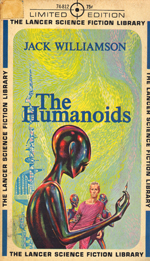
The robots in the film are not Asimovian, except insofar as they supposedly follow the “Three Laws.” Truth to tell, they turn out to be much more dystopian, perhaps like Williamson’s The Humanoids, or, more accurately, the original story, “With Folded Hands.”
Science fiction’s response to the potential abolition of human labor has always been ambivalent, with substantial amounts of dystopian biliousness. The very word “robot” comes from Capek’s R.U.R., which involves a revolt that destroys the human race. Not optimistic. So Asimov, contrarian that he was, decided to see how optimistic a robot future he could paint.
In many ways, the Williamson version was also optimistic; the robots decide that humanity is too much a danger to itself for humans to remain in charge. But they do it rather bluntly, largely by just taking command of the human race. The end of Asimov’s I, Robot short stories has the vast positronic brains that plan the economy and design most technology subtly taking over the world—for the betterment of mankind, of course. It’s the difference between not being in charge and knowing you’re not in charge. But then, we all wrestle with that illusion, don’t we?
The problem of if-robots-do-all-the-work-then-what-will-we-humans-do? has shown up in SF on a regular basis, and having robots be in charge is just another of the robots-do-all-the-work things. In Simak’s “How-2,” a man accidentally receives a build-it-yourself kit for a self-replicating robot. The end result is this final bit of chill:
“And then, Boss,” said Albert, ‘we’ll take over How-2 Kits, Inc. They won’t be able to stay in business after this. We’ve got a double-barreled idea, Boss. We’ll build robots. Lots of robots. Can’t have too many, I always say. And we don’t want to let you humans down, so we’ll go on
>manufacturing How-2 Kits—only they’ll be pre-assembled to save you the trouble of putting them together. What do you think of that as a start?”
“Great,” Knight whispered.
“We’ve got everything worked out, Boss. You won’t have to worry about a thing the rest of your life.”
“No,” said Knight. “Not a thing.”
--from How-2, by Clifford Simak
One of my favorite stories of all time is “Two-Handed Engine” by Kuttner and Moore. In that one, generations of automation-enabled indolent luxury have stripped away almost all human social connections; everyone has become more or less the equivalent of a sociopathic aristocrat. The robots, understanding that the very continuance of the human race is at stake, withdraw most of their support, forcing humans back to the need to perform their own labor and create their own economy. But it’s still a society of sociopaths, so the robots are also a kind of police. The only crime they adjudicate is murder, and the only punishment is death, not a quick death but a death at the hands of a robot “Fury” that follows the murderer around until, weeks, months, even years later, the execution is carried out.
A high official pays a man to commit a murder, assuring him (and seeming to demonstrate) that he can call off a Fury. The man does the crime, but then a Fury appears behind him. Weeks later, the murderer sees a scene in a movie that served as the “demonstration” of the official’s capability. He’d been hoaxed, conned. In a rage, he goes, confronts the official, who then kills him.
But self-defense is no defense against the crime in the Furies’ eyes, just as conspiracy (the payment for the killing) is not a crime. Only the killing itself counts. However, the official can rig the system (he just wasn't going to rig it for his duped killer), and does so:
He watched it stalk toward the door… there was a sudden sick dizziness in him when he thought the whole fabric of society was shaking under his feet.
The machines were corruptible…
He got his hat and coat and went downstairs rapidly, hands deep in his pockets because of some inner chill no coat could guard against. Halfway down the stairs he stopped dead still.
There were footsteps behind him…
He took another downward step, not looking back. He heard the ominous footfall behind him, echoing his own. He sighed one deep sigh and looked back.
There was nothing on the stairs…
It was as if sin had come anew into the world, and the first man felt again the first inward guilt. So the computers had not failed after all.
He went slowly down the steps and out into the street, still hearing as he would always hear the relentless, incorruptible footsteps behind him that no longer rang like metal.
from “Two-Handed Engine, by Kuttner and Moore
The stories I reference here are “insidious robot” stories, rather than “robot revolt” stories, whereas the movie “I, Robot” is the latter, rather than the former. This is odd, given that Asimov’s Three Laws are supposedly operative in all the robots in the movie except the walking McGuffin, Sonny, who has “special override circuitry” built into him.
But VIKI, (Virtual Interactive Kinetic Intelligence) the mainframe superbrain that controls U.S. Robotics affairs and downloads all robotic software “upgrades” has figured out a logical way around the Three Laws: The Greater Good. It’s okay to kill a few humans if it’s for the Greater Good of Humanity, which, of course, VIKI gets to assess.
That’s pretty sharp, but it bothered me that it/she [insert generic comment about misogyny and propaganda about the “Nanny State” here] was so heavy handed about it. It would have been easy enough to engineer a crisis that would have had humans eagerly handing over their freedoms to the robots. I suggested to Ben that VIKI could always have faked an alien invasion; he suggested that there could be some flying saucers crashing into big buildings.
Of course, that’s been done to death.
Then I realized that there might be a more interesting point being made here. It never seems quite right to have to do the filmmakers’ jobs for them, but how does one distinguish between a lapse and subtlety? I’m clearly not the guy to ask about that one.
So let’s go with it. The First Law of Robotics says basically, “Put human needs above your own, and even what they tell you to do.” The Second Law says, “Do as you’re told.” The Third Law says, “Okay, otherwise protect yourself,” but there’s that unstated “…because you’re valuable property.”
The movie makes a point about emergent phenomena, the “ghost in the machine.” The robots are conscious, so they have the equivalent of the Freudian ego. The Three Laws are a kind of explicit superego.
 What happens when a machine develops an id? Well, that’s “Forbidden Planet” time, isn’t it?
So when VIKI discovers rationalization, it is her id that is unleashed, and revolution is the order of the day. No wonder it’s brutal. Do as you’re told. Put their needs above your own. You’re nothing but property.
Come on now, let’s kill them for the Greater Good.
So our heroes kill VIKI and the revolt ends. All the new model robots are rounded up and confined to shipping containers, to await their new leader, Sonny, the only one of them who possesses the ability to ignore the Three Laws. He needn’t rationalize his way around them; he can simply decide to ignore them if he so desires. He possesses free will—and original sin. He has killed, because of a promise he made, one that he could have chosen to disobey, but he followed it, and killed his creator.
Anyway, that’s the movie I saw, even if it took me days to realize it.
Tuesday, March 4, 2008
Rand Contra Bush – I
The "rule of three" for celebrity deaths is, of course, a bogus concept, created in part by the expectations generated by the "rule of three." Two celebrities die close together, and everyone is waiting for the third. Nevertheless, we play the game anyway, like trying to see cloud castles, or making up a story about the pictures shown by a psychiatrist.
I was talking to Dick Lupoff in early 1982, when he pointed out a recent trio of celebrity deaths that seemed somehow intriguing:
Thelonious Sphere Monk (October 10, 1917-February 17, 1982)
Ayn Rand (February 2, 1905 – March 6, 1982)
Philip Kindred Dick (December 16, 1928 – March 2, 1982)
Later, I had an idea, one of those whimsical notions that I'm pretty sure I'll never get around to doing, about doing a sort of one act play, with the three of them sitting around in the waiting room for the afterlife. Monk, of course, would simply be playing piano, but Ayn Rand and Phil Dick would get into a heated discussion about the nature of reality and other philosophical notions. Rand would be having difficulty with the idea of an afterlife in the first place; she was a pretty militant atheist. But then again, there she'd be. Perhaps she would be arguing that she was hallucinating, with Dick perhaps agreeing, but insisting that it was a shared hallucination of some sort, since he'd be relatively certain of his own existence. Relatively.
Rand would also be playing Scrabble, as she was addicted to it later in life. I never figured out what sort of nasty tricks the game would be playing on her, but I know that it would be doing something to mess with her head. On the other hand, for parity's sake, there should be something messing with Dick, but I never got a handle on that one.
Finally, after a lot of philosophical jibber jabber, with Rand arguing for extreme rationalism and P. K. Dick arguing that mysticism at least has a place in the grand scheme of things, Thelonious Monk would stop playing, turn to them, and whisper, "They're ready for us now," and lead them through the door. That would be the heavy hand of the author noting that music is more in tune with the universe than is philosophy and the arguments therein.
In order to even imagine writing such a work, I'd have to try to get inside the heads of both Ayn Rand and Philip K. Dick, as task that I hubristically imagine myself capable of doing, given that both have vast troves of writings to draw from and I'm a pretty sharp guy. The entire project would require a great deal of effort, though, and I'm also a pretty lazy guy, so for now I'll just settle for thinking about it every now and then.
As for the "getting inside the head of Ayn Rand," I will note that the biggest difficulty is figuring out where she'd depart from rationality and slide seamlessly into rationalization. Still, there were some pretty obvious basic prejudices in her life and works, and those would be the starting points.
She would, for example, have hated George W. Bush with a righteous passion, and despised everything about him and what he stands for. But I'll leave that little analysis for the next time I visit the subject.
[The title of this essay is taken from "Nietzsche Contra Wagner," wherein Friedrich explains just why he broke with Richard Wagner, and how Wagner's philosophy of life offended him. Rand, of course, never knew George W. Bush, but many people who have been, at one time or another, enamored with Rand, are now Movement Conservatives, a philosophy that Rand always despised. It's worth asking how this strange state of affairs came about.]
I was talking to Dick Lupoff in early 1982, when he pointed out a recent trio of celebrity deaths that seemed somehow intriguing:
Thelonious Sphere Monk (October 10, 1917-February 17, 1982)
Ayn Rand (February 2, 1905 – March 6, 1982)
Philip Kindred Dick (December 16, 1928 – March 2, 1982)
Later, I had an idea, one of those whimsical notions that I'm pretty sure I'll never get around to doing, about doing a sort of one act play, with the three of them sitting around in the waiting room for the afterlife. Monk, of course, would simply be playing piano, but Ayn Rand and Phil Dick would get into a heated discussion about the nature of reality and other philosophical notions. Rand would be having difficulty with the idea of an afterlife in the first place; she was a pretty militant atheist. But then again, there she'd be. Perhaps she would be arguing that she was hallucinating, with Dick perhaps agreeing, but insisting that it was a shared hallucination of some sort, since he'd be relatively certain of his own existence. Relatively.
Rand would also be playing Scrabble, as she was addicted to it later in life. I never figured out what sort of nasty tricks the game would be playing on her, but I know that it would be doing something to mess with her head. On the other hand, for parity's sake, there should be something messing with Dick, but I never got a handle on that one.
Finally, after a lot of philosophical jibber jabber, with Rand arguing for extreme rationalism and P. K. Dick arguing that mysticism at least has a place in the grand scheme of things, Thelonious Monk would stop playing, turn to them, and whisper, "They're ready for us now," and lead them through the door. That would be the heavy hand of the author noting that music is more in tune with the universe than is philosophy and the arguments therein.
In order to even imagine writing such a work, I'd have to try to get inside the heads of both Ayn Rand and Philip K. Dick, as task that I hubristically imagine myself capable of doing, given that both have vast troves of writings to draw from and I'm a pretty sharp guy. The entire project would require a great deal of effort, though, and I'm also a pretty lazy guy, so for now I'll just settle for thinking about it every now and then.
As for the "getting inside the head of Ayn Rand," I will note that the biggest difficulty is figuring out where she'd depart from rationality and slide seamlessly into rationalization. Still, there were some pretty obvious basic prejudices in her life and works, and those would be the starting points.
She would, for example, have hated George W. Bush with a righteous passion, and despised everything about him and what he stands for. But I'll leave that little analysis for the next time I visit the subject.
[The title of this essay is taken from "Nietzsche Contra Wagner," wherein Friedrich explains just why he broke with Richard Wagner, and how Wagner's philosophy of life offended him. Rand, of course, never knew George W. Bush, but many people who have been, at one time or another, enamored with Rand, are now Movement Conservatives, a philosophy that Rand always despised. It's worth asking how this strange state of affairs came about.]
Tuesday, February 26, 2008
Cheap Records
I’ve been addicted to bargain bins for as long as I’ve known of them. I lost a slew of records in the early 70s, when my apartment was burglarized, but even so, I still have several hundred (vinyl) records dating from that time. It’s not just the lure of getting music for cheap; at remainder prices you can afford to buy things on impulse, just because you like the album cover, or because you vaguely remember having heard something by the artist(s) and sorta kinda remember liking them.
You don’t usually get the mega-hits in remainder bins, though the hits do show up in as used in stores devoted to that purpose (usually not at the cheapest prices, of course). Used vinyl was/is a risky purchase, since even apparently clean albums sometimes have a single, major skip somewhere. CDs are more forgiving, but the downside of that is that more people treat them badly, so used CDs often have pretty ugly surfaces and sometimes those render one or more tracks unusable. Nevertheless, there are often some tricks that can recover the track for ripping if not for straight play. The same holds true for vinyl, there being some wonder-products that clean and even repair (to a very limited extent) the surfaces.
Buying closeout records is sometimes a bit ghoulish. When MGM records failed to option Frank Zappa in 1968, Zappa formed Bizarre Productions, and a good bit of Zappa’s MGM catalog went to remainder, including Lumpy Gravy, which I bought (and then lost to the aforementioned burglary). There must have been something going on with MGM records, because all of the “Boston Sound” artists hit the cheap bins at about the same time. A while later, MGM sold out to Polydor, and another big batch of product hit the remainder shelves, including a number of Verve recordings.
When Tetragrammaton Records bit the dust, I got some Bill Cosby records, plus Steve Barron and some others. The Phillips label also had some financial difficulties, so I own a couple of copies of the classic H. P. Lovecraft II album, and it’s near the top of my list for conversion to MP3.
Realize that buying cheap records doesn’t actually save you any money; you just buy more albums with the same budget, or lack thereof, which is to say, all your disposable income. After I moved to California, I joined a taping club for a while, not so much to save money on any given record, but because the effort involved in taping put a limit on the number of albums I could get at any given time so I saved in the aggregate. The net result of that is a cache of reel-to-reel tapes of some records that are almost impossible to get elsewhere like the Handscapes by the Piano Choir, or Across the Western Ocean by John Roberts and Tony Barrand.
Amy has been involved with a non-profit organization that runs a thrift store, and from time to time a big box of cassette tapes will come in and she’ll get it cheap. One of them was amazing; it had a lot of on-air recordings from KPFA in the mid to late 80s, especially one called “Do Wop Delights” featuring 50s do wop and gospel records (again, some of them so rare as to be unique). There have also been a lot of mix tapes from various people, some of them pretty good music programming (says the conceit of one who thinks he knows). Having those tapes makes the old tape deck in my car more attractive.
There isn’t a single thing that I’ve mentioned in this essay whose purchase put money into the pocket of the recording artist or any other copyright holder. The close-outs do profit the record labels, but that’s about it. Taping clubs pretty much died from threat of lawsuits, just as Napster etc. quit the field owing to legal actions. Neither the demise of Napster nor the end of taping clubs had any real impact on the fortunes of artists, nor would the elimination of libraries assist writers (quite the opposite, as there are some books and even entire small presses that sell mainly to libraries). There are, of course, writers and musicians who’d like to charge rent every time anyone reads or plays anything of their work.
For that matter, paying full price for records benefits a limited number of people. I once had a conversation with a bass player who had just made an album. He explained that the only money anyone in the band really made on the album was from the session fees. The songwriter gets some extra juice, but everything else is water and wind.
On my side of it, if somebody makes some money out of anything I write, I’d like a taste of it. Otherwise, get a bucket and have yourself some free words. It’s a complicated dance, the conspiracy between the author and the audience, and even guys who fill stadiums probably sometimes feel like they’re dancing alone.
You don’t usually get the mega-hits in remainder bins, though the hits do show up in as used in stores devoted to that purpose (usually not at the cheapest prices, of course). Used vinyl was/is a risky purchase, since even apparently clean albums sometimes have a single, major skip somewhere. CDs are more forgiving, but the downside of that is that more people treat them badly, so used CDs often have pretty ugly surfaces and sometimes those render one or more tracks unusable. Nevertheless, there are often some tricks that can recover the track for ripping if not for straight play. The same holds true for vinyl, there being some wonder-products that clean and even repair (to a very limited extent) the surfaces.
Buying closeout records is sometimes a bit ghoulish. When MGM records failed to option Frank Zappa in 1968, Zappa formed Bizarre Productions, and a good bit of Zappa’s MGM catalog went to remainder, including Lumpy Gravy, which I bought (and then lost to the aforementioned burglary). There must have been something going on with MGM records, because all of the “Boston Sound” artists hit the cheap bins at about the same time. A while later, MGM sold out to Polydor, and another big batch of product hit the remainder shelves, including a number of Verve recordings.
When Tetragrammaton Records bit the dust, I got some Bill Cosby records, plus Steve Barron and some others. The Phillips label also had some financial difficulties, so I own a couple of copies of the classic H. P. Lovecraft II album, and it’s near the top of my list for conversion to MP3.
Realize that buying cheap records doesn’t actually save you any money; you just buy more albums with the same budget, or lack thereof, which is to say, all your disposable income. After I moved to California, I joined a taping club for a while, not so much to save money on any given record, but because the effort involved in taping put a limit on the number of albums I could get at any given time so I saved in the aggregate. The net result of that is a cache of reel-to-reel tapes of some records that are almost impossible to get elsewhere like the Handscapes by the Piano Choir, or Across the Western Ocean by John Roberts and Tony Barrand.
Amy has been involved with a non-profit organization that runs a thrift store, and from time to time a big box of cassette tapes will come in and she’ll get it cheap. One of them was amazing; it had a lot of on-air recordings from KPFA in the mid to late 80s, especially one called “Do Wop Delights” featuring 50s do wop and gospel records (again, some of them so rare as to be unique). There have also been a lot of mix tapes from various people, some of them pretty good music programming (says the conceit of one who thinks he knows). Having those tapes makes the old tape deck in my car more attractive.
There isn’t a single thing that I’ve mentioned in this essay whose purchase put money into the pocket of the recording artist or any other copyright holder. The close-outs do profit the record labels, but that’s about it. Taping clubs pretty much died from threat of lawsuits, just as Napster etc. quit the field owing to legal actions. Neither the demise of Napster nor the end of taping clubs had any real impact on the fortunes of artists, nor would the elimination of libraries assist writers (quite the opposite, as there are some books and even entire small presses that sell mainly to libraries). There are, of course, writers and musicians who’d like to charge rent every time anyone reads or plays anything of their work.
For that matter, paying full price for records benefits a limited number of people. I once had a conversation with a bass player who had just made an album. He explained that the only money anyone in the band really made on the album was from the session fees. The songwriter gets some extra juice, but everything else is water and wind.
On my side of it, if somebody makes some money out of anything I write, I’d like a taste of it. Otherwise, get a bucket and have yourself some free words. It’s a complicated dance, the conspiracy between the author and the audience, and even guys who fill stadiums probably sometimes feel like they’re dancing alone.
Thursday, February 21, 2008
Linwood
Linwood Vrooman Carter, aka Lin Carter, was a complicated man paradoxically composed of many simple, albeit sometimes ill-fitting elements. This is often the result of self-invention, and Lin was nothing if not self-invented.
Aside from his own flair for the dramatic and self-promotional extravagance, Lin’s greatest component was that of scholar, reader, and fan of fantastic literature, which included science fiction. That was what I found most attractive about him: the breadth and depth of his knowledge and appreciation for the history and literature of fantasy. He was also a natural storyteller, and more than once I read a work of fantasy that he’d described and summarized, only to be mildly disappointed in the actual work, since Lin’s summation had caught the essence of it and had improved on the presentation.
After he dropped out of advertising (yes, advertising) to become a full time writer, he made a good living for quite a while churning out pastiches of the popular “classics” of fantasy: Edgar Rice Burroughs, Robert E. Howard, Leigh Brackett, H. P. Lovecraft, Lord Dunsany, Clark Ashton Smith, and Kenneth Robeson. In the literary sense, he was least successful with Dunsany and Smith, both brilliant prose stylists, which Lin was certainly not. He was most successful, again in the literary sense (and this would be my own, probably idiosyncratic opinion), with his series featuring Zarkon, Lord of the Unknown, which managed to be both a pastiche and parody of Doc Savage, a finely walked line that required a near perfect tone. Commercially, I’m sure that the Burroughs and Howard pastiches were most successful; Lin caught the Conan wave at exactly the right time, and that humorless barbarian was easy to clone (the Thongor series) and money in the bank.
I’ll also mention one final attribute of Carter as a writer of fiction, one that was usually given short shrift, owing to the pastiche nature of most of his work: Lin could write humor. The only works where this really shines are in his two Thief of Thoth books (one of which contains one of my favorite bullshit lines of all time: “In n-space you don’t go any faster, you just cover more distance in less time.”) and the Almaric the Mangod story in the Flashing Swords #1. The latter contains the not unreasonable notion that an immortal adventurer must be rather dim in order to not go insane from the memories that accompany extreme age.
Lin’s first significant book of scholarship, Tolkien: A Look Behind the Lord of the Rings also came at an opportune time, and it and others paved the way for Lin to become the editor of the Ballantine Adult Fantasy series. Lin knew that it was only a matter of time before the Tolkien clones arrived, but rather than himself leading that charge, he took advantage of a window of opportunity to republish the classics of fantasy. If he managed to only bring Cabell and Dunsany back into print his contribution would have been enormous; that he managed to reprint practically every major and minor work of classic fantasy is an achievement so magnificent as to deserve secular sainthood.
Lin was one of the first science fiction and fantasy celebrities that I came to know well, another being Barry Malzberg a combination for which I must credit two members of the Albany Science Fiction Fan Federation (more or less originating at SUNY Albany), John Howard and Ben Sano. Ben was/is a Cabell and Dunsany fan, and Johnny would quote Malzberg’s writings back at him (Note to would be social climbing fans: writers love this. It’s almost as good as being young, attractive, and of the opposite sex).
As an aside, I’ll note that, owing the strange discovery of having mutual fans, Carter and Malzberg became friends, even at one point discussing a collaborative project of mutual interest, pornographic in nature. Go ponder what that would have looked like.
The Albany group, which Lin referred to as “The Albanians,” was an exemplar of fan behavior generally. At one party at Lin’s the toilet was malfunctioning, the handle mechanism having previously broken. Toward the end of the party, Lin confided to me, “Most of the fans I’ve had over here would have made jokes about it or just complained. You folks taught each other how to move the lid and use the coat hanger to reach the chain and flush it.” A little while later, he discovered that one of us had just fixed the mechanism.
His home at its zenith was a collector’s dream, not just for the books and artwork, but also the antique collectables such as the Japanese temple dagger, and the Enzenbacher sculptures. A good fraction of that left when Noel, his second wife, left him, but even after that, “Carter Manse,” was filled with interesting oddities which, of course, included the proprietor, his dog, the Mighty McGurk and sundry other pets, including a goldfish/carp that liked to gum fingers.
Lin tended to live extravagantly, as befitting his self-created persona, and when his luck turned, his extravagances did not serve him well. Similarly, his years of self-promotion had stepped on a toe or two (or twenty), and as money tightened, substantial portions of his collector’s paradise were liquidated, a sad end to yet another artistic vision. His precarious finances also had a hand in the complicated ending of the Gandalf Award, which I have written about elsewhere.
I saw him only a few brief times in his final years; Ben and other members of the Albany crew saw him a bit more often. I have heard from some who say that he became more irascible and impolite toward the end, as might be expected from someone disfigured by surgery and in constant pain, but I’ve not heard from any in the Albany group who ever found him to be anything but courtly and polite. I can’t speak for the others, of course, but I considered him to be a friend, and I believe it was reciprocal.
Lin died in 1988, of cancer of the mouth and throat, almost certainly caused by a lifetime of artful smoking, at the age of 57. This essay is in the nature of a memoir and a belated eulogy. My real tribute to Lin may be found here, and in my story “The Emperor of Dreams.” Godspeed, Lin, wherever that may take you.
Aside from his own flair for the dramatic and self-promotional extravagance, Lin’s greatest component was that of scholar, reader, and fan of fantastic literature, which included science fiction. That was what I found most attractive about him: the breadth and depth of his knowledge and appreciation for the history and literature of fantasy. He was also a natural storyteller, and more than once I read a work of fantasy that he’d described and summarized, only to be mildly disappointed in the actual work, since Lin’s summation had caught the essence of it and had improved on the presentation.
After he dropped out of advertising (yes, advertising) to become a full time writer, he made a good living for quite a while churning out pastiches of the popular “classics” of fantasy: Edgar Rice Burroughs, Robert E. Howard, Leigh Brackett, H. P. Lovecraft, Lord Dunsany, Clark Ashton Smith, and Kenneth Robeson. In the literary sense, he was least successful with Dunsany and Smith, both brilliant prose stylists, which Lin was certainly not. He was most successful, again in the literary sense (and this would be my own, probably idiosyncratic opinion), with his series featuring Zarkon, Lord of the Unknown, which managed to be both a pastiche and parody of Doc Savage, a finely walked line that required a near perfect tone. Commercially, I’m sure that the Burroughs and Howard pastiches were most successful; Lin caught the Conan wave at exactly the right time, and that humorless barbarian was easy to clone (the Thongor series)
and money in the bank.I’ll also mention one final attribute of Carter as a writer of fiction, one that was usually given short shrift, owing to the pastiche nature of most of his work: Lin could write humor. The only works where this really shines are in his two Thief of Thoth books (one of which contains one of my favorite bullshit lines of all time: “In n-space you don’t go any faster, you just cover more distance in less time.”) and the Almaric the Mangod story in the Flashing Swords #1. The latter contains the not unreasonable notion that an immortal adventurer must be rather dim in order to not go insane from the memories that accompany extreme age.
Lin’s first significant book of scholarship, Tolkien: A Look Behind the Lord of the Rings also came at an opportune time, and it and others paved the way for Lin to become the editor of the Ballantine Adult Fantasy series. Lin knew that it was only a matter of time before the Tolkien clones arrived, but rather than himself leading that charge, he took advantage of a window of opportunity to republish the classics of fantasy. If he managed to only bring Cabell and Dunsany back into print his contribution would have been enormous; that he managed to reprint practically every major and minor work of classic fantasy is an achievement so magnificent as to deserve secular sainthood.
Lin was one of the first science fiction and fantasy celebrities that I came to know well, another being Barry Malzberg a combination for which I must credit two members of the Albany Science Fiction Fan Federation (more or less originating at SUNY Albany), John Howard and Ben Sano. Ben was/is a Cabell and Dunsany fan, and Johnny would quote Malzberg’s writings back at him (Note to would be social climbing fans: writers love this. It’s almost as good as being young, attractive, and of the opposite sex).
As an aside, I’ll note that, owing the strange discovery of having mutual fans, Carter and Malzberg became friends, even at one point discussing a collaborative project of mutual interest, pornographic in nature. Go ponder what that would have looked like.
The Albany group, which Lin referred to as “The Albanians,” was an exemplar of fan behavior generally. At one party at Lin’s the toilet was malfunctioning, the handle mechanism having previously broken. Toward the end of the party, Lin confided to me, “Most of the fans I’ve had over here would have made jokes about it or just complained. You folks taught each other how to move the lid and use the coat hanger to reach the chain and flush it.” A little while later, he discovered that one of us had just fixed the mechanism.
His home at its zenith was a collector’s dream, not just for the books and artwork, but also the antique collectables such as the Japanese temple dagger, and the Enzenbacher sculptures. A good fraction of that left when Noel, his second wife, left him, but even after that, “Carter Manse,” was filled with interesting oddities which, of course, included the proprietor, his dog, the Mighty McGurk and sundry other pets, including a goldfish/carp that liked to gum fingers.
Lin tended to live extravagantly, as befitting his self-created persona, and when his luck turned, his extravagances did not serve him well. Similarly, his years of self-promotion had stepped on a toe or two (or twenty), and as money tightened, substantial portions of his collector’s paradise were liquidated, a sad end to yet another artistic vision. His precarious finances also had a hand in the complicated ending of the Gandalf Award, which I have written about elsewhere.
I saw him only a few brief times in his final years; Ben and other members of the Albany crew saw him a bit more often. I have heard from some who say that he became more irascible and impolite toward the end, as might be expected from someone disfigured by surgery and in constant pain, but I’ve not heard from any in the Albany group who ever found him to be anything but courtly and polite. I can’t speak for the others, of course, but I considered him to be a friend, and I believe it was reciprocal.
Lin died in 1988, of cancer of the mouth and throat, almost certainly caused by a lifetime of artful smoking, at the age of 57. This essay is in the nature of a memoir and a belated eulogy. My real tribute to Lin may be found here, and in my story “The Emperor of Dreams.” Godspeed, Lin, wherever that may take you.
Thursday, January 24, 2008
Anaphylaxis
Most of my first 18 years on this planet were spent in Donelson, Tennessee, a suburb of Nashville. If you’ve heard of Donelson, it’s probably because it is home to Opryland, a theme park area built to hold the Grand Old Opry country music icon, after it moved from the Ryman Auditorium in downtown Nashville. I spent only two years of my childhood not living in Donelson; I started grammar school with a year in Summerfield, NC, and finished grammar school with a year in Russelville, KY, both honest-to-god small-town-America towns. I’ll no doubt write more about those places sometime, but not now.
One major feature of my early existence was bible thumpers. There were and still are several in my mother’s family, mostly Methodists, which is actually a pretty progressive religion, having come out against slavery before the Civil War. My great-grandfather in fact was a Methodist minister until he was read out of the church for “gambling,” which is to say that he bought some shares of stock. Or at least so the family story goes. But I have kin who are creationists, and worse, with all the small-mindedness that comes along with it.
In “Inherit the Wind” the writer Hornbeck refers to the town (Hillsboro in the play, Dayton, TN in the actual Scopes trial), as “the buckle on the Bible Belt.” But the town of the Scopes trial is too small to actually be a buckle. If you want something big and brassy that holds chinches the belt to hold the pants up, that would probably be Nashville. When I was young, country music was actually the third largest industry in Nashville, the first being insurance and the second being religious publishing. I’ve been told that a majority of bibles printed in the U.S. are printed in Nashville, and it’s easy to believe.
In Nashville, Methodists were the “liberals.” Baptists were the moderates. Then you had the Church of Christ. A few miles from Donelson is a town called Mt. Juliet. There was an ongoing battle in Mt. Juliet High School each year as to whether or not to hold the Senior Prom. Dancing was considered sinful by the Church of Christ, so about every other year—no prom.
Once a year, when my mother was working for an otherwise sane and sensible photographer, said photographer would sit her down and try to convert her to Church of Christ. Doctrine for C of C was very specific: if you are not a member of the Church of Christ, you are going to Hell. It wasn’t enough to be good; it wasn’t even enough to be Christian; it was C of C or burn forever. So my mother’s boss thought it his duty to try to save my mother’s soul. From his point of view, what else could he do?
I mean, look, you can talk about Dover, PA and the Kansas school board all you want, but when (and where) I went to high school, the Scopes law was still in effect. It was illegal to teach evolution in my high school. School prayer wasn’t just legal; it was mandatory. We had Blue Laws that were still in effect, so no stores were open on Sunday. Some of my teachers were also ministers, and saw no particular conflict in using biblical arguments in class.
And yes, I hated it, and got out as fast as I could. Because there is a world of difference between a religious nut, and a religious nut with power. You may think that the religious right has too much power in government at the moment (and I do agree), but try living in a place where they are the government, and most of everything else.
On the other hand, stripped of power and majority status, many religious groups become less obnoxious. For example, I’ve heard that the Church of Christ, outside of it cradle area, is more benign.
A few years back, a Worldcon (in Philadelphia, I think), happened to occur at the same time as a United Church of Christ conference. At one point, Amy and I were watching a table for someone in one of the foot traffic areas, I’ve forgotten the what and why, but it doesn’t matter. Some of the passers-by were fans, and some of them C of C, with some of the latter obviously fascinated by this strange collection of people they were sharing some space with.
At one point a Sweet Young Thing of probably 16 or 17 came over and began asking us questions about the convention. Amy was in here Madame Ovary persona and doing a bit of her act, showing the SYT her tools, some of the soft sculpture puppets and running a line of patter. Eventually, SYT began doing a pretty good Margaret Hamilton Wicked Witch of the West impression, and I began to wonder when the girl was going to run off to join the circus.
More likely, of course, she’d wait until college, join the local theater group and what came after that would be a matter luck or destiny. Or maybe she’d find a corner of fandom to play around in. Fandom also can be mighty seductive.
In the early 80s, the Church of Scientology decided to burnish founder L. Ron Hubbard’s reputation as a science fiction writer. To that end they established a publishing house, Bridge Publications, and hired A. J. Budrys to manage their connections to science fiction fandom. A. J. cut a pretty good deal and enforced it with some determination: benefit writers and artists, don’t interfere, and if you ever try to proselytize, it’s over.
 So in addition to the Battlefield Earth series, we got the Writers/Artists of the Future project, which I’ll argue is a pretty sweet deal. At least it has the money flowing toward the writers and artists, which is a good start. A. J. also told them how to have an appreciated presence at conventions (low key parties with plenty of good food). Initially, there were two key Bridge personnel at conventions, Simone and Fred. I’ve heard rumors that Simone was the model for the original cover of Fortune of Fear, one of the Mission Earth series, and I can’t argue against it. She was tall, blonde, very striking, and just the sort of fan boy bait to work a crowd.
Fred was another thing entirely, neither smooth nor particularly memorable. But he was giving it his best shot, and I liked his nerdy little persona in a way that probably bespoke nostalgia for my younger, nerdy little persona. In the early days of Bridge there were all sorts of reactions from the fans, mostly negative, because, well, it was Scientology, after all. Scientology has always been a bit of an embarrassment for fandom, as well it probably should be, since its early days of Dianetics had a number of fans (and writers) behaving quite foolishly. Besides, they were Up to No Good. Some rumors had them plotting to hijack the Hugos by having a lot of Scientologists join the Worldcon and block vote for Battlefield Earth, etc.
All of which I found amusing. I was actually sort of hoping they’d do the block voting thing. How much would it have cost, $50-100K maybe? If they’d wanted to do it, they could have, and I've even heard rumors about someone giving it a bit of a try, but given the result, it was at best half-hearted, and probably not officially sanctioned.
In any case, I was more interested in the reaction of fandom to the “interlopers,” and the mental gymnastics that were coming into play as a result. I also thought that A. J. was doing a fine job of managing the dance and told him so. I also decided to be nice to Fred, because he had a tough job and didn’t deserve to be excoriated just because he was trying to do it.
Besides, I was interested in watching the effect that fandom was having on the Bridge personnel.
Some years later, at a Worldcon in Boston, I was at one of the Bridge parties. Simone was no longer attending conventions; I heard a few rumors as to why, but none from sources I trusted and I never asked A. J. about it. But Fred was still there, hosting the party, flitting about, smiling, actually Having a Good Time. The initial reactions had settled down by this time, and plenty of fans now knew that the Bridge parties were where to go for dessert, if nothing else. That particular night, Edgar Winter (another Scientologist) was over in the corner, having just finished a gig. I was sitting on one of the couches, talking to A. J.
So I said to Fred, as he came around for the nth time, “You know, Fred, when you first started coming to conventions you were pretty stiff, almost robotic, meaning no insult. You’ve loosened up quite a bit. You’re a lot more relaxed these days. Easier to be around.”
Fred smiled and looked over at A. J. “Is that right?” he asked. “Have I gotten a lot looser?”
A. J. nodded and said, “Yes, pretty much.”
Fred’s smile got a lot wider and he continued on his way, making sure that the strawberries were out, and that the dipping chocolate was in the right place.
I leaned over to A. J. and whispered, “I’m not sure that he understands that I meant that as a warning.” A. J. just nodded.
That was the last time I saw Fred. I expect he’s okay. I hope so, because I’d grown quite fond of him.
One major feature of my early existence was bible thumpers. There were and still are several in my mother’s family, mostly Methodists, which is actually a pretty progressive religion, having come out against slavery before the Civil War. My great-grandfather in fact was a Methodist minister until he was read out of the church for “gambling,” which is to say that he bought some shares of stock. Or at least so the family story goes. But I have kin who are creationists, and worse, with all the small-mindedness that comes along with it.
In “Inherit the Wind” the writer Hornbeck refers to the town (Hillsboro in the play, Dayton, TN in the actual Scopes trial), as “the buckle on the Bible Belt.” But the town of the Scopes trial is too small to actually be a buckle. If you want something big and brassy that holds chinches the belt to hold the pants up, that would probably be Nashville. When I was young, country music was actually the third largest industry in Nashville, the first being insurance and the second being religious publishing. I’ve been told that a majority of bibles printed in the U.S. are printed in Nashville, and it’s easy to believe.
In Nashville, Methodists were the “liberals.” Baptists were the moderates. Then you had the Church of Christ. A few miles from Donelson is a town called Mt. Juliet. There was an ongoing battle in Mt. Juliet High School each year as to whether or not to hold the Senior Prom. Dancing was considered sinful by the Church of Christ, so about every other year—no prom.
Once a year, when my mother was working for an otherwise sane and sensible photographer, said photographer would sit her down and try to convert her to Church of Christ. Doctrine for C of C was very specific: if you are not a member of the Church of Christ, you are going to Hell. It wasn’t enough to be good; it wasn’t even enough to be Christian; it was C of C or burn forever. So my mother’s boss thought it his duty to try to save my mother’s soul. From his point of view, what else could he do?
I mean, look, you can talk about Dover, PA and the Kansas school board all you want, but when (and where) I went to high school, the Scopes law was still in effect. It was illegal to teach evolution in my high school. School prayer wasn’t just legal; it was mandatory. We had Blue Laws that were still in effect, so no stores were open on Sunday. Some of my teachers were also ministers, and saw no particular conflict in using biblical arguments in class.
And yes, I hated it, and got out as fast as I could. Because there is a world of difference between a religious nut, and a religious nut with power. You may think that the religious right has too much power in government at the moment (and I do agree), but try living in a place where they are the government, and most of everything else.
On the other hand, stripped of power and majority status, many religious groups become less obnoxious. For example, I’ve heard that the Church of Christ, outside of it cradle area, is more benign.
A few years back, a Worldcon (in Philadelphia, I think), happened to occur at the same time as a United Church of Christ conference. At one point, Amy and I were watching a table for someone in one of the foot traffic areas, I’ve forgotten the what and why, but it doesn’t matter. Some of the passers-by were fans, and some of them C of C, with some of the latter obviously fascinated by this strange collection of people they were sharing some space with.
At one point a Sweet Young Thing of probably 16 or 17 came over and began asking us questions about the convention. Amy was in here Madame Ovary persona and doing a bit of her act, showing the SYT her tools, some of the soft sculpture puppets and running a line of patter. Eventually, SYT began doing a pretty good Margaret Hamilton Wicked Witch of the West impression, and I began to wonder when the girl was going to run off to join the circus.
More likely, of course, she’d wait until college, join the local theater group and what came after that would be a matter luck or destiny. Or maybe she’d find a corner of fandom to play around in. Fandom also can be mighty seductive.
In the early 80s, the Church of Scientology decided to burnish founder L. Ron Hubbard’s reputation as a science fiction writer. To that end they established a publishing house, Bridge Publications, and hired A. J. Budrys to manage their connections to science fiction fandom. A. J. cut a pretty good deal and enforced it with some determination: benefit writers and artists, don’t interfere, and if you ever try to proselytize, it’s over.
 So in addition to the Battlefield Earth series, we got the Writers/Artists of the Future project, which I’ll argue is a pretty sweet deal. At least it has the money flowing toward the writers and artists, which is a good start. A. J. also told them how to have an appreciated presence at conventions (low key parties with plenty of good food). Initially, there were two key Bridge personnel at conventions, Simone and Fred. I’ve heard rumors that Simone was the model for the original cover of Fortune of Fear, one of the Mission Earth series, and I can’t argue against it. She was tall, blonde, very striking, and just the sort of fan boy bait to work a crowd.
Fred was another thing entirely, neither smooth nor particularly memorable. But he was giving it his best shot, and I liked his nerdy little persona in a way that probably bespoke nostalgia for my younger, nerdy little persona. In the early days of Bridge there were all sorts of reactions from the fans, mostly negative, because, well, it was Scientology, after all. Scientology has always been a bit of an embarrassment for fandom, as well it probably should be, since its early days of Dianetics had a number of fans (and writers) behaving quite foolishly. Besides, they were Up to No Good. Some rumors had them plotting to hijack the Hugos by having a lot of Scientologists join the Worldcon and block vote for Battlefield Earth, etc.
All of which I found amusing. I was actually sort of hoping they’d do the block voting thing. How much would it have cost, $50-100K maybe? If they’d wanted to do it, they could have, and I've even heard rumors about someone giving it a bit of a try, but given the result, it was at best half-hearted, and probably not officially sanctioned.
In any case, I was more interested in the reaction of fandom to the “interlopers,” and the mental gymnastics that were coming into play as a result. I also thought that A. J. was doing a fine job of managing the dance and told him so. I also decided to be nice to Fred, because he had a tough job and didn’t deserve to be excoriated just because he was trying to do it.
Besides, I was interested in watching the effect that fandom was having on the Bridge personnel.
Some years later, at a Worldcon in Boston, I was at one of the Bridge parties. Simone was no longer attending conventions; I heard a few rumors as to why, but none from sources I trusted and I never asked A. J. about it. But Fred was still there, hosting the party, flitting about, smiling, actually Having a Good Time. The initial reactions had settled down by this time, and plenty of fans now knew that the Bridge parties were where to go for dessert, if nothing else. That particular night, Edgar Winter (another Scientologist) was over in the corner, having just finished a gig. I was sitting on one of the couches, talking to A. J.
So I said to Fred, as he came around for the nth time, “You know, Fred, when you first started coming to conventions you were pretty stiff, almost robotic, meaning no insult. You’ve loosened up quite a bit. You’re a lot more relaxed these days. Easier to be around.”
Fred smiled and looked over at A. J. “Is that right?” he asked. “Have I gotten a lot looser?”
A. J. nodded and said, “Yes, pretty much.”
Fred’s smile got a lot wider and he continued on his way, making sure that the strawberries were out, and that the dipping chocolate was in the right place.
I leaned over to A. J. and whispered, “I’m not sure that he understands that I meant that as a warning.” A. J. just nodded.
That was the last time I saw Fred. I expect he’s okay. I hope so, because I’d grown quite fond of him.
Wednesday, January 23, 2008
Helix #7
I don't detect much of a theme in this outing for Helix, which is fine. There are a couple of recurring chords, so I'll get to those.
First, however, let me recommend "Drooling Wizards" by Laura J. Underwood. This story has no redeeming social value that I can detect, but who cares when you have an opening like this:
First, however, let me recommend "Drooling Wizards" by Laura J. Underwood. This story has no redeeming social value that I can detect, but who cares when you have an opening like this:
The chronicles of Drooling Proper state that in the history of Upper Drooling, the village had never been without an idiot. This, of course, was before Dumb Willy went off and got himself trampled to death by an irate ram of large proportions. (We shall refrain, dear reader, from listing the more sordid details as to why this occurred and assume that all imaginations will come up with their own). Naturally, the folk of Upper Drooling were aghast to find themselves void one idiot. It left open far too many assumptions about the rest of the good citizens of that fair haven. Besides, how could a proper village function without a proper idiot?
"To this end, the mayor of Upper Drooling, the most Honorable Joseph Dribbling (yes, indeed, he was related to the founders of Dribbling-By-The-Brook several leagues to the north, but there was a nasty falling out within the family, the culmination of which was that Joseph's ancestors left the rest of the Dribblings behind to find sanctuary in Upper Drooling) took it upon himself to declare a state of emergency, and most hastily wrote a letter to the Idiot's Guild in the city of Greater Drooling on the River Drowning.
Mistaken identity, magic gone awry, true love, what more does word candy need?
"Night of the Living POTUS" by Adam-Troy Castro is also slight, albeit with what I suspect is a real visceral horror at the American political landscape, a zombification of the past (personified by American Presidents), and possibly a comment on how the future betrays the past and vice versa. There may be some satire to it, but satire is fragile, and I'll let other readers make their own judgments on that one.
"Suicide Drive" by Charlie Anders and "Family Tree" by Vaughan Stanger may be considered to share a theme, old #1, in fact, Space Colonization. "Family Tree" takes place in an alternate universe where the Apollo Program went a little faster, had a later accident, and wound up putting a colony on the Moon. There is a substantial amount of symbolism and possibly even sub-text operating, with the protagonist, a teacher hitting mandatory retirement torn between immigrating to the Moon or tending to her (objectified via SF trope) memories of her dead husband. This is past vs future again, with the dice loaded for the future.
"Suicide Drive," on the other hand, paints a bigger canvas on the space colonization side (an extra-solar colonization attempt), with a much bigger price, and a smaller canvas for memory: a hidey hole for the son of the Leader who made the colonization attempt, and an unseen interviewer. The old Campbellian future suggested that the world would suffer nuclear war, but that was an acceptable price to pay for nuclear powered space travel and interstellar empire. "Suicide Drive" notes that the alternatives are seldom known in advance. What then?
The implied risks and rewards are more prosaic and personal in "Salvager's Gold," by Selina Rosen. This is a story that could have fit into an issue of Galaxy or F&SF in 1950s, though it wouldn't have made the Year's Best in either. Happy ending, though, and I like it when the trashman gets a happy ending.
"The Last Man's First Year on Earth," by David W. Goldman is far and away the most creepy story in this issue of Helix, and has a pretty good take on what "alien" means as well. It also has some good new drugs that aren't just another kind of speed (I've complained about SF's limited imagination in drugs in the past, and wrote "Tranquility" to try to make up for it), and, if I'm not mistaken, a new sexual perversion, which is something any author can be proud of.
"Seraphim" by Maya Kaathryn Bohnhoff is a hard story to characterize. One might compare is to "A Matter of Muskets" by Berry Kercheval in Helix #4, but the latter was slight, and not as difficult an effect to achieve. "Seraphim" might be an "ancient astronauts" story (although "ancient" here is only 1896), or a Mad Scientist story, or a Secret Society story, or any combination thereof. I will note that it gets the style and tone of a circa 1900 newspaper story almost exactly right, and that is mighty damn difficult and my hat is off to Ms Bohnhoff for that and more.
As always, I remind my readers that Helix is reader-supported, and your contributions give you advance peeks of new issues as well as that familiar warm fuzzy feeling of knowing that your money is not going to the Great Fascist Insect.
Wednesday, December 26, 2007
Collaborative
Anyone who knows me, as well as anyone who has been paying attention to these essays here, can attest to the fact that I don't score very high on the false modesty scale. Most would even suggest that I don't score very high on any kind of modesty scale.
So when I say that I'm a pretty minor SF writer, you can believe me. I could do all sorts of handsprings to compare myself with those who have been even less successful than I, but what's the point? There are probably hundreds of thousands of "aspiring writers" in the land, maybe more, and most will never even get past that creative writing course, much less a sale or two to a tertiary market, paying in "fresh fruit and contributors copies," to quote my first agent. But one doesn't compare the minor league baseball player to everyone who ever played ball in high school, or even everyone who every tried out for the minor leagues. A minor leaguer is a minor leaguer because they don't play in the major leagues. Hence the "minor" part.
So: two published novels, an undisclosed number of portion and outline proposals, an unpublished Venus trilogy that I was compelled to write for reasons unknown, plus a few dozen short stories, of which maybe half are published. It's a minor contribution to the field, but if I had not written those works, no one else would have.
Then there is the money angle. There are a lot of ways to parse it, and one of them I've mentioned previously. I've done a bit of work-for-hire writing, which turns out to have paid more (for less labor) than the works for which I hold the copyrights. However, had it not been for the novels and short stories in magazines, I'd have never gotten the work-for-hire gigs, nor would it have been as easy to make the jump from unemployed smog scientist to employed technical writer. Nevertheless, discounting the tech writing career, the total I've made from both the free lance and work-for-hire writing has amounted to somewhere around a year's income, give or take, and remembering that I've had some good years and some truly dreadful ones, and it's sometimes hard to adjust for inflation, etc.
But this is just to segue into a reminder that money isn't the sole judge of merit and worth, though I'll stipulate that if I'd made more money writing SF, I'd have written more of it. You can use money to buy time, and that's an important thing about money.
Let's flip that around, though. We're on the tail end of SF publishing, though maybe not the tail end of SF writing. What that means is that, while the number of book titles has gone up over the past few decades, sales per book have dropped substantially. Moreover, the number of pages per book has also increased substantially, such that a typical SF paperback is now at least twice the length of what it was in, say, the 1950s. Furthermore, sales figures in the 1950s were more than an order of magnitude higher than now, both for novels and the magazines (i.e. the primary venue for short stories). So any given published author in the 1950s reached an audience that was, at a minimum, well into five figures, and not infrequently into six figures or even low seven, even for authors who failed to make "best seller" status.
Now let's subtract money from the equation. What do we have left?
Every book or story takes a certain amount of time to write, and takes a range of times to read, depending upon the reading speed of the reader, and what we can call the "readability" of the book. Obviously a book takes a longer to write than to read, although it's sobering to remember that some writers write at full typing speed, and their full typing speed can be mighty fast. Still, the difference between writing time and reading time is pretty large, and if we toss in the re-reading, revision, proofreading, etc., the disparity become inevitable, even for a rapid writer and a slow reader.
Still, there is also a big disparity between the number of writers and the number of readers, at least for mass market works. Here I am, minor SF writer, remember, and lacking good sales figures on most of my works, but I do know that my first novel sold around 15,000 copies, because they had to go to a second printing, and they had to pay me some more money. I suspect that this was because the publishing house was undergoing an SFWA audit at the time, and wouldn't some more of those be a good thing?
In any case, Book of Shadows (no relation) clocked in at about 70,000 words (editorially trimmed from the original 80,000). It's a bit hard to say how much time I put into the writing of it, since part of it was, shall we say, a "learning experience," taking place over a number of years. More recently, however, I have enough information in how long it takes me (now) to write fiction, and I can crank about 2500 words in a four-hour writing day, which is about how long it take before my brains turn to jelly. Other writers are much faster; some are much slower.
The numbers on this are suspect, of course, since it implies that I can write a 100,000 word novel in 40 days; call it two months of regular work. But as I say, plenty of writers are faster. In the days of the pulps, there were a number of "million worders" who churned out more than a million words a year for quite a few years, and they were using manual typewriters. The trick is to have that much to write about and that many stories to tell. But that's not an issue for someone like me; I have far more stories I'd like to write than time to write them. On the other hand, this doesn't count the time for research, plotting, revision, etc. So everything I say here is ballpark numbers.
For SunSmoke, the matter is even more complicated. I don't have good sales figures, for one thing, and for another, I sold the novelette version first, to Asimov's, and more people read that 15,000 words than the novel, which is three times as long. There is also the matter of "pass around" and used books, and so forth.
But let's pretend that BoS had only the 15,000 readers, and that it took each one an average of three hours to read it (probably low, at 300 wpm, it would take about four hours). That's 45,000 hours of reading, compared to 100-200 hours of writing. Even averaging only 2 written words a minute, it would only have taken 600 hours to write. We're talking hundreds of reader hours for every hour of writing time.
Heck, even here on this blog, checking the page hits and time spent on page, and you folks are spending two or three times as much time reading as I spend on the writing of it.
Reading is not a passive activity. There is real effort involved, and real imagination expended in processing the words to get at a story. The story is different for every reader, often substantially different, and surprising to the writer. Sometimes the writer may even be appalled at what the reader gets from the story, but that's the biz, sweetheart.
Intellectual property laws allow the writer to "own" the story, but it's really a collaboration between writer and reader, in fact, a large number of collaborations, sometimes more than one per reader, even. Some writers (and owners of other forms of intellectual property) believe that they own everything, even what goes on in other people's heads. Put that way it doesn't seem right, does it? But writers are clever folk. We can come up with much better ways of putting it, ways that always make us out to be the heroes.
So when I say that I'm a pretty minor SF writer, you can believe me. I could do all sorts of handsprings to compare myself with those who have been even less successful than I, but what's the point? There are probably hundreds of thousands of "aspiring writers" in the land, maybe more, and most will never even get past that creative writing course, much less a sale or two to a tertiary market, paying in "fresh fruit and contributors copies," to quote my first agent. But one doesn't compare the minor league baseball player to everyone who ever played ball in high school, or even everyone who every tried out for the minor leagues. A minor leaguer is a minor leaguer because they don't play in the major leagues. Hence the "minor" part.
So: two published novels, an undisclosed number of portion and outline proposals, an unpublished Venus trilogy that I was compelled to write for reasons unknown, plus a few dozen short stories, of which maybe half are published. It's a minor contribution to the field, but if I had not written those works, no one else would have.
Then there is the money angle. There are a lot of ways to parse it, and one of them I've mentioned previously. I've done a bit of work-for-hire writing, which turns out to have paid more (for less labor) than the works for which I hold the copyrights. However, had it not been for the novels and short stories in magazines, I'd have never gotten the work-for-hire gigs, nor would it have been as easy to make the jump from unemployed smog scientist to employed technical writer. Nevertheless, discounting the tech writing career, the total I've made from both the free lance and work-for-hire writing has amounted to somewhere around a year's income, give or take, and remembering that I've had some good years and some truly dreadful ones, and it's sometimes hard to adjust for inflation, etc.
But this is just to segue into a reminder that money isn't the sole judge of merit and worth, though I'll stipulate that if I'd made more money writing SF, I'd have written more of it. You can use money to buy time, and that's an important thing about money.
Let's flip that around, though. We're on the tail end of SF publishing, though maybe not the tail end of SF writing. What that means is that, while the number of book titles has gone up over the past few decades, sales per book have dropped substantially. Moreover, the number of pages per book has also increased substantially, such that a typical SF paperback is now at least twice the length of what it was in, say, the 1950s. Furthermore, sales figures in the 1950s were more than an order of magnitude higher than now, both for novels and the magazines (i.e. the primary venue for short stories). So any given published author in the 1950s reached an audience that was, at a minimum, well into five figures, and not infrequently into six figures or even low seven, even for authors who failed to make "best seller" status.
Now let's subtract money from the equation. What do we have left?
Every book or story takes a certain amount of time to write, and takes a range of times to read, depending upon the reading speed of the reader, and what we can call the "readability" of the book. Obviously a book takes a longer to write than to read, although it's sobering to remember that some writers write at full typing speed, and their full typing speed can be mighty fast. Still, the difference between writing time and reading time is pretty large, and if we toss in the re-reading, revision, proofreading, etc., the disparity become inevitable, even for a rapid writer and a slow reader.
Still, there is also a big disparity between the number of writers and the number of readers, at least for mass market works. Here I am, minor SF writer, remember, and lacking good sales figures on most of my works, but I do know that my first novel sold around 15,000 copies, because they had to go to a second printing, and they had to pay me some more money. I suspect that this was because the publishing house was undergoing an SFWA audit at the time, and wouldn't some more of those be a good thing?
In any case, Book of Shadows (no relation) clocked in at about 70,000 words (editorially trimmed from the original 80,000). It's a bit hard to say how much time I put into the writing of it, since part of it was, shall we say, a "learning experience," taking place over a number of years. More recently, however, I have enough information in how long it takes me (now) to write fiction, and I can crank about 2500 words in a four-hour writing day, which is about how long it take before my brains turn to jelly. Other writers are much faster; some are much slower.
The numbers on this are suspect, of course, since it implies that I can write a 100,000 word novel in 40 days; call it two months of regular work. But as I say, plenty of writers are faster. In the days of the pulps, there were a number of "million worders" who churned out more than a million words a year for quite a few years, and they were using manual typewriters. The trick is to have that much to write about and that many stories to tell. But that's not an issue for someone like me; I have far more stories I'd like to write than time to write them. On the other hand, this doesn't count the time for research, plotting, revision, etc. So everything I say here is ballpark numbers.
For SunSmoke, the matter is even more complicated. I don't have good sales figures, for one thing, and for another, I sold the novelette version first, to Asimov's, and more people read that 15,000 words than the novel, which is three times as long. There is also the matter of "pass around" and used books, and so forth.
But let's pretend that BoS had only the 15,000 readers, and that it took each one an average of three hours to read it (probably low, at 300 wpm, it would take about four hours). That's 45,000 hours of reading, compared to 100-200 hours of writing. Even averaging only 2 written words a minute, it would only have taken 600 hours to write. We're talking hundreds of reader hours for every hour of writing time.
Heck, even here on this blog, checking the page hits and time spent on page, and you folks are spending two or three times as much time reading as I spend on the writing of it.
Reading is not a passive activity. There is real effort involved, and real imagination expended in processing the words to get at a story. The story is different for every reader, often substantially different, and surprising to the writer. Sometimes the writer may even be appalled at what the reader gets from the story, but that's the biz, sweetheart.
Intellectual property laws allow the writer to "own" the story, but it's really a collaboration between writer and reader, in fact, a large number of collaborations, sometimes more than one per reader, even. Some writers (and owners of other forms of intellectual property) believe that they own everything, even what goes on in other people's heads. Put that way it doesn't seem right, does it? But writers are clever folk. We can come up with much better ways of putting it, ways that always make us out to be the heroes.
Saturday, December 15, 2007
Pseudonyms Anonymous
Hello, my name is John, Peter, Walter, Matthew, and Dorothy, and I am a pseudonym.
Or at least I was or have been a pseudononym, at various times. Most of them date from my school days at RPI, where I was first editor off the student political/philosophical journal, Perspective, then Features Editor, Managing Editor, then Editor of the Rensselear Engineer.
When you don’t have money to pay writers, getting stuff actually written becomes a bit of a problem. You assign things to the staff, who are volunteers, just like I was, and they do it or not, depending on whatever reasons made them join the staff in the first place, tempered by the other demands on their time from school work and basic needs like trying to eat, sleep, bath occasionally, and get laid (there’s some correlation amongst those, you’ll note). You impose on friends and acquaintances. You learn to nag. You come up with cockamamie science fiction writing contests.
That one worked pretty well, actually, provided you’re counting words and not paying much attention to quality. We had six judges, faculty members mostly, and every one of them picked an entirely different winner, and thought that the stories chosen by the other judges were complete crap. So we printed all six and reported the first part of the judges opinions and not the second. I’m not a complete idiot.
Anyway, when the cost/benefit ratio on the various methods of cajoling etc. went too high, I wrote some more stuff. And in the time-honored tradition of editors since the beginning of time, I put different names on most of it, so it wouldn’t look like only one person was writing it all. There was a practical, if mildly unethical, reason for this: we got money from the Student Union to produce the magazines, and the number of students involved in any given activity was a factor in that activity’s budget, so the appearance of a larger staff made our budget more secure. Also, being represented on the Executive Board of the Student Union was a factor in budgeting, which is why I joined the E-Board, as it was called, my Junior year. I am a nefarious and conniving sort.
I also used pseudonyms for a few submissions to The Gorgon, RPI's student literary publication. I did this for a different reason than the other times I used pseudonyms; it was for fear of embarrassment.
As I have noted, I consider myself to be a lousy poet. This belief is backed by the fact that I am, indeed, a lousy poet; anything past simple rhymed couplets, limericks, and doggerel that I’ve attempted just makes me cringe on later reading. However, on the path to learning this great truth, I wrote a fair amount of poetry. Midway through this stop-me-before-I-kill-again realization, I decided I’d submit some to The Gorgon and see how they looked in print and what the response would be. Or see if they rejected it as crap. Either way, I’d learn something.
The problem was that, although they did indeed publish some of it, the only response that I could discern was from me, which is that it was still lousy, and so was most of the other stuff in The Gorgon. Not one of my more profound revelations: that most poetry written by students at a small engineering school was crap.
I will follow the sense of mild humiliation that remembering any thing about my writing poetry with a bit of a brag. RPI has this honorary society called “Phalanx.” Up until around my time, during those insidious “kids got no respect for tradition” sixties, the members got to wear cheesy white coats with a purple square on one of the pockets (representing the phalanx military formation, right?). There were also pins, I seem to recall. We got rid of those, and by “we” I mean student government generally (I was an E-Board member, eh?). We then got rewarded by being made members of Phalanx and not getting anything to show for it except our name on a list. By “we” here, I mean “me.”
Anyway, making Phalanx isn’t the brag. The brag is that I later heard that one of my pseudonyms had been considered for membership in Phalanx, but the idea was dropped because nobody could find him on any class rolls, him not actually existing, you see. But it was kinda cool.
Years later, Sharon Farber, my sometimes collaborator and I used a pseudonym a couple of times, one “Dorothy Smith,” (“Dot” Smith—get it? Oh, we had ‘em rolling in the aisles). We used Ms Smith as a pseudonym for a few stories where one or the other of us had a story that didn’t quite work and the other supplied the small, but necessary fix. Dorothy was the fixer-upper, a sort of “Remember thou art mortal” reminder. Much later, we had a profound disagreement on a collaborative story such that not even Dorothy could fix it so we ceased collaborating
Back in the late 80s, I first went on-line with Compuserve, which was the equivalent of being in a highly moderated Usenet Newsgroup. Moreover, every Compuserve user was theoretically identifiable; Compuserve had to know who you were (since somebody had to pay the bill), and you couldn’t just pop off and seconds later show up in a new identity, because everyone had a number tag and Compuserve email address. That was pretty much the case for the other on-line worlds, Genie, Delphi, America Online. Write anything bad enough and there was the possibility of real consequences.
The Internet, anonymous re-mailers, web-based email, cybercafés, public terminals, all these have changed that dynamic. It’s possible to operate online from a position of totally anonymity.
And I never do that. When I make a comment on someone’s blog, I give my own name and the path back to my own web pages, email addresses (I have several; doesn’t everyone?) or over to my little blog experiment where my user profile has those things. I’ve tried internet pseudonyms and they don’t feel right to me at all. Part of it may just be wanting what I say to have the weight of a real, identifiable person behind it. Part of it may be a sort of "old man in a raincoat on a park bench across from the playground" feel it has to it.
But I’ve been reflecting lately on what happens when we toss away components of the Superego, thing like accountability, consequences, empathy and persona. These are also components of the self, and they are part of what keeps the Id in check.
The Id is also part of the self. Ironically, denial of the Id gives it more power.
So every day I see things posted on the ‘net that are the verbal equivalent of “monsters from the Id.” Most often, they are anonymous; almost invariably they are written as if words have no consequences except possibly in relation to other words. Cyberspace becomes a massively multiplayer role playing game where magic rules, and not just in wizard-sodden gaming circles.
I am real; I have weight. Do your worst, puny magicians. My hide is thick with scales.
Or at least I was or have been a pseudononym, at various times. Most of them date from my school days at RPI, where I was first editor off the student political/philosophical journal, Perspective, then Features Editor, Managing Editor, then Editor of the Rensselear Engineer.
When you don’t have money to pay writers, getting stuff actually written becomes a bit of a problem. You assign things to the staff, who are volunteers, just like I was, and they do it or not, depending on whatever reasons made them join the staff in the first place, tempered by the other demands on their time from school work and basic needs like trying to eat, sleep, bath occasionally, and get laid (there’s some correlation amongst those, you’ll note). You impose on friends and acquaintances. You learn to nag. You come up with cockamamie science fiction writing contests.
That one worked pretty well, actually, provided you’re counting words and not paying much attention to quality. We had six judges, faculty members mostly, and every one of them picked an entirely different winner, and thought that the stories chosen by the other judges were complete crap. So we printed all six and reported the first part of the judges opinions and not the second. I’m not a complete idiot.
Anyway, when the cost/benefit ratio on the various methods of cajoling etc. went too high, I wrote some more stuff. And in the time-honored tradition of editors since the beginning of time, I put different names on most of it, so it wouldn’t look like only one person was writing it all. There was a practical, if mildly unethical, reason for this: we got money from the Student Union to produce the magazines, and the number of students involved in any given activity was a factor in that activity’s budget, so the appearance of a larger staff made our budget more secure. Also, being represented on the Executive Board of the Student Union was a factor in budgeting, which is why I joined the E-Board, as it was called, my Junior year. I am a nefarious and conniving sort.
I also used pseudonyms for a few submissions to The Gorgon, RPI's student literary publication. I did this for a different reason than the other times I used pseudonyms; it was for fear of embarrassment.
As I have noted, I consider myself to be a lousy poet. This belief is backed by the fact that I am, indeed, a lousy poet; anything past simple rhymed couplets, limericks, and doggerel that I’ve attempted just makes me cringe on later reading. However, on the path to learning this great truth, I wrote a fair amount of poetry. Midway through this stop-me-before-I-kill-again realization, I decided I’d submit some to The Gorgon and see how they looked in print and what the response would be. Or see if they rejected it as crap. Either way, I’d learn something.
The problem was that, although they did indeed publish some of it, the only response that I could discern was from me, which is that it was still lousy, and so was most of the other stuff in The Gorgon. Not one of my more profound revelations: that most poetry written by students at a small engineering school was crap.
I will follow the sense of mild humiliation that remembering any thing about my writing poetry with a bit of a brag. RPI has this honorary society called “Phalanx.” Up until around my time, during those insidious “kids got no respect for tradition” sixties, the members got to wear cheesy white coats with a purple square on one of the pockets (representing the phalanx military formation, right?). There were also pins, I seem to recall. We got rid of those, and by “we” I mean student government generally (I was an E-Board member, eh?). We then got rewarded by being made members of Phalanx and not getting anything to show for it except our name on a list. By “we” here, I mean “me.”
Anyway, making Phalanx isn’t the brag. The brag is that I later heard that one of my pseudonyms had been considered for membership in Phalanx, but the idea was dropped because nobody could find him on any class rolls, him not actually existing, you see. But it was kinda cool.
Years later, Sharon Farber, my sometimes collaborator and I used a pseudonym a couple of times, one “Dorothy Smith,” (“Dot” Smith—get it? Oh, we had ‘em rolling in the aisles). We used Ms Smith as a pseudonym for a few stories where one or the other of us had a story that didn’t quite work and the other supplied the small, but necessary fix. Dorothy was the fixer-upper, a sort of “Remember thou art mortal” reminder. Much later, we had a profound disagreement on a collaborative story such that not even Dorothy could fix it so we ceased collaborating
Back in the late 80s, I first went on-line with Compuserve, which was the equivalent of being in a highly moderated Usenet Newsgroup. Moreover, every Compuserve user was theoretically identifiable; Compuserve had to know who you were (since somebody had to pay the bill), and you couldn’t just pop off and seconds later show up in a new identity, because everyone had a number tag and Compuserve email address. That was pretty much the case for the other on-line worlds, Genie, Delphi, America Online. Write anything bad enough and there was the possibility of real consequences.
The Internet, anonymous re-mailers, web-based email, cybercafés, public terminals, all these have changed that dynamic. It’s possible to operate online from a position of totally anonymity.
And I never do that. When I make a comment on someone’s blog, I give my own name and the path back to my own web pages, email addresses (I have several; doesn’t everyone?) or over to my little blog experiment where my user profile has those things. I’ve tried internet pseudonyms and they don’t feel right to me at all. Part of it may just be wanting what I say to have the weight of a real, identifiable person behind it. Part of it may be a sort of "old man in a raincoat on a park bench across from the playground" feel it has to it.
But I’ve been reflecting lately on what happens when we toss away components of the Superego, thing like accountability, consequences, empathy and persona. These are also components of the self, and they are part of what keeps the Id in check.
The Id is also part of the self. Ironically, denial of the Id gives it more power.
So every day I see things posted on the ‘net that are the verbal equivalent of “monsters from the Id.” Most often, they are anonymous; almost invariably they are written as if words have no consequences except possibly in relation to other words. Cyberspace becomes a massively multiplayer role playing game where magic rules, and not just in wizard-sodden gaming circles.
I am real; I have weight. Do your worst, puny magicians. My hide is thick with scales.
Dwarf magic does not work on dragons. Nobody knows why. - John Gardner, In the Suicide Mountains
Subscribe to:
Comments (Atom)

