Showing posts with label women and snakes. Show all posts

Thursday, July 10, 2008

Yet another Medusa


This is one serious woman with snakes. The original source can be found here.

Friday, July 4, 2008

Woman and Snake: Amano


This one was sent to me by a friend. Amano is a Japanese artist that I don't know nearly enough about, because he's really good. In addition to the .jp site, there's a .com site for those who insist on English.

Wednesday, June 25, 2008

Women and Snakes: Simplicity


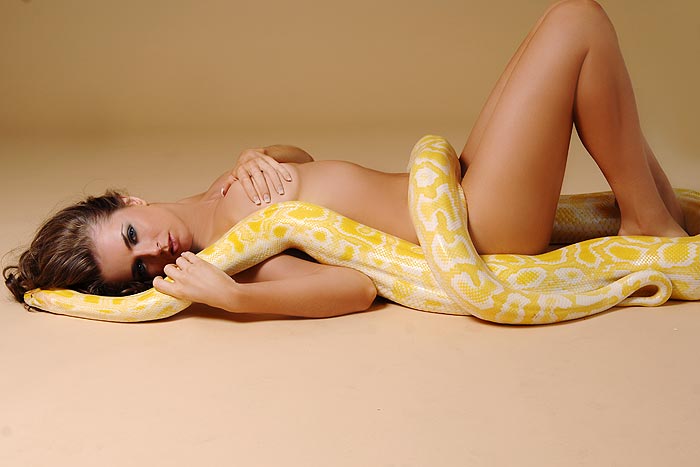
Because sometimes, you just want to see a photo of a scantily clad, good-looking woman, in heels, on a bed, with some snakes.

Tuesday, June 17, 2008

Woman and Snakes: A Loss for Words


This one comes from Crooked Brains. I'm at a loss to describe it. I'm pretty sure it's disturbing, but then what? Is it grotesque? Is it erotic? Is it beautiful? Is it even possibly obscene? Could it be said to be essentially exotic? Evocative? Rich in associational content? Bizarre? Wondrous? Unsanitary? Shocking?

I'm gonna go with, I wonder what it would be like to meet either the woman or her snakes?

Friday, June 6, 2008

Metafun

Just a little blogging about the blog here. We just recently had our first 1000 visitor day, of which roughly 900 of them were folks glancing at the Mapplethorpe essay. I'm guessing that either Mapplethorpe or Lisa Lyon appears as subject matter in some art course somewhere, and we get a flash crowd whenever it shows up during the school year. None of them ever seem to click on the Google ad, though, so there's no money in it for me, yet. Dang, don't they understand that the Google ad will find them a better school, or something?

We also have another minor infestation of Randites in the Coda thread. I find the entire matter more than a bit interesting. In some circles, they're called "Randroids," which is clever, but implies a sort of robotic affect (the philosophical equivalent of Asperger's Syndrome, perhaps) that is diametrically opposed to the in-your-face nothing-but-personal-attack-and-insults style that we've all come to recognize. Also, most of the Rand traffic here should be for the John-Galt-is-a-Slan essay, since I did a little shilling for it recently. Yet they gravitate towards the Rand Contra Ayn Rand Institute essay and invariably miss the point (despite it being right there in the title) that I'm saying Rand would disagree with the Ayn Rand Institute, and that the Ayn Rand Institute is actually preaching collectivist guilt and nationalistic retalliation (in advocating deliberate, preemptory attacks on civilian populations). One might almost think that Randites believe in magic words or something.

There also used to be actual Randites, as I recall, people who at least took some effort to try to present arguments and logical constructions. This current crew doesn't even seem to know how to read, which makes the whole "This was the most important book I ever read" thing a bit problematic. Did they have it read to them, like my second grade teacher read us The Wizard of Oz? Which contains some fine philosophical speculation, incidentally.

I've also just posted what I think is the best chapter in Blood Relations over on the Serial Novel Sister to this blog. And that reminds me that I was in the middle of some more sophisticated philosophical speculations on Stochasticism and Parallel Universes, but I seem to have gotten…Oh, look! A Woman with a Snake!

Friday, May 23, 2008

Women and Snakes: Collier and Rubens

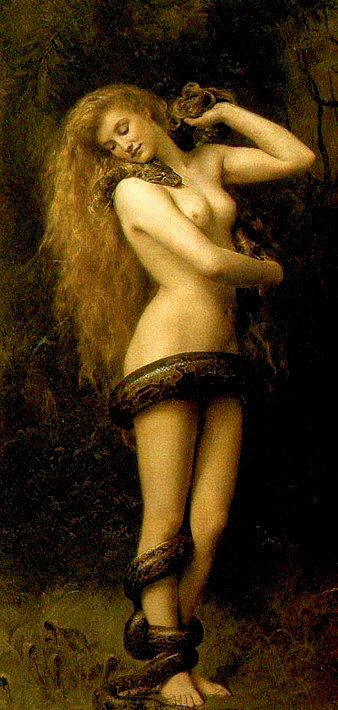
Lilith, by John Collier


One of my commenters suggested that the last bit of "Women and Snakes" artwork I posted did not meet his standards of artistry. That's okay; I can handle dissent. However, I pity anyone who cannot appreciate either of these two, for whatever reason.

Adam and Eve, by Rubens


Two different artists, and the only commonality is the snake, really, as Lilith only appears as a woman apocryphally, and not in the Christian Bible as such.

I'm tempted to let my own projections run a little while. Lilith, Adam's first wife (apocryphally), embraces the snake, and makes him her own. There is a small suggestion of this with Eve, but her downcast eyes are looking not at the snake, (who is above her in the tree), but rather in avoidance of Adam's scolding. Hmmph. No wonder Lilith left him, the jerk.

In the great folk engines, Lilith is related to Circe, Kali, and all the other female powers that were driven into darker aspects by...something. What this something might be I leave as an exercise for the reader, acknowledging that the entire thing is just a stroll around the litoral regions of Lake Id and Superego Cove.

Thursday, May 15, 2008

Women and Snakes: Steven Stahlberg's "One Last Time"


Part of this "Women and Snakes" series thing is that I do the web searching so you don't have to. There are some really bad photos, artwork, and other crappy images involving women and snakes on the web. There are also some very nice ones, and the one above is one of the the best. The artist is Steven Stahlberg, whose web site is http://www.androidblues.com/.

Friday, May 9, 2008

Minoan Snake Goddess


There is a wealth of material concerning the Minoan Snake Goddess, much of it speculative, in that wonderful way that archeology manages to project the psychology of archeologists via learned discourse and much brushing of dirt.

For my own part, I'm just laying out the gallery. If someone wants to read a female dominated religion and culture into it all, I'm fine with it.

Monday, April 21, 2008

Women and Snakes: Snakebabe


As nearly as I can tell, pretty much all the possible linguistic permutations pertaining to women and snakes get some usage, somewhere, so it's inevitable that at least someone would be "Snakebabe." That someone happens to be Maria Gaza, who is a stage magician, fire eater, snake handler, and animal lover (get your mind out of the gutter, dammit; this is a nice lady we're talking about here). Her website is actually pretty tame, but there's a "Must be over 18" sticker on the front door, I expect because she hangs out with a fast (adult video, Vegas, etc.) crowd.

One of her activities is taking in snakes that have been abandoned by the usual idiot owners who didn't get the idea that snakes can get big enough to be a problem. She discusses this, among other things, in this interview. That interview is adorned by various photographs from Isabel Snyder. I'm copping one of them, because they are very good, and I'm hoping that Ms Snyder is okay the use in exchange for the linkback.

Thursday, April 10, 2008

Planet Fabulon


This is more of what you can find if you do an image search for "Snakes on a Dame." Both from the website Planet Fabulon, which I recommend highly for its old pulp covers and Midnight Movie Madness feel.

Saturday, April 5, 2008

Your Weekly Woman and Snake


One of Toulouse- Lautrec's favorite models was the dancer Jane Avril. Here she is being threatened by the decoration on her own dress. Pre-surrealism, but definitely post-Freud.

Sunday, March 23, 2008

More Medusas


Here is this week's supply of "Snakes on a Dame." They are from a U.K. photographer named Ken Smith, and, as you can see, I'm hyperlinking to his page every way I can think of. These folks deserve recognition, after all.

I've sometimes wondered about that "Medusa turning men to stone" thing. It might be a metaphor, ya think?

Tuesday, March 11, 2008

Another Case of Snakes on a Dame


I believe that there's a bit of an ongoing conflict between Google and Yahoo! (ya think?). Some things appear on Google Images that don't appear on Yahoo! Images and vice versa. Also, some sites make it difficult to hot link to them, and it appears that Flickr is one of them.

However, I try to do right by people, and if you click on the above photo, you will get to the Flickr page and photo. The title is, in fact, "Snakes on a Dame," which is how I found it, obviously. The photographer's tag is SignFire, real name Jarrett Terrill. The model is Evonne Acevedo Johnson.

Terrill and Evonne also do a good Medusa:


And my work here is done.

Wednesday, March 5, 2008

Snakes on a Dame


I can't believe it took me so long to think up this title. Not that it's all that original, mind you. And, yes, this photo only contains one snake.

But there was this one other photo of Lisa Lyon with a snake, and I'm a completist about some things.

Wednesday, February 20, 2008

Women and Snakes


Well, it's time maybe for a little meta-update here, and I must say that it's a little disappointing to have all this fine intellectual and pop culture fodder here, not to mention the wit and poignant memoir, only to discover that the main reason that people drop by here is to see Lisa Lyon wearing a snake.

Okay, okay, I get it. Women and snakes. I see the attraction. I'm a little surprised that my essay on Black Snake Moan didn't get more attention, but that was a movie review, and didn't have any sexy pictures in it. Maybe I should have reviewed the remake of Bedazzled, and put the Elizabeth Hurley photo in it.

More pop culture reference, I was watching a CSI rerun on cable a few nights ago, the one about the UFO cult that thought we'd been invaded by lizard people, and there is some goofball saying something like "The Snake is a symbol of knowledge." Uh, yeah. Right. Knowledge. That's the ticket. That is absolutely what I'm thinking about when I see a woman with a snake. Knowledge.

As you might expect, there is an entire "Women and Snakes" fandom, no surprise there. Actually, I'd say that there are several, interlocking fandoms. There are guys who like to look at women with snakes, or photographs of women with snakes. There are photographers who like to photograph women with snakes. And then there are a lot of women who like snakes.

One person, who is in both of the last two categories seems to have a studio in Oakland, fairly near where I live, called "Snake's Kin Studio." Her site also has a number of videos, for those who like to be sure the snakes are still alive.

One of the sites these images come from has the specific disclaimer, "There is no pornography on this site." I pretty much agree, although I don't always know it when I see it.

Wednesday, October 10, 2007

Mapplethorpe

Robert Mapplethorpe was a major figure in 20th Century photography, in the same league as Diane Arbus, Ansel Adams, and others who transformed photography from a bastard child into an acknowledged venue for fine art. That Mapplethorpe’s lover, Sam Wagstaff was also a major patron and advocate of photography as fine art helped to accelerate the speed of the transition, and amplified Mapplethorpe’s influence, as did his friendship with such icons as Patti Smith.

Photo by Robert Mapplethorpe


Mapplethorpe came of age during the first flowering of “gay culture” as a publicly acknowledged and accepted part of American society and the arts. Prior to the late sixties, and seventies, it was generally understood that some areas of the arts and culture had a substantial homosexual representation (fashion, theater, and dance especially, plus those parts of pop culture that were called “camp”) but since homosexuality was usually illegal, and generally frowned upon as such, pretense and appearances were maintained and closet doors remained closed.

But after such things as the infamous “Stonewall Riots,” in New York, and a general softening of strictures about sex generally, part and parcel of “The Sixties” and “The Counterculture,” the “love that dare not speak its name” took to shouting its name into bullhorns for a while, at least in certain safe venues such as New York’s Greenwich Village and San Francisco’s Castro District.

Some of Mapplethorpe’s most famous (perhaps notorious would be a better word) photographs, was his “X, Y, and Z Portfolios”, quasi-documentary records of the time and its practices, the most infamous probably being the self-portrait with a bull whip in his anus. Other photos of the time are less shocking, but still charged with homoeroticism.

Then came Lady, Mapplethorpe’s photographic study of the body builder Lisa Lyons. This work may have single handedly created a new cultural image of feminine beauty. Previously, two female body types dominated the public imagination, the “never too rich or too thin” ideal of the fashion model, and the soft curvaceousness of Marilyn Monroe, Jane Mansfield, or Bridget Bardot.

Lisa Lyons


Lyons fit neither of those patterns; she was neither thin nor soft. Suddenly, the “hard bodied” female burned itself into the public eye. And with Mapplethorpe’s eye for light and shadow, that body became Hellenic, even Olympian. The Battle Babe was finally given the body whose form fit the function: that of challenging men physically as well as in other areas of endeavor. Lyons’ legs looked strong enough to kick a door down, and her arms looked like they could throw you across the room. The only question was how much you’d enjoy it.

I saw the traveling Mapplethorpe show when it came to the U.C. Art Museum some years back. This was the show that wound up being tried for obscenity in Ohio in 1990 as another battle in the Culture Wars. It also came just a year after Mapplethorpe himself died of AIDS. One of the most striking photographs in the show was another self portrait, Mapplethorpe facing the camera holding tightly to a cane with a death’s head skull at its top.

Self Portrait of Robert Mapplethorpe


But there was another aspect of the show that I found quite ironic. Between the sex of the earlier period and the death images taken when he knew he was dying, there was a period when he seemed to have photographed flowers almost obsessively. The irony is multi-layered. Those who brought the obscenity charges against the show confined themselves to just five photographs, no doubt because they knew that the rest of the exhibit was uncontroversial; even the nude photos of Lisa Lyons, well dang, she’s a woman, and naked women are part of what art galleries are supposed to be about. The flowers would have just confused everything.


But within the chronology of the Mapplethorpe’s life’s work, it seemed as if he became tired of the obvious and the raw, just as adolescents and young adults (most of us anyway) eventually become tired of the hunt and the frenzy and eventually settle down to a quieter existence. The Amish even plan for it, with Rumspringa, the time for sowing the wild oats. Contrariwise, the strictest upbringings produce the wildest breakouts; Mapplethorpe himself was raised Catholic, and observed that he turned every still life into an altar. Even a dolt of a preacher could use the example of Mapplethorpe as a metaphor for trying to return to grace through the natural beauty of the flower portraits.


Or maybe not, because it’s equally easy to see through that ruse. Mapplethorpe’s flowers were voluptuous and erotic, their beauty fleeting, captured in the single eternal moment of the camera click. Like all Romantics, Mapplethorpe’s work was always about sex and death, from beginning to its premature end, with even the flowers serving both bower and wake.