Showing posts with label art. Show all posts

Thursday, July 10, 2008

Yet another Medusa


This is one serious woman with snakes. The original source can be found here.

Friday, July 4, 2008

Woman and Snake: Amano


This one was sent to me by a friend. Amano is a Japanese artist that I don't know nearly enough about, because he's really good. In addition to the .jp site, there's a .com site for those who insist on English.

Friday, June 27, 2008

Dylan: Lay Down Your Weary Tune


For Black Dog Barking, who wondered in comments why the invisible hand of the market never put this on a commercial album. My answer would be that the invisible hand works in mysterious ways, only a few of which having to do with markets and money.

As noted, the photography is from Miranda Jane, who is unknown to me until now. More of those "invisible college" things that the pointy heads such as myself talk about.

Wednesday, June 25, 2008

Women and Snakes: Simplicity


Because sometimes, you just want to see a photo of a scantily clad, good-looking woman, in heels, on a bed, with some snakes.

Tuesday, June 24, 2008

The Occult History

[previously posted on We Are All Giant Nuclear Fireball Party]

I won the raffle at a party thrown by a job agency a while back, and one of the prizes was a gift certificate from Starbucks. I don’t drink coffee; a single glass of Coke at dinner is enough to move my sleep time back an hour or more. But Starbucks sells other stuff, so I had a cup of hot chocolate and bought the Dylan No Direction Home CD.

The PBS special on Dylan was directed by Scorsese, and covered Dylan’s career up to the point where he had his motorcycle accident. It feels important, somehow, that Dylan survived the accident, that he didn’t follow the “good career move” that got so many of the other 60s icons. Dylan was always the Trickster, so it also feels appropriate, and besides, living is better than dying. I don’t care how many mediocre albums he’s made since then, how many unmemorable songs. He’s alive; good for him.

One of the things that was very obvious, and left very unmentioned, in No Direction Home was how thoroughly ripped he was for much of the time. The scenes from “Don’t Look Back” were particularly obvious, with Dylan’s speech, wordplay, little tics and gestures, all showing the obvious signs of amphetamine use. Gee, a pop star in the 60s on tour, using speed. What a shock. And a lot of his songs are scornful; just watch one of his press conferences and take a guess as to why.

The obvious reason why the documentary didn’t mention the drug use is that, once drugs get mentioned in any narrative, the overall narrative gets hijacked by the drug narrative. It’s pretty much the same with sex; once sex gets mentioned, it takes over the story line, because that’s what people are most interested in. I’m not sure what happens to a sex narrative once drugs are mentioned, or vice versa. I suspect it’s just that there is a sex/drugs story, and well, there you are.

The drug narrative, in order to be palatable, pretty much has to follow either the “I saw the light and now I am redeemed” plot line, or the “descent into hell followed by death” plot line. No others are really acceptable to a mass audience, although there are specialty tastes, of course, and times do change. It used to be the case that adultery had to be punished, for example, but not so much these days. Of course, adultery used to be actually illegal, and drugs still are. More accurately, the drug narrative is the illegal drug narrative. Legal drugs tend not to get much of a mention because there is no “moral principle” involved, unless the drugs are procured illegally, of course.

This wasn’t always the case. Opium was legal when Coleridge wrote “Kubla Khan” and that got turned into a morality fable, of a sort. When you examine it closely, however, it’s hard to find what the moral of the tale is. Without opium, there wouldn’t have been a poem; its incompleteness is usually blamed on the “gentleman from Porlack.” It’s also worth asking if “Kubla Khan” would have received the same response if it had not been known as an opium dream, and if it had been finished. Again, no way to know, is there?

Drugs affect art. Hell, everything affects art. But drugs, owing to their effects on the psyche, modify art more than most other things. Of course, love has had more effect on art than, say, heroin or amphetamines, but love has its own neurotransmitters. Pharmacologically, love is a stimulant. Add War, in its most general terms, to the list, and you’re still talking about internally generated substances linked to external events. Love, War, Drugs, go write about those. Let me know if you find richer subjects.

Most of the attention given to drugs in the narrative of the artist and the artistic life follows the plot of seduction and corruption. He had such a promising career until he became an addict. By the time she was 40, she looked 70 and her voice was shot, owing to the combination of alcohol and drugs. And so forth.

I once saw a bio of F. Scott Fitzgerald that referred to the matter as a “Faustian Bargain,” and that has more truth to it. We can decry the art lost to early death from alcoholism, but we cannot know how much of the art during life was the product of that alcoholism. One is supposed to hew to the line that drugs and alcohol only subtract, never add, but can one really listen to “Subterranean Homesick Blues” and believe that it would have been the same song without a speed boost?

Dylan in particular was old school beat poetry with a rhyming dictionary. Try to imagine Kerouac without the liquor and speed, Burroughs without the heroin, Ginsberg without the peyote. One might was well imagine Nick and Nora Charles without martinis or Hemmingway without the guns and fights.

In SF, there are also plenty of overt examples of the occult history. In my essay Sleeping in Fritz Leiber’s Bed, I note that Leiber’s alcoholism informed a number of his stories, including ”The Thirteenth Step”, “Gonna Roll the Bones”, and “The Secret Songs”. Leiber might have written other stories had he not been an alcoholic, but they would have been different stories. The same is surely true of Philip K. Dick, whose habit (until his health failed him) was to sell a book contract, then take enough amphetamine to “speed rush” (Dick’s own phrase for it) the book into existence. And really now, does anyone think that Dick’s paranoid, reality-shifting, dark-yet-glittering visions would have been the same without the meth and dex?

The title of this essay is the short-hand that my friend Dave and I use to refer to the general subject of the effects of drugs on history generally, but on art in particular. I think Dave first used it when he’d listened to Elvis: The Sun Sessions and discovered a cut entitled “Bop Pills.” “Jim,” he said, “We overlooked something very important. Elvis was a truck driver.” What he meant, of course, was that truck drivers have always used uppers, and always knew where to get them. “Bop Pills” was part of how you got to bop.

You can certainly make your own list of all the art that has had drugs as part of the pervasive influence. “Wine, women, and song,” has been replaced by “Sex, Drugs, and Rock ‘n Roll.” It’s the same old song, though everything else about it has changed.

Well hell, without sex and drugs, what would the songs be about?

Tuesday, June 17, 2008

Woman and Snakes: A Loss for Words


This one comes from Crooked Brains. I'm at a loss to describe it. I'm pretty sure it's disturbing, but then what? Is it grotesque? Is it erotic? Is it beautiful? Is it even possibly obscene? Could it be said to be essentially exotic? Evocative? Rich in associational content? Bizarre? Wondrous? Unsanitary? Shocking?

I'm gonna go with, I wonder what it would be like to meet either the woman or her snakes?

Friday, June 6, 2008

Metafun

Just a little blogging about the blog here. We just recently had our first 1000 visitor day, of which roughly 900 of them were folks glancing at the Mapplethorpe essay. I'm guessing that either Mapplethorpe or Lisa Lyon appears as subject matter in some art course somewhere, and we get a flash crowd whenever it shows up during the school year. None of them ever seem to click on the Google ad, though, so there's no money in it for me, yet. Dang, don't they understand that the Google ad will find them a better school, or something?

We also have another minor infestation of Randites in the Coda thread. I find the entire matter more than a bit interesting. In some circles, they're called "Randroids," which is clever, but implies a sort of robotic affect (the philosophical equivalent of Asperger's Syndrome, perhaps) that is diametrically opposed to the in-your-face nothing-but-personal-attack-and-insults style that we've all come to recognize. Also, most of the Rand traffic here should be for the John-Galt-is-a-Slan essay, since I did a little shilling for it recently. Yet they gravitate towards the Rand Contra Ayn Rand Institute essay and invariably miss the point (despite it being right there in the title) that I'm saying Rand would disagree with the Ayn Rand Institute, and that the Ayn Rand Institute is actually preaching collectivist guilt and nationalistic retalliation (in advocating deliberate, preemptory attacks on civilian populations). One might almost think that Randites believe in magic words or something.

There also used to be actual Randites, as I recall, people who at least took some effort to try to present arguments and logical constructions. This current crew doesn't even seem to know how to read, which makes the whole "This was the most important book I ever read" thing a bit problematic. Did they have it read to them, like my second grade teacher read us The Wizard of Oz? Which contains some fine philosophical speculation, incidentally.

I've also just posted what I think is the best chapter in Blood Relations over on the Serial Novel Sister to this blog. And that reminds me that I was in the middle of some more sophisticated philosophical speculations on Stochasticism and Parallel Universes, but I seem to have gotten…Oh, look! A Woman with a Snake!

Friday, May 23, 2008

Women and Snakes: Collier and Rubens

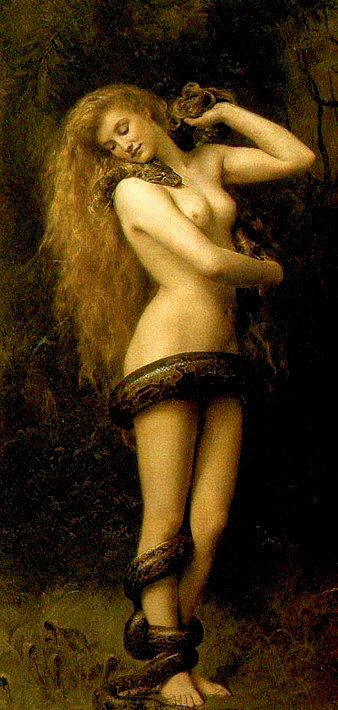
Lilith, by John Collier


One of my commenters suggested that the last bit of "Women and Snakes" artwork I posted did not meet his standards of artistry. That's okay; I can handle dissent. However, I pity anyone who cannot appreciate either of these two, for whatever reason.

Adam and Eve, by Rubens


Two different artists, and the only commonality is the snake, really, as Lilith only appears as a woman apocryphally, and not in the Christian Bible as such.

I'm tempted to let my own projections run a little while. Lilith, Adam's first wife (apocryphally), embraces the snake, and makes him her own. There is a small suggestion of this with Eve, but her downcast eyes are looking not at the snake, (who is above her in the tree), but rather in avoidance of Adam's scolding. Hmmph. No wonder Lilith left him, the jerk.

In the great folk engines, Lilith is related to Circe, Kali, and all the other female powers that were driven into darker aspects by...something. What this something might be I leave as an exercise for the reader, acknowledging that the entire thing is just a stroll around the litoral regions of Lake Id and Superego Cove.

Saturday, May 17, 2008

Pleasantville

[This essay originally appeared in my newsgroup on Feb. 25, 2007. I'm uploading it here because I'm about to post an essay on Rick Nelson, whose early life appeared on a sitcom.

Note: the first couple of times I began this essay, it dissolved into failure, mostly because I was attempting to synopsize portions of the movie. Big mistake. Movies are experiential, Pleasantville even more than most; if you haven’t seen it, you should might want to skip this essay, not so much because of “spoilers” but simply because what I’m saying may not make much sense. If you have seen it, but need some reminders, there is a pretty good synopsis on the Wikipedia.

Also, Roger Ebert wrote a decent review.

My take differs, of course.]

Old black-and-white sitcoms do tend to blur together in memory. I can locate the episode of “Father Knows Best” where Mr. Anderson gives Bud a $10 a week allowance (quite a sum in those days) with the stipulation that Bud can only spend the money on himself. He soon finds that it alienates him from all his friends, so he goes back to doing chores for a smaller allowance that has no strings. It was an interesting little parable on the downside of wealth, among other things, and I pinched the seed of the idea for my story “Heart’s Desire/Anything You Want.”

I remember the next one also as being “Father Knows Best,” but it could have been “My Three Sons.” The teenage son (Bud? Chip?) is experimenting with ham radio and talking to his friends, when a mysterious (and sultry) female voice shows up, teasing them etc. They rig up a direction finder and track her down—discovering that she’s the shy girl they all know with the bad stammer. She’s mortified, and can’t talk in person without the stutter—until they ask her about her radio rig, and suddenly the speech impediment disappears. Yet another bit of proto-nerd chic.

I can easily remember a dozen 50s-early 60s sitcom plots that could never have appeared on the imaginary Pleasantville. But that’s because Pleasantville isn’t about 1950s sitcoms, any more than it’s really about suburbia, or the 1950s generally, or even about childhood and adolescence. It’s about memory, memory and its bastard cousin, nostalgia.

Current nostalgia for the suburban 1950s targets the memories of boomers such as myself, but it depends upon the coincidence of those memories with the more general phenomenon of childhood memories. “Those were simpler times,” is how it is often put, but they were simpler only to children, because children are simpler beings. In truth, the 50s were no more simple to those who had to struggle for their lives and livelihoods than any other era. It’s simpler only if you had no responsibilities to bear.

Moreover, the suburbs themselves reflected a sort of nostalgic longing for something that never existed: the idealized remembrance of small town, rural America. Some suburbanites came directly from the rural towns and tried to reproduce their own histories in that way. Others came from the cities, fleeing modern life, with all its temptations, temptations they themselves had already sampled, but, well, best to protect the kids from them. Kids do all sorts of crazy things.

As indeed we did, as we were bored beyond imagining, hoping to get the hell out of there so our lives could “begin.” Jean Shepherd used to start up his college gigs by asking his audience, “How many of you out there believe that your life hasn’t started yet?” He mocked the raised hands as being naïve, or worse. Life is life; if you haven’t figured out that it’s already begun, then you’re doomed to be waiting for a long, long time.

So the outsiders show up in Pleasantville and things begin to change. Jennifer/Mary Sue is rebellious from the start, introducing her first date, Skip, to sex, and bringing the first bit of color to the scenery (a single red rose). Skip misses a basket during basketball practice and everyone treats the ball as if it were radioactive; no one had ever missed a basket before, nor had they ever lost a game. But sex spreads and saps the energy from the hitherto perfectly sublimated athletes, and they lose a game, again, a first.

Then Mary Sue teaches her Mother about sex (a deliberately ironic role reversal), including how to masturbate, which turns Mom technicolored and lights the tree outside afire.

But it’s David/Bud who turns out to be the real subversive, despite his love of the television show, though maybe because he likes the characters. He introduces his soda fountain boss to Art, and the boss’s artistic tendencies blossom. Bud has read the books that have previously been blank, and as he recounts the stories, the pages fill in with text. He shows the fire department how to put out the fire that his Mother has caused (yeah, yeah, “burning bush” joke) and in doing so, becomes a town hero and gets the cookies that Margaret was supposed to bake for another boy. He he helps his mother cover up her color change with makeup. Bud is the really dangerous one.

The color change is the central visual conceit of the movie, and various notions have been argued for what causes it. “Epiphany” is offered. “Change” is another theory. “Strong emotion,” yet one more.

Mary Sue changes color not when she has sex, she’s done that plenty of times in the “real world.” She changes when she dons her Pleasantville glasses and begins to read (D. H. Lawrence, it’s true). She breaks stereotype. Bud changes color when he slugs Whitey (who then bleeds a bit of red blood). Again, when he acts against type.

It’s not just the violence or strong emotion. The crowd that throws rocks through the painted window of the soda shop doesn’t change color; the scene is taken from news footage of civil right riots. It may not be “pleasant,” but it’s entirely within the character of those character types in the 1950s. The book burners are also in black and white; the scene has been compared to 1930s Germany, but burning Beatle albums are just as good a comparison.

The Mayor never gets angry; when he does, he loses his shades of gray, and loses control of the town as well.

As they lean about sex, the soundtrack spouts rock-and-roll. When Bud explains that there are places where the roads don’t just run in a circle, “Take Five” begins, a late night radio piece that promises a road to the Great Beyond. They’re all looking for a way out, and they finally find it, in sex, in art, in the act of becoming more than what they are supposed to be.

So we were children and our world was small, narrowly circumscribed. Then it became larger as we grew. It was several concerted accidents of history that made it all seem of-a-piece. In fact, everyone has that journey offered to them; each of us takes it to varying degrees. Pleasantville should be a reminder of that journey. I hope it has resonance for a broader group than us aging Boomers. It seems more universal than that.

But I do so wish, given the wry ironies about Bud’s “colored girlfriend,” and the use of images that obviously emanate from civil rights marches and sit-ins, that there had been some actual black people in Pleasantville at the end. Try as I might, however, I couldn’t think of a way to do that without it seeming forced. There were no black families living in Donelson when I was young. It was only my thrice weekly trips to downtown Nashville that let me view the world in black and white, and not just white.

Thursday, May 15, 2008

Women and Snakes: Steven Stahlberg's "One Last Time"


Part of this "Women and Snakes" series thing is that I do the web searching so you don't have to. There are some really bad photos, artwork, and other crappy images involving women and snakes on the web. There are also some very nice ones, and the one above is one of the the best. The artist is Steven Stahlberg, whose web site is http://www.androidblues.com/.

Friday, May 9, 2008

Minoan Snake Goddess


There is a wealth of material concerning the Minoan Snake Goddess, much of it speculative, in that wonderful way that archeology manages to project the psychology of archeologists via learned discourse and much brushing of dirt.

For my own part, I'm just laying out the gallery. If someone wants to read a female dominated religion and culture into it all, I'm fine with it.

Monday, April 21, 2008

Women and Snakes: Snakebabe


As nearly as I can tell, pretty much all the possible linguistic permutations pertaining to women and snakes get some usage, somewhere, so it's inevitable that at least someone would be "Snakebabe." That someone happens to be Maria Gaza, who is a stage magician, fire eater, snake handler, and animal lover (get your mind out of the gutter, dammit; this is a nice lady we're talking about here). Her website is actually pretty tame, but there's a "Must be over 18" sticker on the front door, I expect because she hangs out with a fast (adult video, Vegas, etc.) crowd.

One of her activities is taking in snakes that have been abandoned by the usual idiot owners who didn't get the idea that snakes can get big enough to be a problem. She discusses this, among other things, in this interview. That interview is adorned by various photographs from Isabel Snyder. I'm copping one of them, because they are very good, and I'm hoping that Ms Snyder is okay the use in exchange for the linkback.

Friday, April 11, 2008

Jabber


'Twas brillig, and the slithy toves
Did gyre and gimble in the wabe;
All mimsy were the borogoves,
And the mome raths outgrabe.

When I was in the seventh and eighth grade, I walked to school each morning with Mick, who was four years older than I. We both shared a love of science fiction and similar stuff, so the age difference was not as much a factor in our friendship as it first might appear, although it was a bit of a downer when he graduated, just as I entered my freshman year.

Donelson High School, where we both attended, was what would now be called a combined middle and high school, I guess, housing grades 7-12. The 7th and 8th graders were primarily situated in what was a newer addition to the school, judging from the construction. The upper grades were in the part of the building that had a pretty old feel too it.

Mick taught me Jabberwocky on the way to school one morning. Maybe it took a couple of mornings, but I doubt it was more than two. My memory was pretty awesome in those days.

"Beware the Jabberwock, my son!
The jaws that bite, the claws that catch!
Beware the Jubjub bird, and shun
The frumious Bandersnatch!"

I'd already heard the opening verse of Jabberwocky, of course, because it was sung by the Cheshire Cat in the Disney version of Alice in Wonderland. But the whole poem has more weight to it, and besides, it's cool to recite.

He took his vorpal sword in hand:
Long time the manxome foe he sought --
So rested he by the Tumtum tree,
And stood awhile in thought

There's a science fiction story entitled, "Mimsy Were the Borogoves" written by "Lewis Padgett, a pseudonym for Henry Kuttner and C. L. Moore. In it, a scientist from the future sends some toys back in time, one batch landing in the 19th Century and the other in the 20th. The 20th Century children who find them play with them and begin to have their thinking transformed. The transformations frighten their parents, who take away the toys. But this action is too late, as the children find the missing information about how to travel into other dimensions by hearing a poem written by a friend of the girl who found a similar toy in the 19th Century. The friend and the girl were Lewis Carroll and Alice Liddell.


And as in uffish thought he stood,
The Jabberwock, with eyes of flame,
Came whiffling through the tulgey wood,
And burbled as it came!

Night of the Jabberwock was a mystery by Fredric Brown, a prolific author of both SF and mysteries. The protagonist is a small town newspaper editor who complains about there not being enough news. He is also a Lewis Carroll fan, and the story combines nearly surreal events (somewhat enhanced by alcohol) and complex plotting. It's a pretty wild ride.


One, two! One, two! and through and through
The vorpal blade went snicker-snack!
He left it dead, and with its head
He went galumphing back.

My senior year in college I moved into an apartment that had been previously occupied by a couple of friends of mine. They did not completely clean the place before they left (do any college students ever do that?) and one of the things they left behind was an issue of the Chicago Seed, an "underground newspaper." That particular issue had a double page spread of the Tennille illustration of Jabberwocky.

I knew that the newsprint would fade; in fact it was already yellowing. So I got some tracing paper and traced the entire print, then pinned that on the wall. I must have had some time on my hands.


"And hast thou slain the Jabberwock?
Come to my arms, my beamish boy!
O frabjous day! Callooh! Callay!"
He chortled in his joy.

I was driving with Ben a couple of days ago, and I forget which one of us began spontaneously to recite Jabberwocky. No matter. Both of us remembered the whole thing.


'Twas brillig, and the slithy toves
Did gyre and gimble in the wabe;
All mimsy were the borogoves,
And the mome raths outgrabe.

Thursday, April 10, 2008

Planet Fabulon


This is more of what you can find if you do an image search for "Snakes on a Dame." Both from the website Planet Fabulon, which I recommend highly for its old pulp covers and Midnight Movie Madness feel.

Saturday, April 5, 2008

Your Weekly Woman and Snake


One of Toulouse- Lautrec's favorite models was the dancer Jane Avril. Here she is being threatened by the decoration on her own dress. Pre-surrealism, but definitely post-Freud.

Sunday, March 23, 2008

More Medusas


Here is this week's supply of "Snakes on a Dame." They are from a U.K. photographer named Ken Smith, and, as you can see, I'm hyperlinking to his page every way I can think of. These folks deserve recognition, after all.

I've sometimes wondered about that "Medusa turning men to stone" thing. It might be a metaphor, ya think?

Tuesday, March 11, 2008

Another Case of Snakes on a Dame


I believe that there's a bit of an ongoing conflict between Google and Yahoo! (ya think?). Some things appear on Google Images that don't appear on Yahoo! Images and vice versa. Also, some sites make it difficult to hot link to them, and it appears that Flickr is one of them.

However, I try to do right by people, and if you click on the above photo, you will get to the Flickr page and photo. The title is, in fact, "Snakes on a Dame," which is how I found it, obviously. The photographer's tag is SignFire, real name Jarrett Terrill. The model is Evonne Acevedo Johnson.

Terrill and Evonne also do a good Medusa:


And my work here is done.

Wednesday, March 5, 2008

Snakes on a Dame


I can't believe it took me so long to think up this title. Not that it's all that original, mind you. And, yes, this photo only contains one snake.

But there was this one other photo of Lisa Lyon with a snake, and I'm a completist about some things.

Wednesday, February 20, 2008

Women and Snakes


Well, it's time maybe for a little meta-update here, and I must say that it's a little disappointing to have all this fine intellectual and pop culture fodder here, not to mention the wit and poignant memoir, only to discover that the main reason that people drop by here is to see Lisa Lyon wearing a snake.

Okay, okay, I get it. Women and snakes. I see the attraction. I'm a little surprised that my essay on Black Snake Moan didn't get more attention, but that was a movie review, and didn't have any sexy pictures in it. Maybe I should have reviewed the remake of Bedazzled, and put the Elizabeth Hurley photo in it.

More pop culture reference, I was watching a CSI rerun on cable a few nights ago, the one about the UFO cult that thought we'd been invaded by lizard people, and there is some goofball saying something like "The Snake is a symbol of knowledge." Uh, yeah. Right. Knowledge. That's the ticket. That is absolutely what I'm thinking about when I see a woman with a snake. Knowledge.

As you might expect, there is an entire "Women and Snakes" fandom, no surprise there. Actually, I'd say that there are several, interlocking fandoms. There are guys who like to look at women with snakes, or photographs of women with snakes. There are photographers who like to photograph women with snakes. And then there are a lot of women who like snakes.

One person, who is in both of the last two categories seems to have a studio in Oakland, fairly near where I live, called "Snake's Kin Studio." Her site also has a number of videos, for those who like to be sure the snakes are still alive.

One of the sites these images come from has the specific disclaimer, "There is no pornography on this site." I pretty much agree, although I don't always know it when I see it.

Friday, February 15, 2008

Crybaby

The distance created by the passage of time and existential change allows me to say, with practically no ego involvement, that I was a golden child. There are a number of photographs of me in my early years, and I was so cute that it is almost Hitler-Jungen creepy: fair-skinned, hair so light that it typically earned the southernism "cotton-top," bright, attentive eyes and a winning smile. In one photo of my second grade class, even the unprejudiced eye is immediately drawn to the image of the towheaded kid with the ear-to-ear grin.

There aren't any photos of me crying, but I did cry a lot as a child. One telling tale is the one my mother tells of me learning to walk. I would crawl over to the screen door that led outside, pull myself up via the cross slats in the door, turn, take a step or two, fall down and then cry for a minute. Then I would crawl over to the door and begin again. My mom says that I did this for hours.

So we see the early origins of the sort of whiney obsessiveness that has served me so well over all these years.

"High strung" is the phrase that is used for such emotionality, at least in the case of a golden child, for whom everyone makes excuses. My family was tolerant, as were many other adults. My friends were somewhat less forgiving, for the obvious, (and I concede entirely) good reasons. Nevertheless, I got away with it for much longer than would ordinarily be the case in the social system in which I grew up, i.e. the mid-South in the 1950s.

The same can be said of my precocious intelligence. There are some sub-cultures and ethnic groups in these United States where intellect is revered and properly encouraged and guided, but Tennessee in the 1950s was not one of them. Nevertheless, I was again protected from this knowledge for quite a while, by family and accident, plus the simple fact that, however precocious, a young child is generally tolerated, even by the most intolerant of adults.

The hammer finally came down when I was eight, in the third grade, in the form of Mizz R. (not her real name, though I use the correct southern spelling of Mizz). Mizz R. was not well-educated, nor bright, nor particularly good with young children. However, this was Tennessee in the mid-50s, and the three jobs available to white women were secretary, nurse, and teacher. The growth industry was in elementary school teachers. During the peak of the Baby Boom the whole country was throwing up schools like crazy, then putting "portables" behind them to hold the overflow. Class sizes were in the mid-30s, so just keeping control of a class could be an issue.

Given this setup, you can see how it can be a real problem when you have a third-grader who knows more about English grammar and is quicker at arithmetic than his teacher.

One irony of it all was that I still thought that Authority was on my side, or at least on the side of the correct answer. I'm sure that, at the beginning, I thought that I was being helpful when I pointed out the errors that Mizz R. made in class. Truth to tell, if she'd had one whit of sense to her, she'd have taken me aside, explained to me that blurting out corrections in class was disruptive, and that she'd take it as a personal favor if I'd write down any errors I spotted and then slip them to her later, so she could correct the problem in the next class. I'd have gone for that. I'd have even made it "our little secret." It would have been easy to turn me into teacher's pet.

Instead, she was on my case all the damn time. And she really went after my "weakness" which is to say the fact that it was fairly easy to make me cry.

Intriguingly enough, the place where the weepiness really manifested was "playground," the elementary school precursor to "gym class." This meant sports of one sort or another, especially softball in the fall and spring. That was always a weak spot; I tended to cry if my side lost a game. So I was branded a "crybaby," by my teacher and fellow students.

I reflect on this a little and there's a hint of the weird to it, because sports is one of the few places in southern culture were crying after a defeat is acceptable. Even fans are allowed to cry if you've just lost "a big one." But no matter, there was the chink in my armor and Mizz R. slipped the knife in.

So I did what most of the other boys had already learned, from their fathers, or peers, or whomever. I learned to hold back the tears, to cover the reaction with other emotions, especially anger, and resentment. And, I suspect, this led back to more bickering in class, because now I was angry a lot, and I was not misdirecting my anger. No, I knew who the problem was, even if I didn't know all the whys and wherefores.

Some later teachers knew how to harness the little mutant that they'd been presented with. My fifth grade teacher had me working on science demonstration experiments after I'd finished all my other work. (One part of the fight with Mizz R. was over homework. I didn't like carrying books home; she thought that kids should have to do homework. So she kept piling on the work, I kept doing it while still at school, and the other kids suffered the consequences. Sorry guys. My bad). My sixth grade teacher simply let me read in class, so I read the entire World Book encyclopedia during the school term.

Other teachers were, like Mizz R., undereducated bullies, and I locked horns with plenty of them. I believe I held the record for being tossed out of Mr. R's (no relation) eighth grade class, but really, what can you say to someone who has just finished explaining to the class that satellites stay in orbit by balancing the gravitational forces between the Earth and Moon? I don't think I actually called him an idiot; I believe that I said, "That's idiotic."

Well, the interesting thing about all that was that it provided a bond between me and my fellow students. Sure, some of them resented the "brain" that was among them, and thought me full of myself and conceited (fair cop, that). But they knew that my fights with the teachers was their fight as well, and that my occasional victories, or even fights to the draw, gave them some covering fire for their own independent actions. There were times when I got thumbs up from the lower stratum, the shop guys, the "hoods" and "delinquents" as they were nicknamed. And more than one of them turned out to be a pretty decent guy, go figure, just somebody who, at one point or another in the past, had refused to knuckle under.

There was, of course, lasting damage, if one wished to call it that. Like so many men, I do not cry easily, even when it is appropriate to do so. I feel the lachrymatory reflex begin and a counter-reflex pops in, that choked up feeling that says, "No, not now. Hold it in. Don't show the weakness."

But I am fortunate. I know the methods of displacement, projection, identification, and the uses of fantasy and art. I am fairly good at this writing thing, and sometimes I can strike the right balance between distance and emotion. Sometimes I can pull my own strings and write something that can make myself cry.